
No More 24 is Already Changing New York—What Can We Build Next?
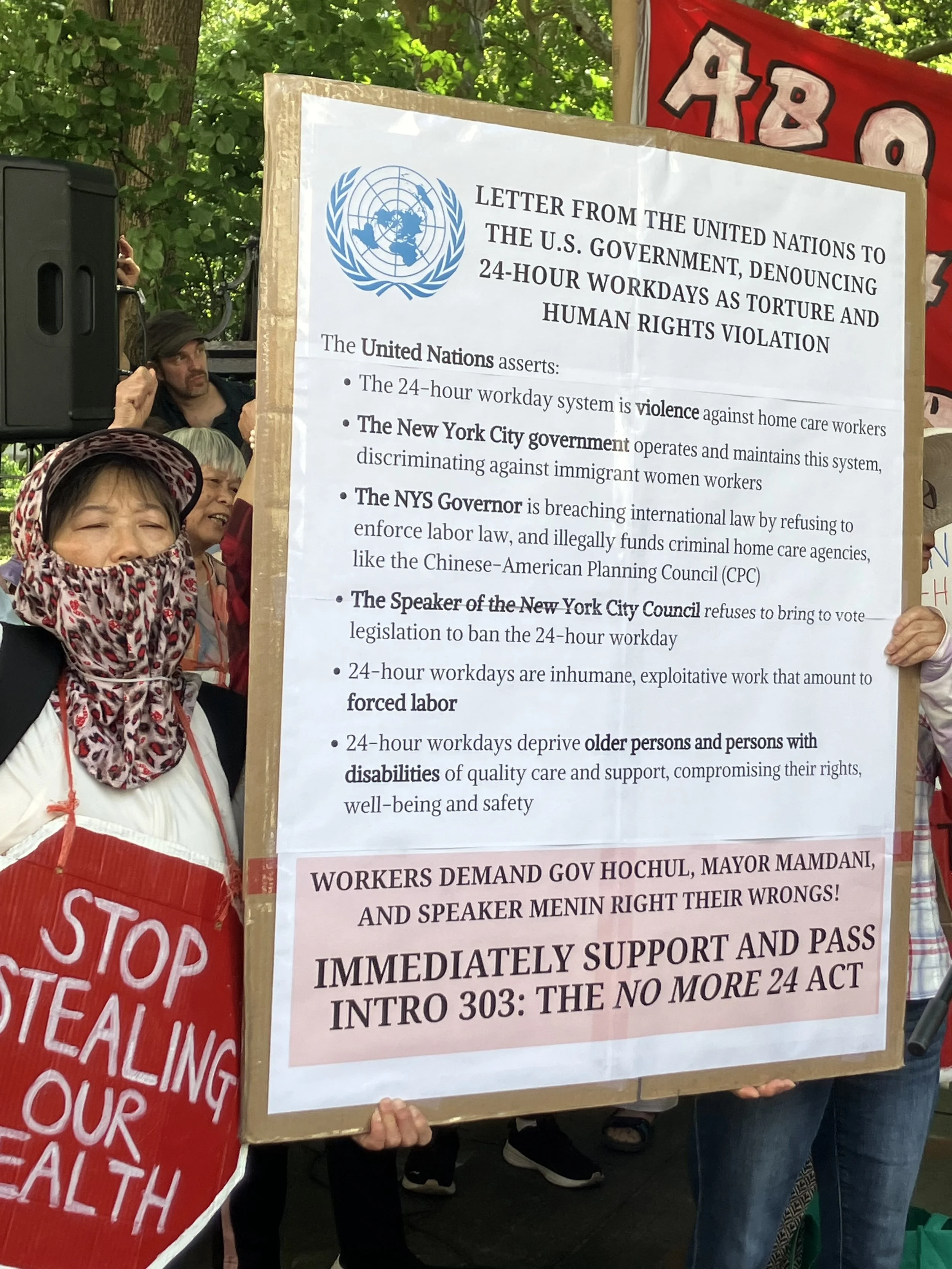
“Stop Stealing Our Health”: No More 24 supporters rallying outside City Hall on June 25 hold up a placard celebrating the UN’s condemnation of New York City’s 24-hour workday. Photo/Joe Maniscalco
Editor’s Note: Steven Zheng is NYU student organizer from Youths Against Sweatshop and the Yecao Collective.
By Steven Zheng
New York’s home care workers are still fighting to pass Intro. 303 because they are still fighting to abolish one of the most brutal labor arrangements the city continues to tolerate: the 24-hour workday.
Workers want New York to stop treating sleeplessness, exhaustion, and broken bodies as a normal condition of care. This spring, they did not wait for City Hall to do the right thing on its own. They forced the issue into public life through a February City Council hearing, daily sit-ins in March, a hunger strike in April, and continued mobilization in May.
Both the campaign and the grassroots organizing of No More 24 have achieved something major, whether or not the city’s political class admits it. It has built a real working-class coalition around a worker-led struggle. By March, a broad alliance — including tenant groups, retiree groups, anti-displacement organizers, labor-aligned groups, and community organizations — was operating under the banner of a “Coalition to Fight for Our Health & Lives.”
By April, rallies centered on support from patient families and healthcare professionals while rejecting efforts to pit patients against workers. By May, the coalition had widened even further, bringing in retirees, faith leaders, nurses, public-housing organizers, democratic clubs, disability advocates, and rank-and-file labor voices.
That is a political achievement in its own right. No More 24 did not stay trapped inside a narrow labor issue box. It became a broader fight over what kind of city New York is willing to be, and whose health and time are treated as disposable.
The movement also produced something harder to measure but just as important: worker-led political clarity. Home care workers themselves set the terms of the struggle. They made clear that people approved for 24-hour care need real care throughout the day and night, and that the current system destroys workers’ health while making genuine care impossible. They also said plainly that exhausted workers cannot provide the best care, and that agencies steal pay while refusing the split shifts patients actually need.
That matters because it shows what kind of leadership this movement has created. This is not a campaign being interpreted for workers by policy experts. It is the workers themselves setting the political terms.
The movement’s third major achievement is that it successfully united disabled groups and home care workers against a false divide. One of the central arguments used against ending the 24-hour workday is that workers’ justice comes at the expense of disabled people and older adults who need care. But the coalition built around No More 24 directly challenged that framing.
Disability-justice supporters argued in their open letter that the 24-hour workday is itself a disability-justice issue because it harms both workers and care recipients, and because real 24-hour care requires split shifts, not super-exploitation. In other words, the fight was never workers versus disabled people. The real conflict was between both groups and the insurance companies and home care agencies that profit from keeping the current arrangement in place. That is one of the movement’s clearest victories. It did not just defend itself against a divide-and-conquer narrative. It drew disability advocates, healthcare workers, families, and other workers into a shared struggle.
Students and faculty from NYU, Columbia, CUNY, The New School, and even Cornell University all signed open letters demanding that Mayor Zohran Mamdani pass the bill. YeCao Collective, a collective formed by NYU international students and young immigrant professionals, helped to organize support by tabling outside Bobst Library and raising funds for the hunger strike.
But the significance of that organizing goes deeper than an open letter. At one rally, a YeCao student organizer explained that, as an international student, solidarity with workers is not just a slogan but “one of the few ways to break out of alienation and become part of collective political life,” and that “solidarity should become action.” No More 24 did not simply arrive on campus as a cause for students to endorse. It became a way for students to rethink their own relationship to labor, community, and politics.
All of this is exactly why the campaign has also exposed the limits of New York’s so-called progressive establishment. The workers’ pressure forced the political class to respond, but the response from above was not simple support. It was a mix of delay, revision, moral panic, and institutional containment.
On March 31, the Legal Aid Society and allied groups urged City Hall to oppose Intro. 303, arguing that it would create a “home care crisis.” In early April, Legal Aid amplified that case publicly in an op-ed warning that the bill would “jeopardize home care and jobs.” Documented reported that Gov. Kathy Hochul was pushing to block the bill and that the Council had already pulled it from a planned vote once.
This is why the No More 24 struggle now matters far beyond one bill. It reveals the limits of a political formation that many people still mistake for the left. That formation can sound radical, use the language of care and justice, and promise redistribution. But when organized workers act for themselves — especially when they demand rupture rather than management — it tends to respond by softening the demand, multiplying exceptions, invoking complexity, and defending institutional equilibrium. That is not a minor flaw. It is the governing logic of an establishment left that is structurally more comfortable representing movements than being transformed by them.
By May 20, that contradiction was visible in the open. DC37 publicly organized a rally urging the City Council to reject Intro. 303, arguing that it threatened union jobs, bargaining rights, healthcare, and pensions. But even there, the movement revealed something important: the conflict was not workers versus everyone else. It was workers and their growing coalition versus an institutional bloc trying to contain them. A Chief Leader opinion essay by DC37 member Caleb Scott argued that DC37 leadership’s defense of the 24-hour workday reflected top-down union governance rather than a genuine rank-and-file worker position.
The question facing New York is no longer whether its elites can speak the language of the left. It is whether the city can build a left that is not structurally organized against workers, the moment they act for themselves. People started to realize that the working class in New York City shared common enemies, and these enemies had common agents. Thus, No More 24 no longer focused solely on a single issue; instead, it became a bridge that enabled different groups to identify with and support one another in their struggles.
The initial spark it ignited led DSA to conduct an internal self examination, causing many ordinary members to resist the antidemocratic actions of the leadership; it aroused international reactions, prompting the United Nations to draft a letter aimed at curbing the inhumane exploitation in New York City; and it also made many people determined to fight for themselves, starting by changing the people around them and getting them involved in the movement.