
Unionized Healthcare Workers Sound Alarm As 40,000 New Yorkers Face Deportation; Many More Nationwide
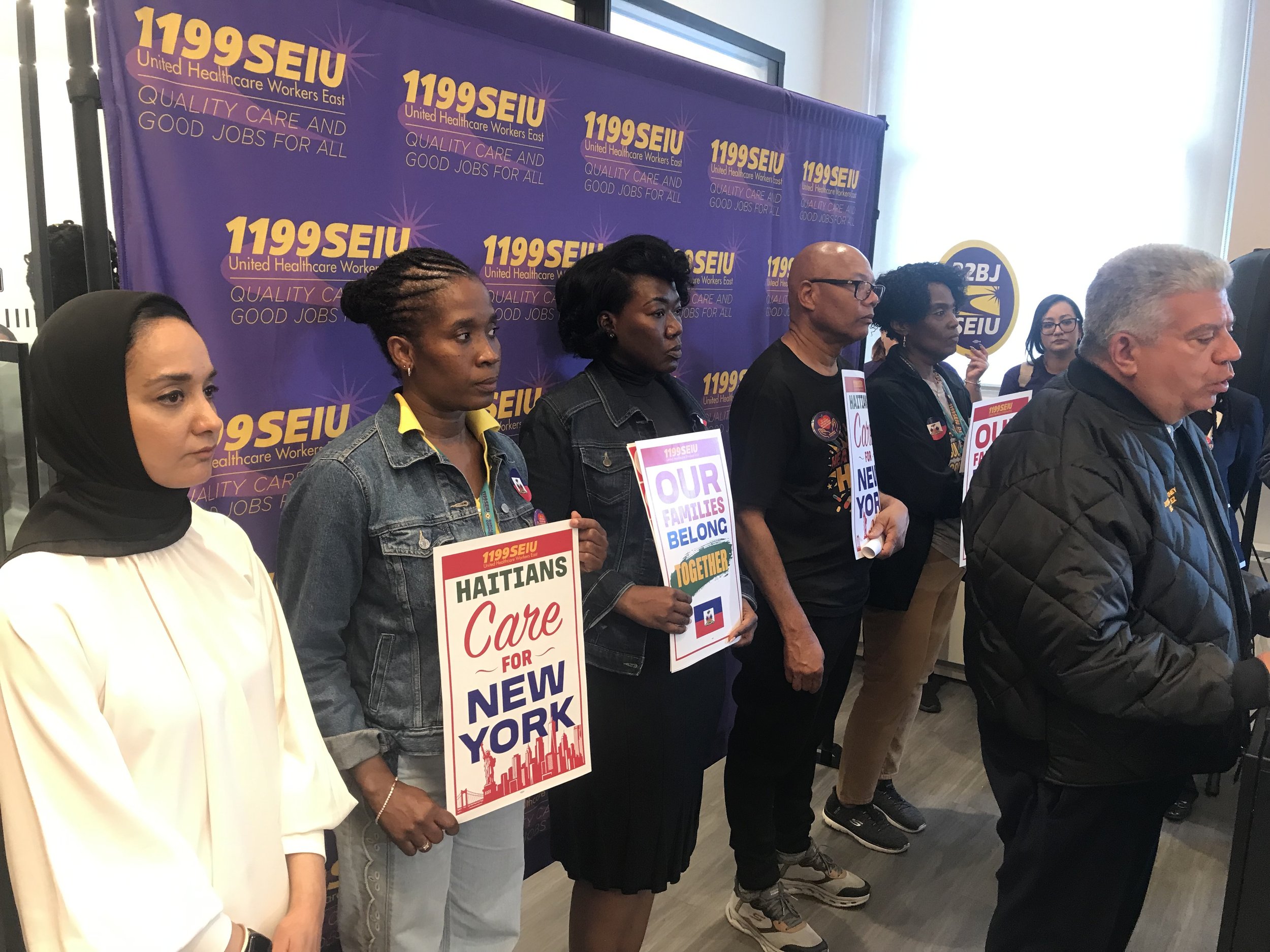
Trade unionists stand with Brooklyn District Attorney Eric Gonzalez this week to denounce the Supreme Court’s decision clearing the way for the Trump administration to strip Temporary Protective Status from workers both here in New York City—and all across the country. Photos/Steve Wisnia
Thanks for reading! If you value this reporting and would like to help keep Work-Bites on the job AND GROWING, please consider becoming a “Work-Bites Builder” today for just $3.00 per month. Work-Bites is a completely independent 501c3 nonprofit news organization dedicated to our readers — and we need your support! Invite friends, family, and co-workers to subscribe to the Work-Bites Wake Up Call!!
By Steve Wishnia
In a 6-3 ruling on June 25, the Supreme Court held this week that the Trump administration has the right to revoke Temporary Protected Status for Haitian and Syrian immigrants, exposing more than 300,000 people to possible deportation.
“This terrible decision is dehumanizing us Haitians,” Sandra Britto, a patient-care technician in Manhattan, responded at a press conference at 1199SEIU’s Manhattan offices later that afternoon. “After 2010, the earthquake, the people they’re going to send back will have nowhere to live. It's unhumane. Unhumane!"
“Nursing-home residents will lose their aides,” said 1199SEIU President Yvonne Armstrong. She called the ruling “the latest in the Trump administration’s racial attacks on our families.”
The health-care union, like its SEIU sibling 32BJ, does not keep track of its members’ nationalities, but a large proportion are immigrants. Armstrong estimated that 20% of Haitian immigrants in New York work in health care.
The Court’s majority opinion, written by Justice Samuel Alito, says the courts have no power to review any claims related to “determinations” about granting or revoking TPS for specific countries, Erik Crew, a staff attorney at the Haitian Bridge Alliance, explained. It means the Trump administration can now petition judges in the about 10 district courts that have postponed deportations of people with TPS to undo those postponements, he told Work-Bites, likely beginning before the decision goes into effect late next month.
More than 40,000 New Yorkers will lose their protected status, New York Immigration Coalition head Murad Awawdeh said.
The legal arguments
Temporary Protected Status, enacted in 1990, grants immigrants from certain countries the right to stay in the U.S. and work legally if the federal government determines that it would be dangerous for them to return, for reasons such as war or natural disaster. They need to pass a background check to qualify.
Then Secretary of Homeland Security Kristi Noem ordered TPS ended for Syrians in September 2025 and for Haitians that November. She claimed that both countries were safe enough to return to. For Haiti, she said that while there was still gang violence, some areas of the country were “suitable to return to.” She also said that it was against the U.S. national interest for Haiti to be a country where “citizens continue to leave in large numbers to seek opportunities in the United States.”
The Court’s decision combines two cases, Trump v. Miot, in which Haitian immigrant Fritz Emmanuel Lesly Miot challenged his possible deportation, and Mullin v. Doe, a similar suit filed by Syrian immigrants against Secretary of Homeland Security Markwayne Mullin.
It would enable the possible deportation of about 350,000 Haitians and 6,000 Syrians, and would likely be applied if TPS is revoked for other countries such as Somalia, Ethiopia, and South Sudan. The Trump administration is trying to end TPS for 13 of the 17 countries it currently applies to.
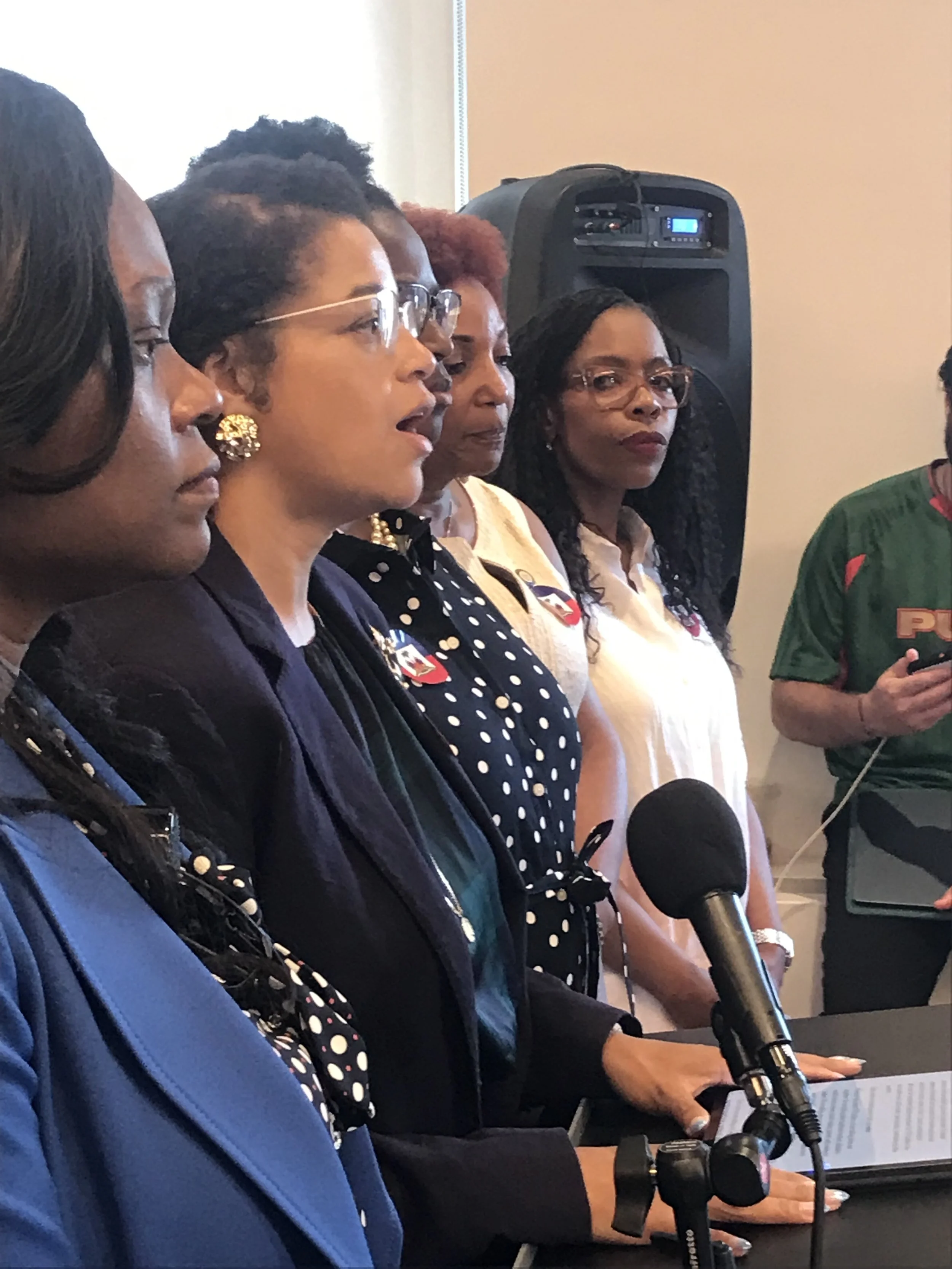
New York City home care workers and elected officials speaking out this week at 1199SEIU’s Manhattan offices called the Supreme Court’s ruling allowing the revocation of Temporary Protective Status for Haitian and Syrian emigres “terrible” and “dehumanizing.”
Alito’s majority opinion decision is based on two prongs. First, it held that under the 1990 TPS law, the Secretary of Homeland Security’s “TPS designation decisions are not subject to judicial review,” because a provision of the law bars “judicial review of any determination” of them. Second, that the plaintiffs couldn’t prove that those determinations were motivated by racial discrimination.
Justice Elena Kagan, dissenting, disputed that. “In fact, the statute allows judicial review of whether the Secretary adhered to the procedures it mandates,” she wrote.
The law, Alito noted, states that in order to terminate TPS, the secretary must “consult with appropriate agencies of the Government” to determine whether conditions have improved enough to justify that.
The district courts in New York and Washington that heard the cases, Kagan wrote, both “concluded that the Secretary probably violated the TPS statute by ordering the terminations without first consulting with other agencies about current country conditions.”
The State Department’s travel advisories in effect warned that both Haiti and Syria were unsafe for U.S. residents to visit because of conditions including kidnapping and terrorism, she noted.
To get around this, Alito stretched the definition of “determination” to include all procedures leading to a simple yes-or-no on the final decision, rather than, as Kagan wrote, defining it as “the resolving of a question by argument or reasoning” or something similar.
Erik Crew told Work-Bites that the Court was using “very scary” semantic logic, using “plain-language reading that fits up with whatever the executive wants to do.”
Considering the argument that completely precluding judicial review would mean that “a Secretary could terminate a TPS designation based on a coin flip,” Alito contended that Congress could pass a law to stop that.
“They did—when they wrote the statute,” Crew said.
Alito denies racial intent
To demonstrate that the administration’s desire to terminate TPS was motivated by racial animosity, the plaintiffs in the original lawsuit brought in a litany of statements against Haitians by Trump and Noem: “They’re eating the dogs… They’re eating the cats.” Haitians in the United States “probably have AIDS.” Haiti is a “shithole country,” which is “filthy, dirty, disgusting.” Haitian immigration is “like a death wish for our country.” Haitians and other immigrants are “poisoning the blood” of our country.
“The statements fairly shout, in their racial undertones and overtones alike, that race entered into the President’s resolve to remove Haitians from this country,” Kagan wrote.
The majority opinion, which avoided repeating any of those statements, claimed that none were “overtly racial,” and that they “all expressed policy views that could rest on race-neutral justifications.” For example, Alito wrote, “a person without racial bias can provide a harshly unfavorable description of living conditions in some of the countries with TPS designations.”
Those statements’ crude tone, he continued, were also not a sign of racism, because “political discourse by prominent public figures is increasingly couched in terms that would have scandalized the public just a short time ago.”
Alito also disputed the assertion that all 13 of the countries for which the administration is trying to end TPS were predominantly “non-white.” Four are in sub-Saharan Africa, three each in Latin America and Asia, two in the Middle East, and one in the Caribbean.
Justice Clarence Thomas, in a concurring opinion, went further. Because admission to the United States is a privilege, not a right, he argued, no one has the right to challenge even “openly discriminatory” immigration laws on the grounds of due process or equal protection.
Haitian lead plaintiff Fritz Miot, Kagan noted, has had TPS for 15 years and works in a California lab researching Alzheimer’s. If he were sent back to Haiti, she added, he might die from diabetes because of “the country’s collapsed health-care infrastructure.” Syrian civil-war refugee Laila Doe works as a behavioral technician for disabled people and takes care of her elderly mother, a U.S. citizen. If sent back to a still-dangerous Syria, she’d have to leave her mother—and bring her 17-year-old daughter, who speaks little Arabic.
“At this juncture, both sets of plaintiffs ask for only one thing: that they may stay in this country while they continue to litigate their claims,” Justice Kagan concluded. “For all the reasons given, they are entitled to that relief, and should not instead be consigned to devastating, and indeed life-threatening, injury.”
Consequences
“This was never about public safety,” Public Advocate Jumaane Williams told the 1199 event: It was about “fascist rule” and white supremacy. President Trump has pardoned hundreds of criminals, he continued, but is “turning people who were legal to nonlegal.”
Canceling TPS strips away legal protections “from people who have done everything right,” who “passed background checks and worked legally,” Brooklyn District Attorney Eric Gonzalez said. It will also make the city less safe, he added, because it “makes people afraid to call 911.” When his younger brother was murdered in 1996, he recounted—for the first time in public, he said—one witness “was an immigrant who was afraid to come forward” for years.
It will affect “thousands and thousands” of 32BJ members, including some “who have been here for decades,” says Roxane Rivera, the union’s third-ranking official: 32BJ represents people from 65 different countries.
“We’re going to have to fight,” she told Work-Bites. Immediate aims are creating a path to citizenship and dealing with the immediate impact on people.