
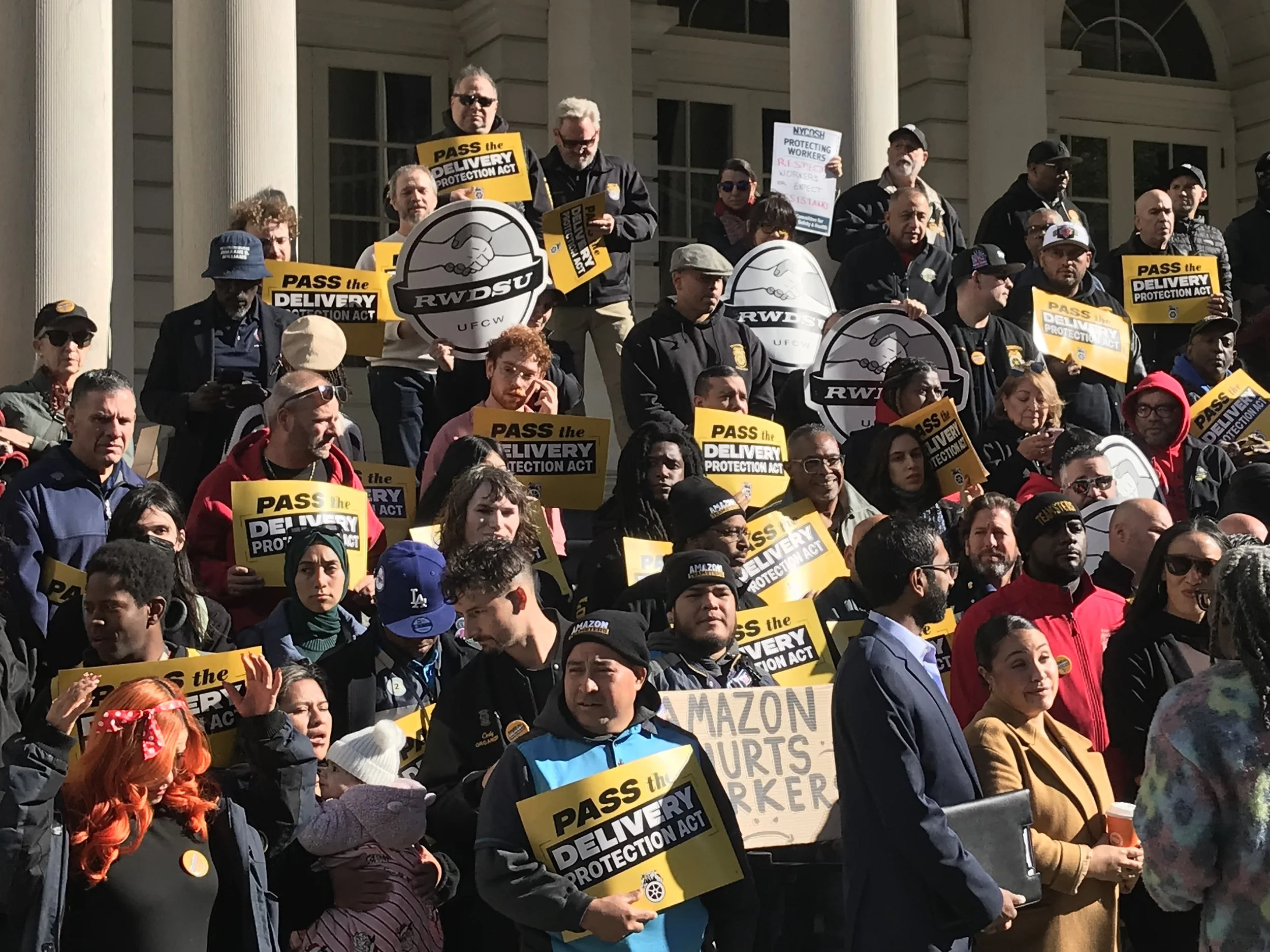
Members of the Teamsters union and their allies united in the fight to pass the Delivery Protection Act turned out in force at City Hall this week—including Mayor Mamdani. Photos/Steve Wishnia
By Steve Wishnia
More than 200 people, mostly Teamsters Union members, rallied on the steps of City Hall Oct. 22, calling on the City Council to pass the Delivery Protection Act, a bill to curb outsourcing of delivery work by Amazon and other companies.
The measure would require the “delivery service providers” (DSPs), the ostensibly independent companies that Amazon and others hire to do “last-mile” deliveries from warehouses to individual customers, to be licensed by the city Department of Consumer and Worker Protection. It also states that all workers providing “core delivery services” or “core warehouse services” must be “directly employed by the facility operator,” and would prohibit hiring them through third parties.
It is sponsored by 33 of the Council’s 51 members and backed by Mayor Zohran Mamdani, but Speaker Julie Menin has not taken any action to bring it to a vote since the Committee on Consumer and Worker Protection held a hearing in April.
“We have the votes,” committee chair Harvey Epstein (D-Manhattan) told the rally. “It’s fourth and inches,” added Councilmember Tiffany Cabán (D-Queens), the bill’s lead sponsor. Both hope to get it passed by the end of the year.
Amazon’s model of hiring outside contractors for deliveries is different from the “independent contractor” model many employers use to evade worker protections such as paying minimum wage, explains Josh Pomeranz, director of operations for Teamsters Local 804, the main union organizing DSP drivers in the city. For companies like Amazon and FedEx, he says, it’s more about avoiding liability for safety problems.
“Amazon has built business models around denying workers fundamental rights. What is that if not exploitation?”
“They push all the liability onto the subcontractors, particularly in the street-safety area,” he told Work-Bites before the rally. If someone in an Amazon van wearing an Amazon shirt and delivering Amazon packages gets into an accident, he said, Amazon will say “we’re not responsible.”
Amazon strongly opposes the Delivery Protection Act. It told the Council in April that the bill would threaten “the more than 40 local small businesses we partner with to deliver to Amazon customers and the jobs of the more than 5,000 people they employ. It would also compel us to seriously examine how we could still meet our commitment to New Yorkers—which includes the potential for relocating operations and delivery facilities outside of New York City.”
It has echoed that theme in numerous mailers and online ads and videos since then, usually posted under the name of groups like the Five Borough Jobs Campaign. One ad estimated that the bill would cost New Yorkers an extra $664 a year in delivery charges. Others feature DSP owners such as Rudy Cazares of the Bronx, who told the Council in April that “when small businesses like mine are pushed out, the workers we employ don't win, they lose their jobs. That is facts.”
Other DSP owners have contended that the bill would destroy the “flexibility” they need to run their businesses profitably.
Cabán told the rally that Amazon has so far spent $13 million on “disinformation.”
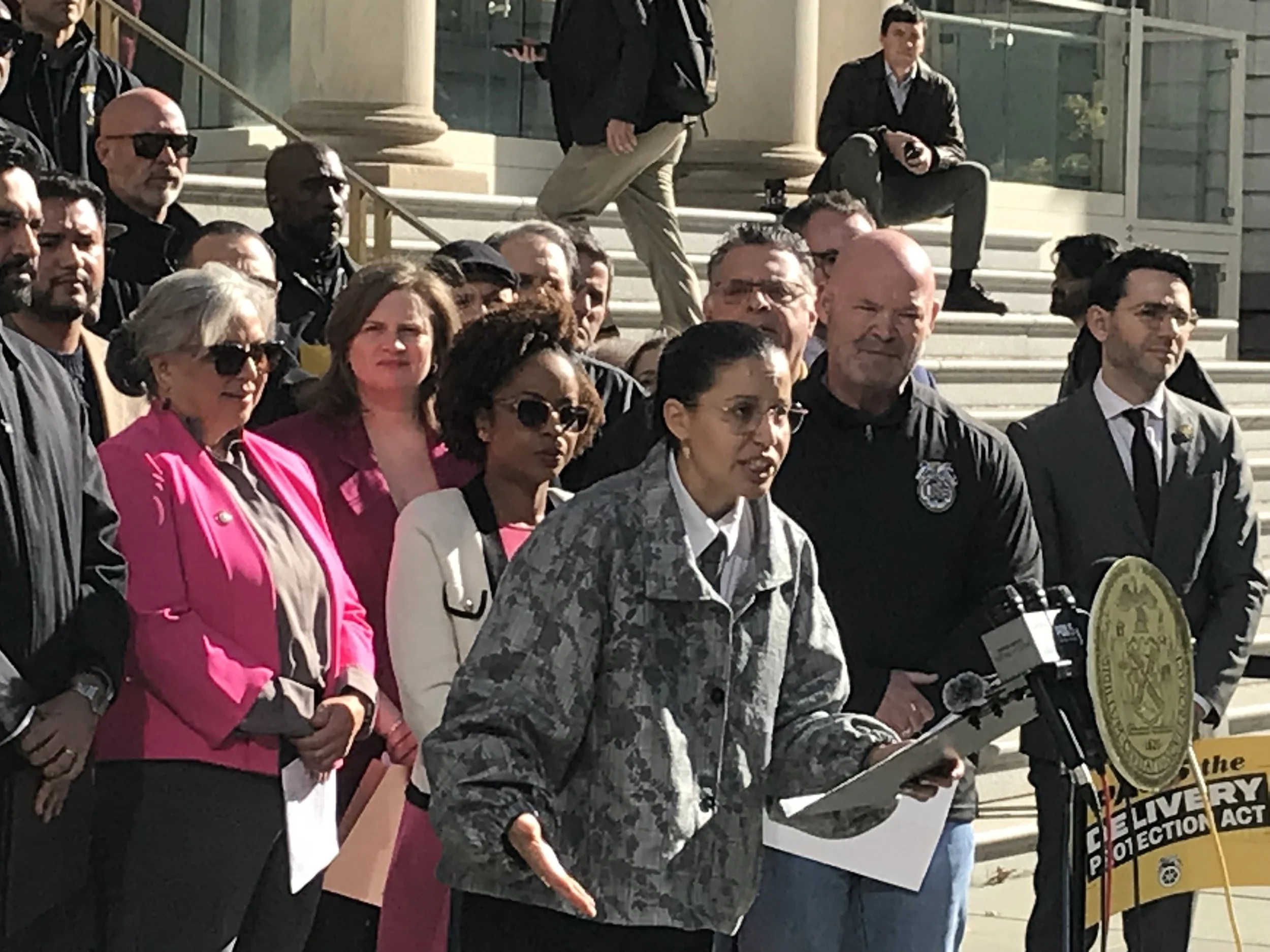
NYC Council Member Tiffany Cabán denounces Amazon’s disinformation campaign against the Delivery Protection Act.
A report released in March by Teamsters Local 804 described DSP contractors as “not truly independent carriers of any kind,” as they often “have no assets beyond their often-exclusive contract with companies like Amazon as the last-mile facility operator.” That operator “unilaterally sets work speed requirements, delivery windows, productivity metrics, customer ratings standards, and vehicle specifications,” often including the vendors from whom they have to buy or lease.
“They are not really in the package-delivery business; they are in the business of ‘providing’ employees for facility operators like Amazon to use to deliver their packages in the manner they desire,” it said.
“They’re payroll agents,” Thomas Gesualdi, head of Teamsters Joint Council 16, told Work-Bites after the rally. “If the driver has an issue, they point the finger anywhere else.” Some may have 100 or more employees, he added, but, “they’re storefronts.”
“The drivers put on a Halloween costume every day. They portray Amazon employees. But Amazon doesn’t want them to have a career path.”
The drivers “put on a Halloween costume every day. They portray Amazon employees,” Teamsters International President Sean O’Brien told the crowd. “But Amazon doesn’t want them to have a career path.”
The union is calling on Speaker Menin to “keep your promises and hold that white-collar crime syndicate accountable,” he added.
Other groups at the rally included the Retail, Wholesale, and Department Store Union, the New York Taxi Workers Alliance, and ALIGN.
Workers need job stability and safe working conditions, but Amazon has “built business models around denying workers fundamental rights,” Mayor Mamdani said. “What is that if not exploitation?”
Reginald Digga Ellis, 57, of Brooklyn, has worked as a DSP driver for three years. The job pays $8 an hour above minimum wage, but the company values “packages over people,” he says. “It’s not fair.”
On a delivery to a house in Greenpoint, he told Work-Bites, he bent over to leave a package, and gashed his scalp bloody on a sharp-cornered light fixture. “ARE YOU ABLE TO CONTINUE?” his dispatcher texted him. The dispatcher also said there was a first-aid kit in the van—but there wasn’t.
At his previous DSP job, Ellis says, he was cut off from access to the app after he asked for a route with fewer walk-up buildings because his knees hurt.
Some DSP drivers have organized unions, but the business model “almost doesn’t allow it,” Local 804 President Vincent Perrone told Work-Bites.
“They broke up with me by text,” laments Latrice Johnson of Queens, the mother of an 11-year-old daughter. “After being top driver a few weeks before, it was devastating to learn I no longer had a job.”
The Maspeth DSP she worked for said it had lost its contract and was laying off all of its more than 100 drivers.
“The real reason is because we were organizing,” Johnson adds. People were getting their hours cut or laid off even during peak season, and “they wanted us to accept that.”
Two DSPs in Woodside successfully organized last year, says former driver Matt Multari. Neither Amazon nor the DSP contractor recognized the union, but it won small victories such as getting drivers paid for lost time during blizzards.
“Whatever local wins we have at our facility, the way to scale that is through legislation,” Multari says. “If you’re not even employed by the company, how are you going to bargain with them?”