
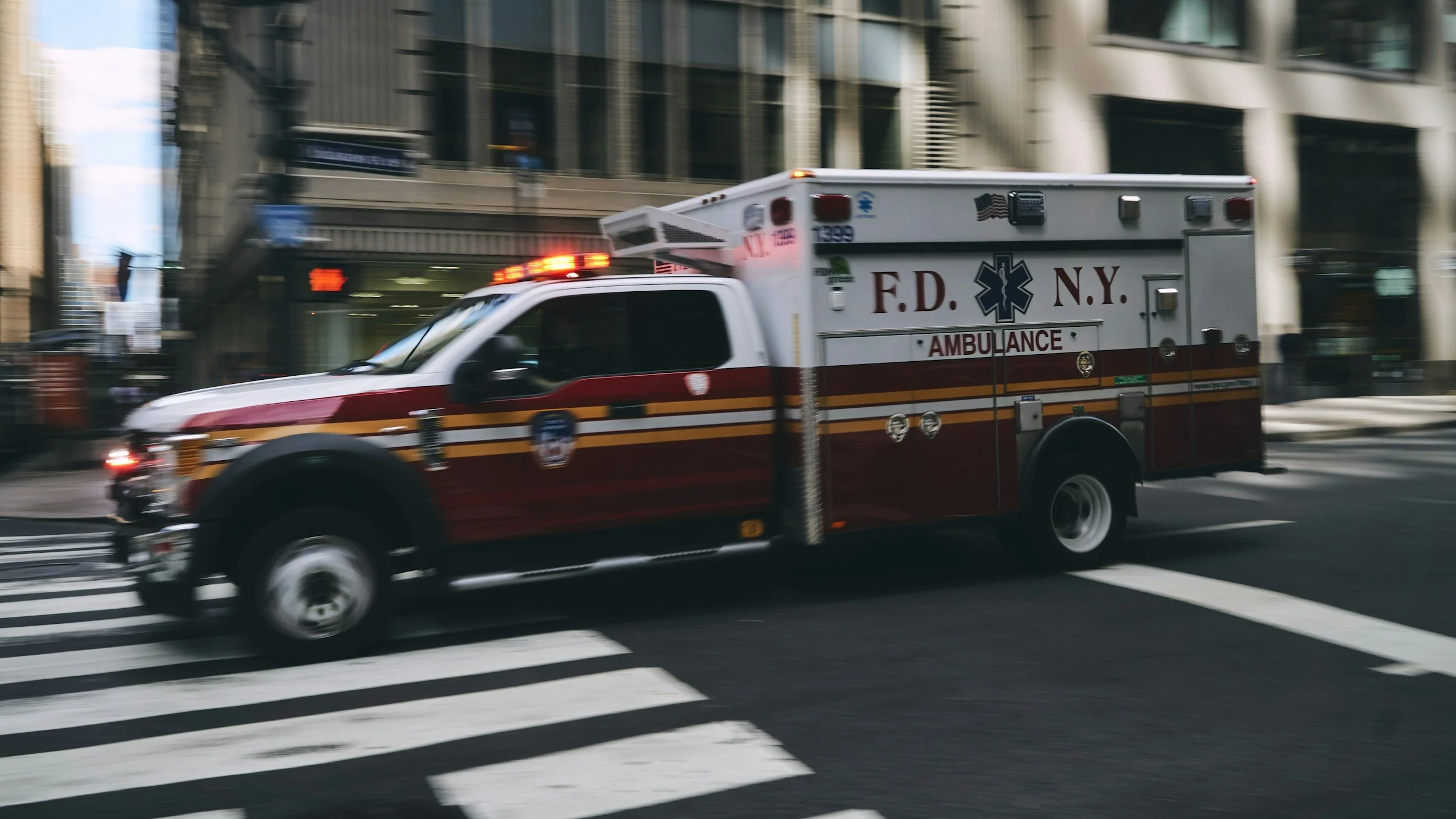
Headed in the wrong direction: The health and safety of every New Yorker remains in jeopardy this week as FDNY EMS response time soar past 13 minutes largely because the department can’t retain enough people to keep ambulances rolling.
By Joe Maniscalco
The City of New York must act now to pay Emergency Medical Services EMTs and paramedics a living wage, City Council Speaker Julie Menin declared on Tuesday.
“I don’t know what kind of city we are that we are allowing this to continue,” the City Council head told a joint hearing of the Fire and Emergency Management and Hospitals committees held at 250 Broadway on Oct. 20.
Average emergency response times across the city are now well over 16 minutes as city EMTs and paramedics unable to make ends meet on paltry salaries that have perennially lagged far behind cops and firefighters continue to leave the profession in unsustainable numbers.
“This is a totally and wholly unacceptable,” Speaker Menin added. “As we wait for wages to increase—response times are increasing to truly unacceptable levels. We know that brain cells begin to die after four minutes without oxygen—so, the idea that we are now at an average response time of 13 minutes point 9 seconds is just wholly unconscionable.”
The survival rate for New Yorkers suffering cardiac arrest, according to a panel of EMS unions leaders testifying at this week’s joint committee meeting, has plummeted from approximately 37 percent in 2019—to just 16 percent today.
“We do about 80 cardiac arrests a day...that works out to about 29,000 cardiac arrests a year. At a 16-percent survival rate that means 5,000 people survived that year. At a 37-percent survival rate 9,000 people survived that year. That means 4,000 people died this year that didn’t need to.”
“We do about 80 cardiac arrests a day,” Michael Greco, president of FDNY EMS local 2507, said. “That works out to about 29,000 cardiac arrests a year. At a 16-percent survival rate that means 5,000 people survived that year. At a 37-percent survival rate 9,000 people survived that year. That means 4,000 people died this year that didn’t need to.”
This week’s joint committee meeting also included testimony from Jennifer Daly—the mother of 14-year-old St. Francis Preparatory HS student Kevin Daly who suffered a stroke at school on the morning of Sept. 28 and couldn’t get help.
She recounted the traumatic events of that morning and how fruitless calls to 911 for help forced her to put Kevin into a car and drive him to New York-Presbyterian Queens Hospital herself.
Speaker Menin, meanwhile, also related another recent incident involving a 16-year-old teen in her district badly injured playing basketball. In that case, the distraught parents had to contact a private ambulance service for help after waiting 30 minutes for EMS to arrive.
EMS merged with the FDNY back in 1996 under the leadership of then-Mayor Rudy Giuliani. But the move never resulted in the pay parity—or respect—EMS workers need and demand.
And they’ve now been working without a contract for over four years.
“The Mayor’s Office has to deal honestly and competitively with this contract that they are negotiating with the unions and not just kick the can down the road.”
“The Mayor's Office has to deal honestly and competitively with this contract that they are negotiating with the unions and not just kick the can down the road,” Fire and Emergency Management Committee Chair Joann Ariola said this week.
Nearly 360 EMTs and another 63 paramedics have left EMS this year to become FDNY firefighters where they can expect to earn six-figure salaries after five-and-half years on the job. Last year, the FDNY “promotions cycle” saw 288 EMTs and 48 paramedics leave to become smoke eaters.
“It’s a positive outcome for the city to have firefighters with EMS and paramedical level training—but it also has a sever impact on EMS staffing in the short-term,” FDNY Chief of Department John Esposito told this week’s joint committee hearing.
Esposito conceded that EMS is in crisis, but suggested that there are elements increasing response times that are unrelated to staffing—including the 19 hospitals New York City has lost to shut downs since 2003.
“We know that building ups EMS staffing is a key part of this issue,” he added. “We need to replace the members who have left EMS to become firefighters, and other EMS members who have issues with wages, schedules, or their own reasons.”
The four-and-half-hour hearing left Ariola visibly frustrated. She advocates passage of Intro. 990—legislation that if passed would require New York City Emergency Management (NYCEM) to alert the public any time FDNY EMS is having difficulties dispatching ambulances.
But the FDNY brass has deep reservations about Ariola’s bill.
“With all due respect, yes, you're saying [EMS] in crisis, but you really are the only people who can solve the crisis,” she said. “I mean, let's be clear— you've got a City Council that wants to raise the wages. The administration is the only people that can actually solve this crisis—and I just don't understand how we can keep perpetuating this when people's lives are literally at risk.”
Work-Bites reached out to the Mayor’s Office for comment on this story, but those efforts—as usual for this administration—have gone unacknowledged.
“Recruiting has become more difficult since the Covid 19 pandemic,” Esposito added. “The union representing the department’s EMT’s is currently at the negotiating table with the City Office of Labor Relations and we are hopeful that a resolution to the next contract will provide a recruiting boost.”