
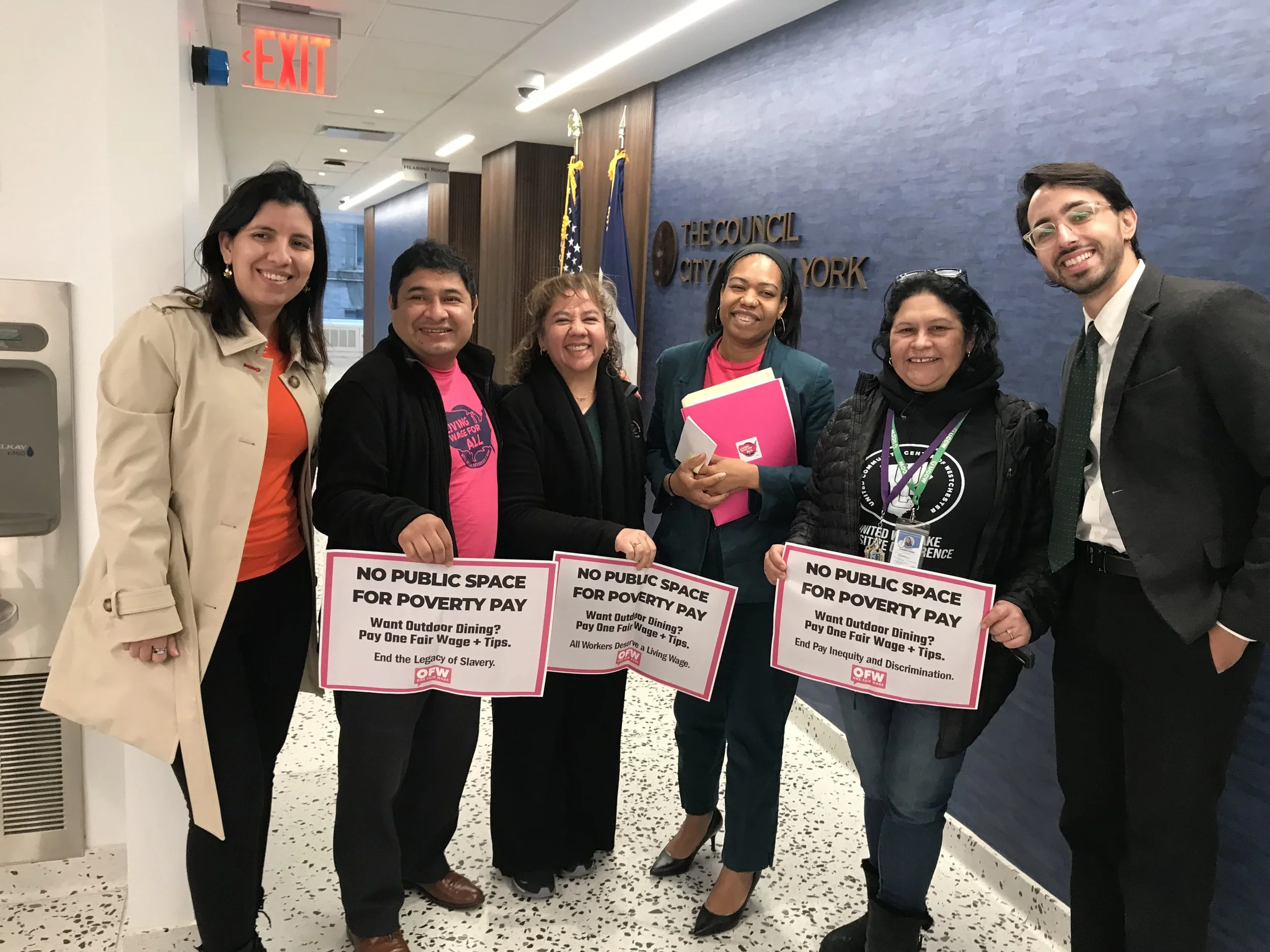
No Public Space For Poverty Pay: OFW Policy Director Jacqueline Littleton [binder] and fellow activists argue that Intro. 655 should also guarantee the full minimum wage for restaurant workers. Photos/Steve Wishnia
By Steve Wishnia
The One Fair Wage campaign, which wants to end the lower minimum wage for tipped restaurant workers, is trying to get that added to proposed city legislation to let New York City restaurants have outdoor dining year-round.
“My rent is the same every month, but my income is not. A slow night, a bad table, a snowstorm… you can’t plan,” One Fair Wage organizer Gio Uribe, a server with “twenty-plus years in the industry,” told Work-Bites before a City Council hearing March 3. “If outdoor dining is here to stay, one fair wage should be too.”
The six-hour hearing by the Council’s Transportation and Infrastructure Committee covered several bills related to the city’s 2026 State of the Streets plan, including measures that would expand bike lanes and bus lanes, enable bilingual street signs citywide, and create more parking for bicycle-delivery workers. Intro 655, sponsored by Councilmember Lincoln Restler (D-Brooklyn), would let sidewalk and roadway cafés operate year-round, by removing seasonal restrictions.
One Fair Wage argues that “if restaurants want a privilege other businesses don’t receive—the use of public space to expand their operations and increase their profits—they should have to meet the same standard every other business already meets.” That would mean paying the full $17-an-hour minimum wage, instead of the state’s $11.35 minimum for tipped food-service workers, where the difference is made up by a “tip credit,” the first $5.65 of their tips.
Outdoor dining means “more customers, more tables, longer shifts, the same subminimum wage. You can’t expect us to rely on tips as a whole paycheck,” said Eric Huntley, a server for over 30 years in Bushwick. He waved a “No Public Space for Poverty Pay” sign before he testified.
“Today, tipped restaurant workers are the only workers left in this entire state who are still paid the subminimum wage,” economist Rayan Semery-Palumbo told the committee.
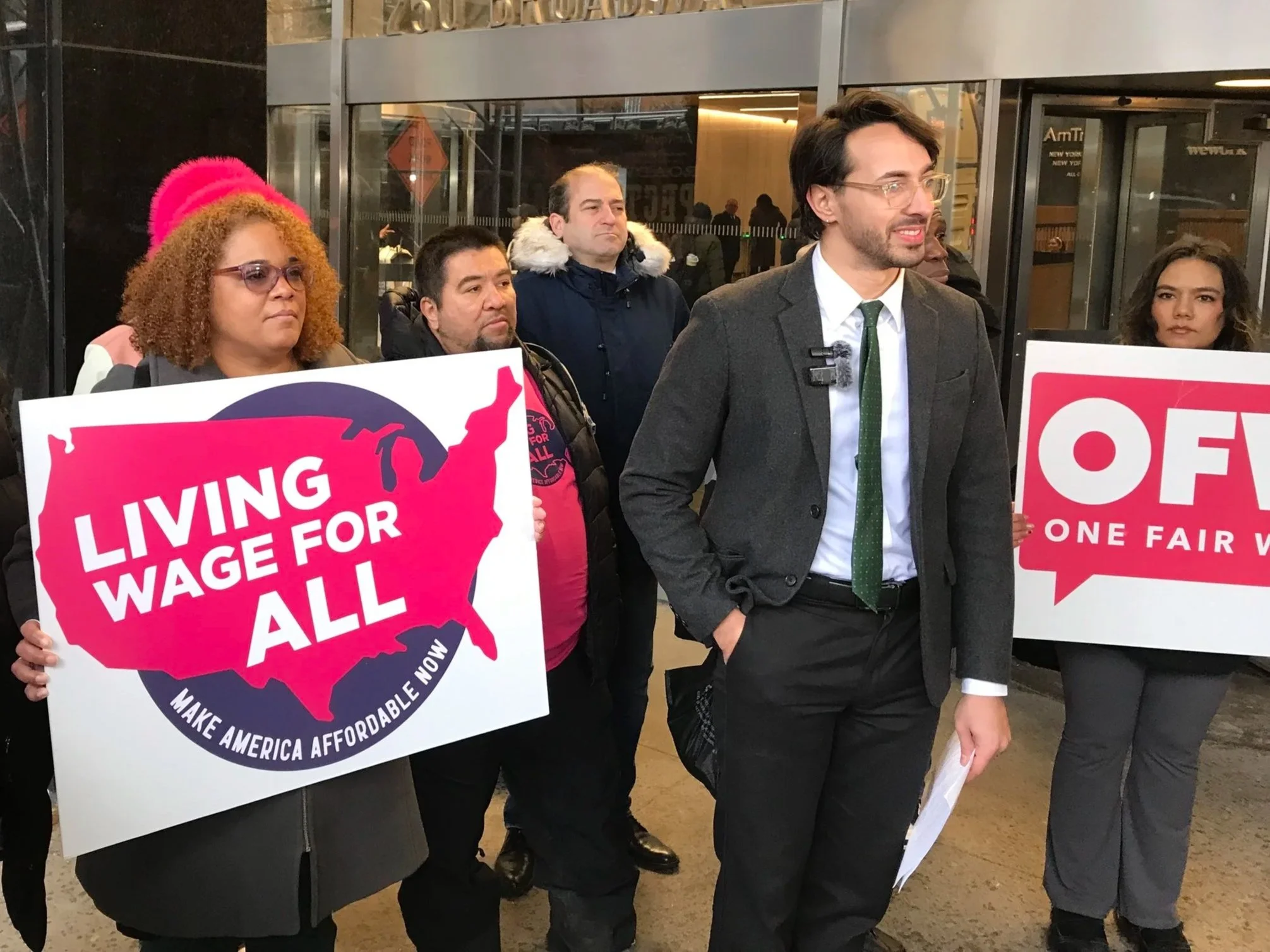
Economist Rayan Semery-Palumbo [tie] stands with One Fair Wage advocates outside 250 Broadway earlier this week.
There are about 271,000 restaurant workers in the city, according to federal Bureau of Labor Statistics figures from 2024, and about 97,000 of them receive tips. But repealing the subminimum, according to One Fair Wage, would most likely affect the 155,000 who work in full-service restaurants, of whom about 55,000 are tipped.
Their median weekly pay is about $894, according to the BLS numbers, but that varies widely by borough. In Manhattan, where two-thirds of them work, the median is $992. In the other boroughs, it ranges from $560 in Staten Island to $743 in Brooklyn.
Seven states—California, Alaska, Minnesota, Montana, Nevada, Oregon, and Washington—require businesses to pay tipped workers the full minimum wage. According to BLS figures, the number of restaurants in those states increased at a slightly higher rate from 2021 to 2023.
The outdoor-dining debate
The city Department of Transportation supports Intro 655, Commissioner Mike Flynn told the committee, subject to considerations about how to handle heating, sanitation, and enforcement. Neighbors and community boards who oppose the bill, however, cited problems with noise, overcrowding, and sanitation, especially rats.
Adding a minimum-wage increase would bring resistance from the restaurant industry. The New York State Restaurant Association says maintaining the tip credit is one of its top legislative priorities, calling it “a valuable economic tool for many restaurants and bars that helps with labor costs, at no detriment to tipped employees.” It specifically names One Fair Wage as an opponent.
“What’s the difference between a restaurant worker and a construction worker? They both have to pay the rent.”
Still, One Fair Wage found several restaurant owners who supported eliminating it. “What’s the difference between a restaurant worker and a construction worker? They both have to pay the rent,” Lou Martins, owner of the Bistro Casa Azul in East Harlem, told Work-Bites before the hearing.
Russell Jackson, former owner of Reverence, a Michelin-praised restaurant in Harlem that closed in early 2025, says it would be simpler to pay one straight wage than to follow state law, which says owners can’t take a tip credit when tipped workers get less than a certain amount in tips or spend more than two hours, or 20% of a shift, doing non-tipped work.
“You know how much time it takes to calculate all that?” he asks. “When they’re on the floor, or when they’re doing knife rolls.”
Councilmember Restler was unavailable to speak about the bill, his office said.
“Former restaurant worker Jeri Denise Thompson told the committee that ‘when your pay depends on tips, you put up with things that no one should have to put up with,’ such as smiling through sexual harassment by customers.”
Former restaurant worker Jeri Denise Thompson told the committee that “when your pay depends on tips, you put up with things that no one should have to put up with,” such as smiling through sexual harassment by customers.
Committee chair Shaun Abreu (D-Manhattan) then reminded witnesses to “stay on topic.” By that point, almost four hours into the hearing, he and Phil Wong (D-Queens) were the only members still in the room.
Delivery-bike parking
The street plan also involves other labor issues. Councilmember Gale Brewer (D-Manhattan) has introduced a bill to add 5,000 parking spaces and corrals for bikes over the next five years. Both Ligia Guallpa of the Workers Justice Project, the parent group of Los Deliveristas Unidos, and delivery cyclist Joshua Wood urged the Council to pass it.
“We are constantly risking our lives being shoehorned into infrastructure that was not designed around us,” Wood said. “We understand that riding on sidewalks is a safety hazard.”
Infrastructure, Guallpa said, hasn’t grown at a pace to match the rise of e-bikes and “app-delivery business models that prioritize speed and profit over safety.”
There are about 80,000 workers who use e-bikes, mopeds, bikes, and e-cargo bikes to make 2.7 million deliveries a week, they said.