
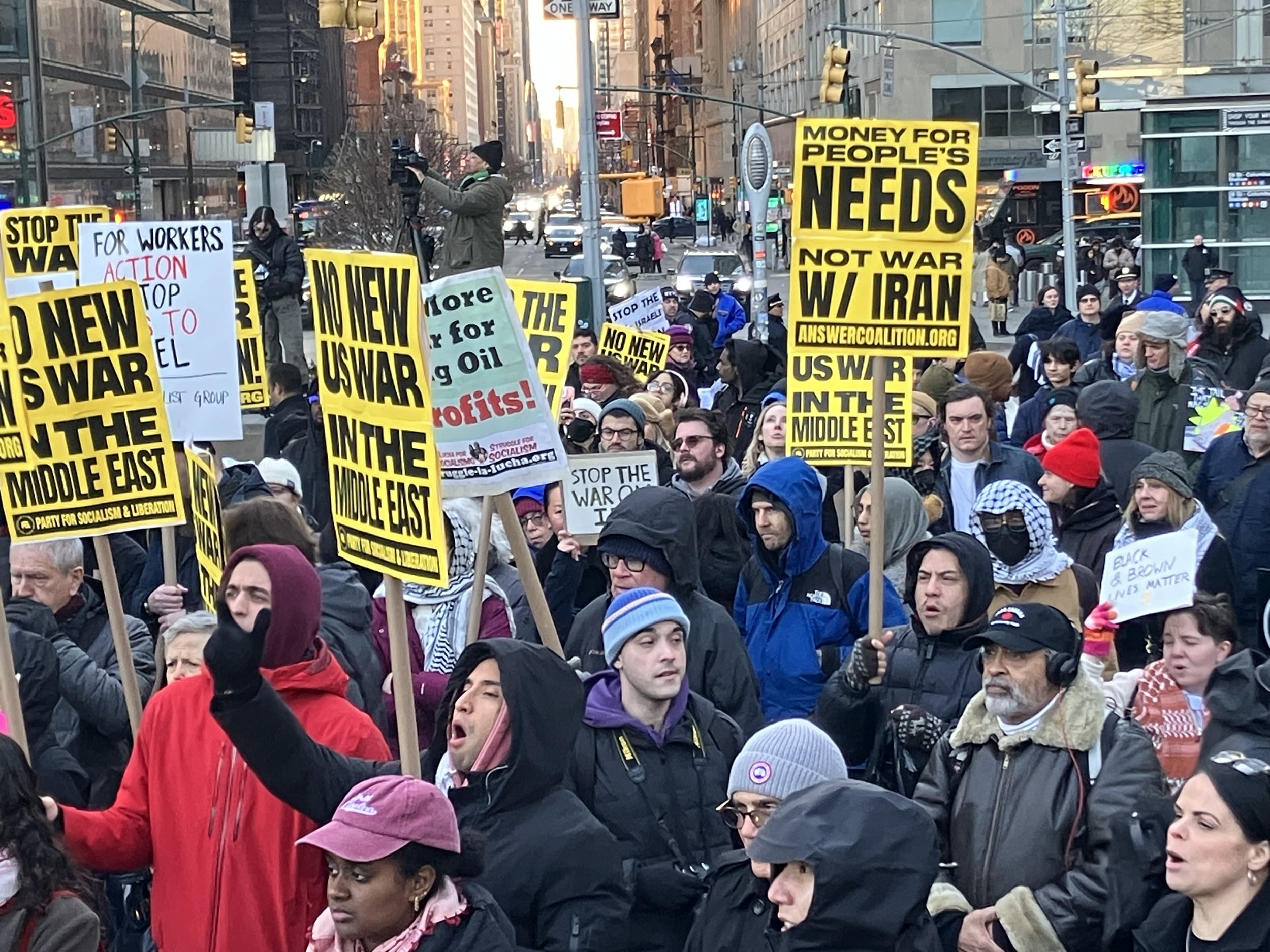
Anti-war protesters gather at Columbus Circle on March 2. Photos/Joe Maniscalco
By Joe Maniscalco
It’s day four of what could be the start of World War III, but the United States’ most powerful counterforce to the increasing carnage—in arguably the most “union strong" city in the country—remains conspicuously on the sidelines.
Emergency demonstrations against the war held in Times Square and Columbus Circle drew just a few hundred people on Feb. 28 and again on Mar. 2. And if you looked around and wondered where all the trade unionists were, you weren’t alone.
Work-Bites reached out to the New York City Central Labor Council, the largest regional labor federation in the country representing some 1 million trade unionists across 300 local unions, for a comment on this story—but we have yet to get a response.
A United Federation of Teachers [UFT] spokesperson successfully reached for comment on Tuesday morning, meanwhile, deferred to statements American Federation of Teachers [AFT] President Randi Weingarten posted on social media Feb. 28, where she managed to both denounce Iran and oppose the bombing.
The UFT represents approximately 200,000 teachers and classroom paraprofessionals across New York City and is one of the most powerful public sector unions in town, as well as being an AFT affiliate.
“For years, the AFT has stood with Iranians who have suffered the Khomeini regime in Iran—indeed last week our executive council resolved to stand in solidarity with our fellow unionists and the Iranian people while opposing US military intervention,” Weingarten said on Blue Sky the day the attacks began. “We pray for peace and demand that all people be able to exercise their fundamental rights to live in safety and security and to speak freely for their democratic right to self-determination.”
1199SEIU, the largest healthcare union in the United States today with more than 200,000 members in New York City and Long Island, issued a statement following Feb. 28’s initial attacks on Iran urging the Untied States Congress to “end this unconstitutional aggression and safeguard working people in America, Iran, and around the globe.”
“War hurts working people, poor people, women, and children. While authoritarian rulers, would-be dictators, and the billionaires that finance endless violence conspire together to enrich themselves and grab at ever more power, it is regular working people who pay the price,” the 1199SEIU statement declared.
The United States Constitution, under Article I, Section 8, Clause 11, gives Congress the sole power to declare war. But in a world where missiles strikes and bombing campaigns have been successfully re-defined as things totally other than war—just like the “major combat operations” Donald Trump described on Feb. 28—who even needs to declare war nowadays?
In his latest Substack entry, former New York Times war correspondent Chris Hedges calls endless war in the US a “bipartisan project,” noting how “two dozen Democrats lept to their feet and applauded every time [Donald] Trump threatened Iran, or lauded Israel, in his State of the Union Address.”
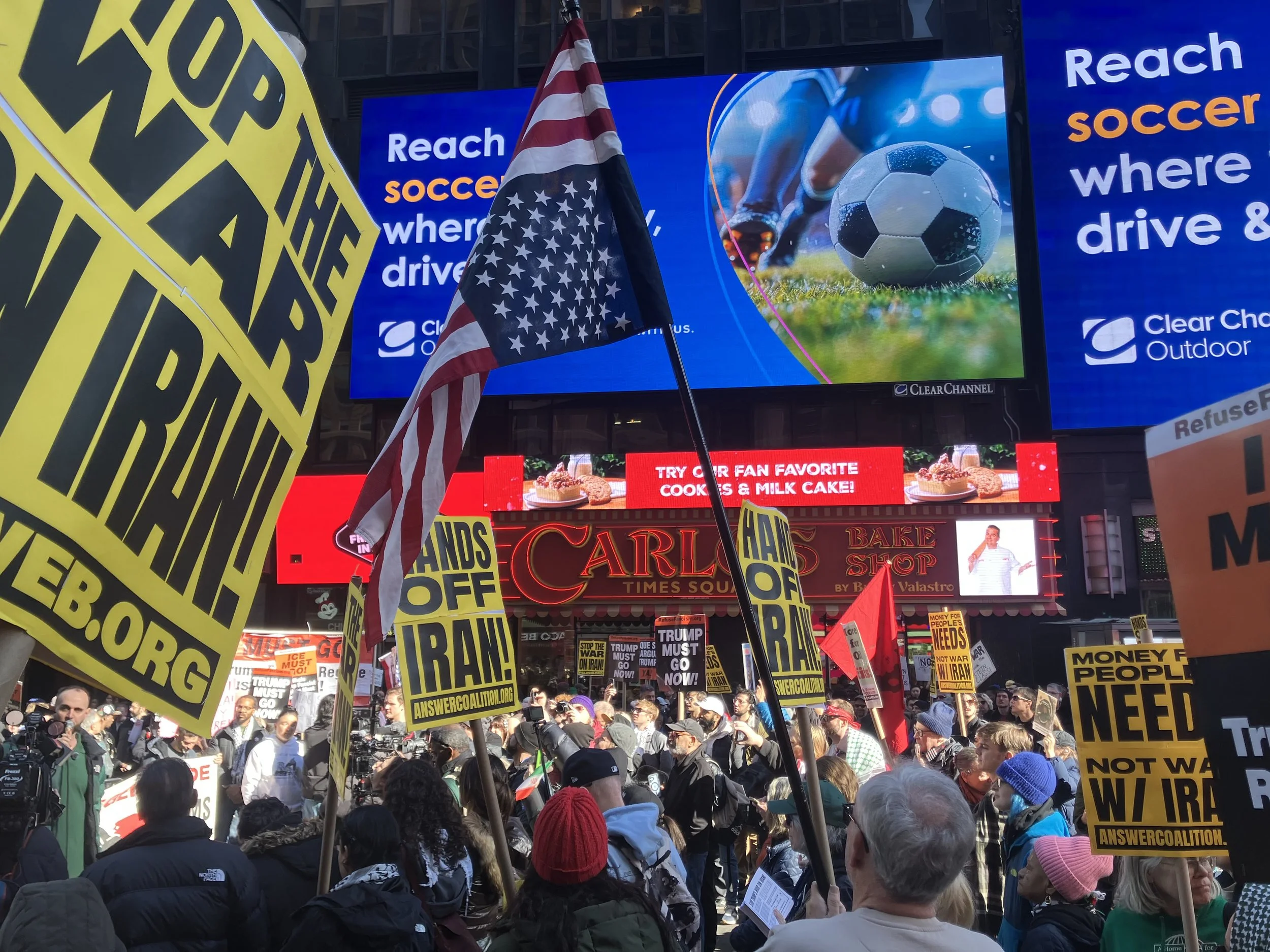
US-Israeli attacks on Iran sparked an emergency demonstration in Times Square on Feb. 28. Where was organized labor?
“Democratic Party leaders are not opposed to attacking Iran—they are opposed to attacking Iran without being consulted,” he adds.
Despite rumblings from the AFL-CIO over the years about breaking with “the lesser of two evils politics,” the upper echelons of entrenched union leadership remain largely subservient to the Democratic Party and continue to function as cogs in its machine.
Corporate media, meanwhile, is doing what it does best, cheering on war and reducing its cost in cold numerical terms that can easily be manipulated to make the murder appear acceptable. The neat and tidy tally at the time of this writing is six American troops killed so far, in addition to 11 deaths in Israel, and at least 787 people dead in Iran.
Those numbers, of course, do not reflect who the dead actually were in life, who they loved, who loved them back, and what their dreams might have been. Nor does it include those maimed, mangled, forever traumatized, or otherwise deceptively categorized as “wounded.”
“We pray for the full recovery of the wounded and send our immense love and eternal gratitude to the families of the fallen. And, sadly, there will likely be more before it ends. That's the way it is,” Trump said over the weekend.
Work-Bites also reached out to both the Answer Coalition and the People’s Forum—two of the groups responsible for helping to organize anti-war actions in Times Square and Columbus Circle—but we have also not gotten a reply from them before going to press.
The Answer Coalition is helping to plan further multi-city actions against the growing war on Iran—those actions are slated for March 7. But it remains to be seen what kind of presence, if any, organized labor will have at those actions, as well.
Some labor leaders are reportedly getting “strike ready” for a nationwide general strike on May 1—International Workers’ Day.
Last month, members of AFSCME Local 1369 signed their first-ever collective bargaining agreement with the Town of Waterbury, Vermont in which they also became one of the first two AFL-CIO units in the country, along with AFSCME workers in South Burlington, to become contractually empowered to engage in a general strike to “defend democracy.”