
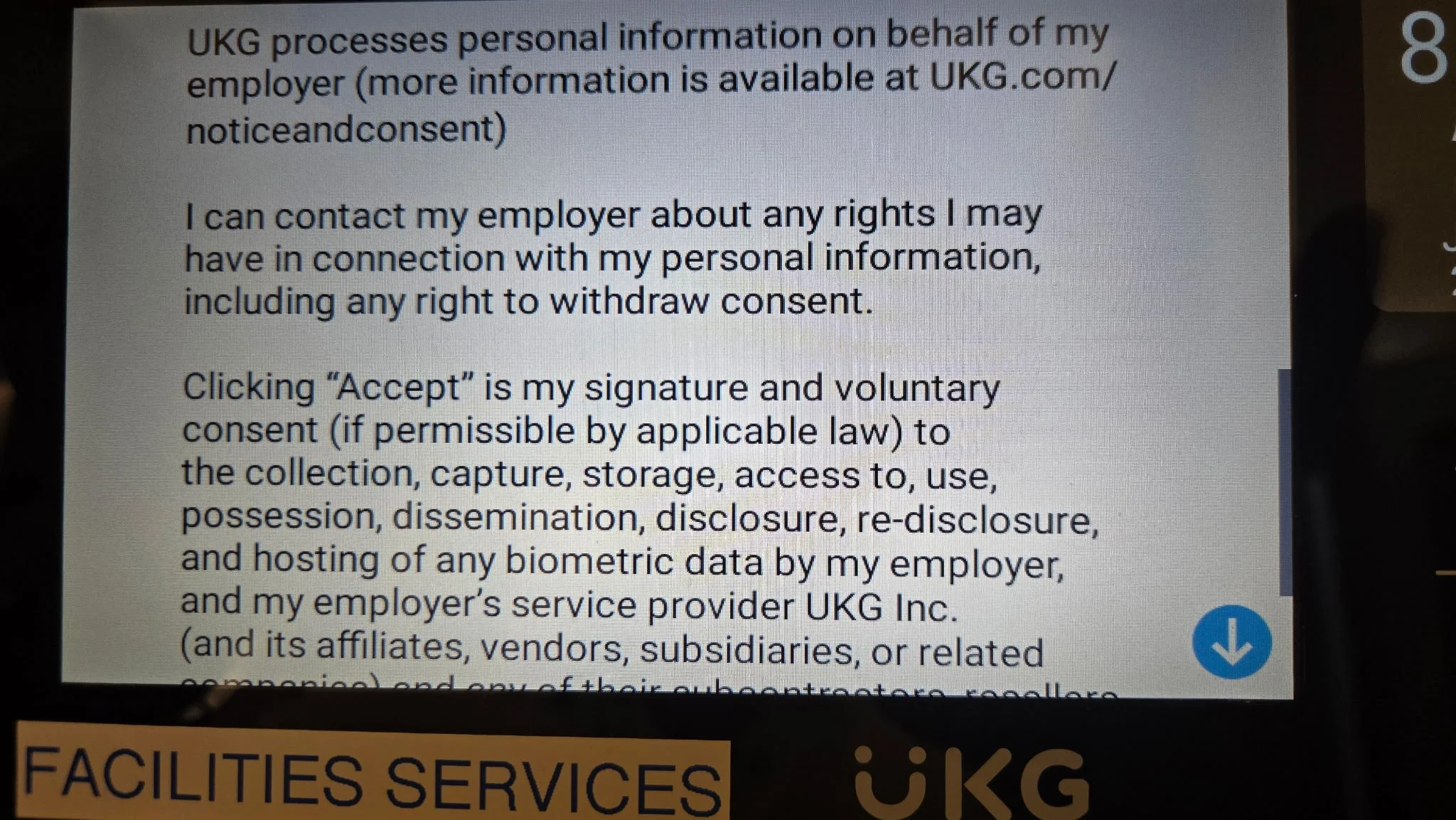
The image above is a screenshot of the UKG waiver CUNY workers have been subjected to as part the institution’s new biometric time-card system.
By Steve Wishnia
At least three maintenance and building-trades employees at The City University of New York [CUNY] have been suspended for refusing to consent to fingerprint scans required for a new biometric time-clock system.
Kyle Simmons, president of the City Laborers Union, Local 924 of AFSCME District Council 37, which represents about 125 of the about 600 CUNY workers affected, charges that the university administration “refused to disclose” that employees were supposed to give individual consent to the fingerprint scans and to turning over that image data to UKG, the company providing the time-clock system. In many cases, he says, supervisors clicked the “Accept” button themselves before taking fingerprint scans from employees.
“Does a public employer have the right to outright lie to its employees?” Simmons asks.
“CUNY campuses have upgraded their timekeeping system to the latest state-of-the-art technology,” a spokesperson for the university system responded. “Employees were informed of the change and that the system does not contain a fingerprint or image of any kind. The system has been successfully rolled out, with all but a few employees enrolling without issue.”
The scanner captures the pattern of the fingerprint’s arches, loops, ridges, and whorls and converts it into a digital “template.” It’s not a traditional fingerprint image like a police officer rolling an arrested suspect’s inked fingertips onto paper, but it is a unique personal identifier.
“Nobody knew anything before July,” Simmons told Work-Bites. In July, Local 924 was given a four-page waiver form for individuals to consent to scans, Simmons further explained during last week’s episode of WBAI-FM’s “Labor and Healthcare Confidential show. The process, he said, was an “assembly line,” in which management gathered workers in groups of 20 to 25, “pushed every button,” and told workers “stick your hands in there.”
“I look on that as fraud,” Simmons added.
CUNY denies that supervisors signed the consent form for workers. “Upon review of this claim by facilities management at each college, it was determined that this allegation was not accurate,” Carmelo Batista, the university’s interim senior executive director of labor relations, wrote in a July 30 email to Simmons. “Please note that across the different CUNY campuses, administration staff from the campuses were present to explain the Kronos registration process with all employees.”
But Joseph Perry, Local 924’s secretary for buildings and grounds at Queens College, disputes that. Last summer, management ordered everyone on his shift—about 25-30 workers, including laborers, carpenters, electricians, and plumbers—to meet at the time clock,” he told Work-Bites. A supervisor called out their names, and they each went up to put two fingers into the machine to have their prints scanned.
“No one knew about waivers, accept, or decline,” Perry said. “I was in shock when I was told about it.”
The UKG biometric time-clock software includes a “manager mode” which enables supervisors to enroll employees by entering their names before taking their fingerprints. A manual for UKG’s InTouch software states that manager mode “allows you to perform supervisory transactions (such as enrolling employees for biometric authentication).” An “InTouch Biometric Enrollment Tutorial” video demonstrates how a manager can enroll an employee before taking a fingerprint scan by tapping the employee’s ID badge or keying in their badge number.
UKG recommends that employees give prints from two fingers in case the first finger is damaged.
For CUNY employees, clicking the “Accept” button meant they gave “voluntary consent (if permissible by applicable law) to the collection, capture, storage, access to, use, possession, dissemination, disclosure, re-disclosure, and hosting of any biometric data by my employer, and my employer’s service provider UKG Inc. (and its affiliates, vendors, subsidiaries, or related companies) and any of their subcontractors, resellers, or successors, consistent with my employer’s timekeeping policy (if applicable).”
“If my information is leaked, who gets the liability?” Local 924 treasurer Victor Maduro said on WBAI. Signing the consent form relieves the employer of liability, he added.
1Kosmos, a New Jersey-based identity-verification company, praises the efficacy of biometric scanners as “unquestionable” on its website, but warns: “If biometric data is compromised, the repercussions can be severe, given that fingerprints cannot be changed, unlike passwords.”
New York State law generally prohibits private employers from requiring biometric identification from workers, but allows it for public employees. But “they’re supposed to negotiate with workers,” Simmons says. “We have not bargained anything.”
“It is well settled that an employer substituting one timekeeping system method for another,” Batista wrote in a July 8 email to Simmons, “is not a mandatory subject of bargaining.”
Once the unions found out about the consent form, members began objecting to signing it. In the July 30 email to Simmons, Batista said that “close to 90% of our trade employees” had already signed, but there was “still a pocket of employees refusing to comply with this direct order.” He said the union must follow the concept of “obey now and grieve later,” and that while CUNY would “like to circumvent any adverse action,” it “reserves the right to take appropriate action for non-compliance.”
Following that, two workers at Bronx Community College who hadn’t signed were suspended for 30 days for noncompliance, one a member of Teamsters Local 237 and the other from International Brotherhood of Electrical Workers Local 3. A Local 924 member at Medgar Evers College in Brooklyn was suspended for 20 days earlier this month, and a hearing was held Nov. 16 on similar charges against another member at Bronx Community College.
Local 237 declined to comment. Local 3 did not respond to phone messages.
A number of other Local 924 members decided to sign before the Nov. 16 hearing because “they didn’t want to get suspended,” Simmons says.
The union is now planning to take the dispute to arbitration and is considering a legal challenge, he adds.