
‘We Want Him to Hear Us’: NYCHA Residents Call Out Mamdani
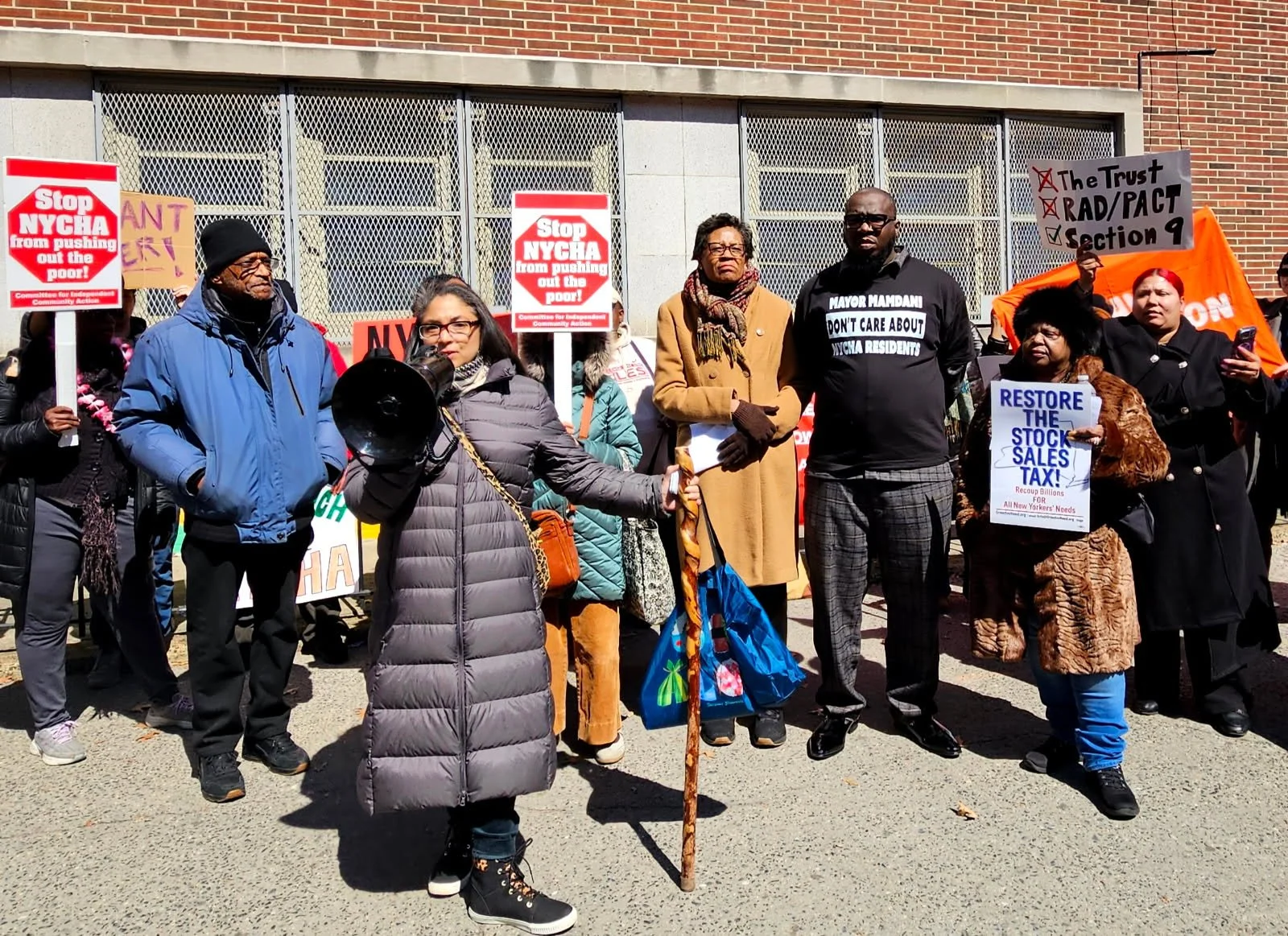
Save Section 9 advocate Ramona Ferreyra and her organization have spent months attempting to contact Mayor Mamdani—to no avail. Photos/Judith Sokoloff
By Steve Wishnia
If Mayor Zohran Mamdani calls himself a socialist, then “NYCHA should not be an afterthought. We are 511,000 residents,” the Rev. Kevin McCall of the Brownsville-based Crisis Action Center told a group of about 50 protesters on E. 109th St. in East Harlem March 27.
Speakers at the rally denounced the mayor for continuing NYCHA’s program to privatize numerous developments and not responding to their requests to meet with him.
“What he’s not going to do is hear us,” Carmen Quinones, head of the resident management corporation at the Frederick Douglass Houses on the Upper West Side, told Work-Bites before the rally. “He wants NYCHA to hear us. We talk to NYCHA every day. We want him to hear us.”
The mayor has not explicitly taken a position on NYCHA privatization beyond saying tenants should have input, but the top two officials overseeing public housing in his administration have endorsed it. At a panel discussion on affordable housing held March 9 by the New York Housing Conference, THE CITY reported, Deputy Mayor for Housing and Planning Leila Bozorg said the administration supported plans to demolish the Fulton and Elliott-Chelsea developments and convert them to privately owned Section 8 housing because it would enable them “to replace over 2,000 public housing units and get 3,000 mixed income units in the future without a single dollar of capital subsidy.” At a City Council hearing March 24, NYCHA CEO Lisa Bove-Hiatt said that the authority planned to demolish more developments, because “we have to pursue every opportunity that’s available to us to make sure that there are affordable places to live.”
An obviously uncomfortable Cea Weaver, head of the city Office to Protect Tenants, told a group of Fulton and Elliott-Chelsea tenants in early February that the administration was “interested in continuing to move forward” with the Section 8 conversion and the “redevelopment” of the buildings. “So you’re going to help with the demolition?” a woman interrupted.
“We want to make sure that your resident rights are protected,” Weaver answered.
“While everything is being demolished,” the woman replied.
Bozorg and Bove-Hiatt are both Eric Adams appointees kept on by Mamdani. Weaver is a longtime housing activist who was a leader in the campaign that led to the state strengthening its rent-stabilization laws in 2019.
Public Advocate Jumaane Williams’ annual list of the city’s worst private landlords—those with the most open housing-code violations in their buildings—has regularly noted that NYCHA has consistently had a backlog of more than 600,000 work orders for repairs. Protesters also objected that when public-housing residents voiced complaints at “Rental Ripoff” events aimed at private-housing tenants, the mayor’s office offered to set up a meeting with NYCHA representatives.
“We have been contacting the mayor for more than a month, and he is not responding,” Ramona Ferreyra of Save Section 9, a resident of the John Purroy Mitchel houses in Mott Haven, told the rally.
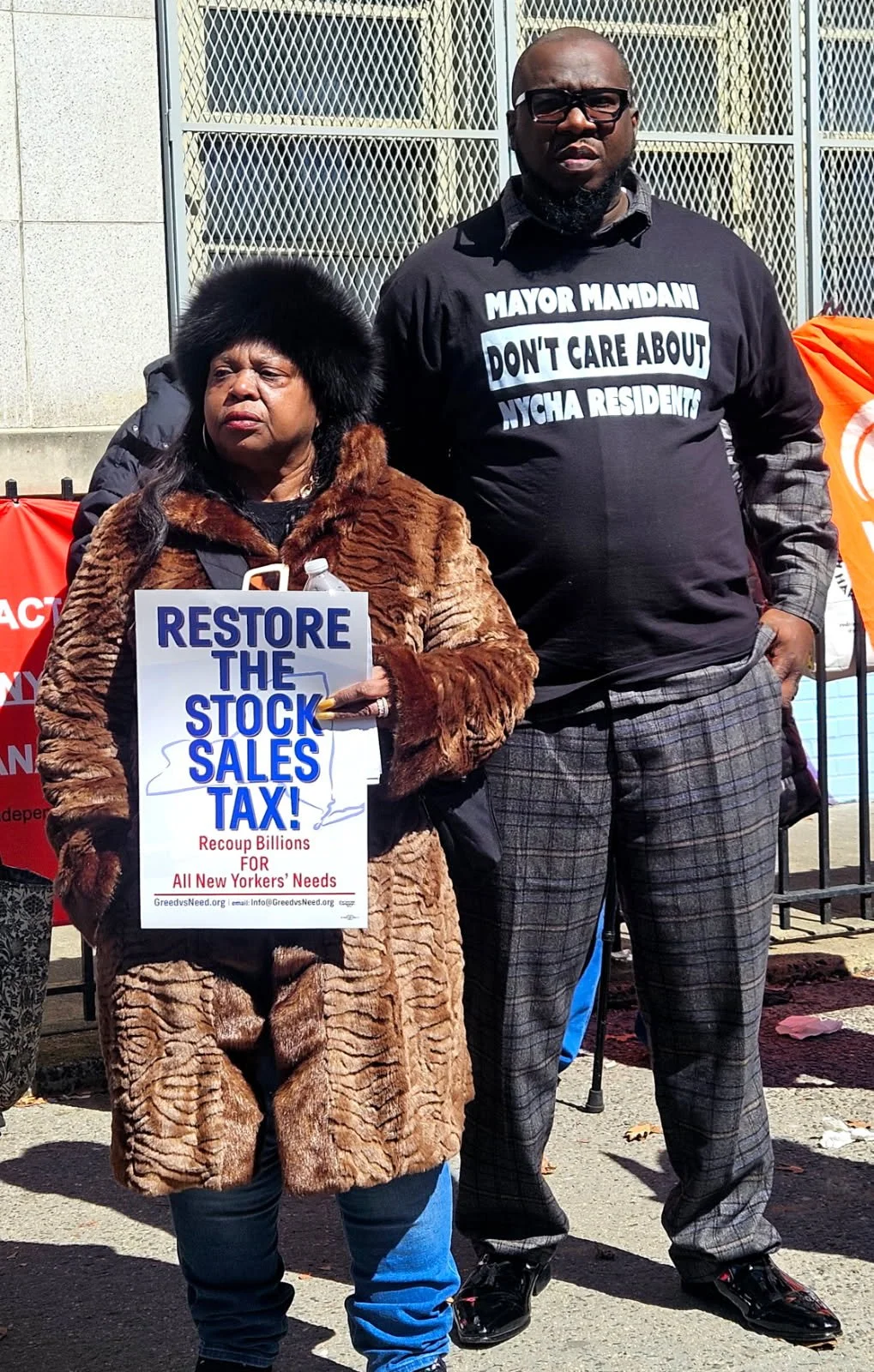
“Mayor Mamdani Don’t Care About NYCHA Residents”: Carmen Quinones and Rev. Kevin McCall call for rescinding the New York State Stock Transfer Tax Rebate.
Section 9 refers to the part of federal housing law that covers public housing. In the past decade, NYCHA has turned about 15% of its apartments over to private landlords, converting them to the Section 8 program, with substantially more in the works. It argues that this is the best way to finance repairs, as the private landlords get more money from Section 8 rent subsidies than it gets from direct federal support.
But in this framework, called Rental Assistance Demonstration/Permanent Affordability Commitment Together (RAD/PACT), “management has a direct interest in making money off your unit,” Save Section 9 says. And funds for Section 8, it adds, are limited and vulnerable to federal budget cuts.
The RAD/PACT program is being promoted as a way to clear up the huge backlog of repairs. But Dr. Jessie Fields told the rally that at a recently privatized building in East Harlem, an 83-year-old woman died in February while it had no heat.
The UPACA 6 senior-housing building, which had chronic problems with lack of heat, was privatized last December, to be run by C+C Apartment Management, the property-management subsidiary of “affordable housing” developer L+M Development Partners. The woman, Leslie Zellars, was found under a pile of blankets by a neighbor, the Amsterdam News reported.
Quinones cited the Jan. 24 gas explosion and fire at the Boston Secor Houses in the northeast Bronx, which killed one person and injured at least 14. It’s one of several NYCHA developments now run by Wavecrest Management, a Queens-based landlord and “affordable housing” developer that was involved in the first RAD/PACT conversion, in Rockaway in 2016. Tenants there told WPIX-TV after the fire that they had complained about smelling gas, but management “did nothing.” (Wavecrest denied that.)
“They should not even be in the portfolio,” Quinones told Work-Bites.
Public housing is one of the largest sources of low-income housing in the city. The Census Bureau’s 2023 Housing and Vacancy Survey found that it had a median rent of $560 a month, a hair above one-third of the $1,641 median for all rental units, and that 77% of NYCHA apartments rented for less than $1,100, compared to 26% of rent-stabilized apartments.
Funding maintenance and repair adequately, however, would take significant new legislation.
Save Section 9 advocates five measures. Two are state bills, both supported by Mamdani and opposed by Governor Kathy Hochul. One, included in the state Senate’s budget proposal, would add a 0.5% surcharge on state income taxes for households making at least $5 million a year; the other would give New York City authority to enact an extra 2% tax on incomes over $1 million. If 10% of that revenue were earmarked for Section 9 housing, the group says, they would bring in $100 million and $400 million respectively.
Dedicating 5% of marijuana sales taxes collected in the city to NYCHA would add another $16.8 million, it adds.
Two legislative long shots would be much more lucrative. A bill to end the state’s rebate of its stock-transfer tax would commit 5% to public housing, an estimated $650 million. And a bill for a 5% federal tax on the wealth of billionaires, introduced in early March by Sen. Bernie Sanders (I-Vt.) and Rep. Ro Khanna (D-Calif.), would reap $22 billion nationwide at the same 5% share, Save Section 9 says.
Ramona Ferreyra credits public housing with keeping her housed. “I have been able to go from living on welfare to making six figures, and then falling back because of a disability,” she said.