
‘Stop Ghosting Us,’ NYC Nurses Say in Record-Setting Strike
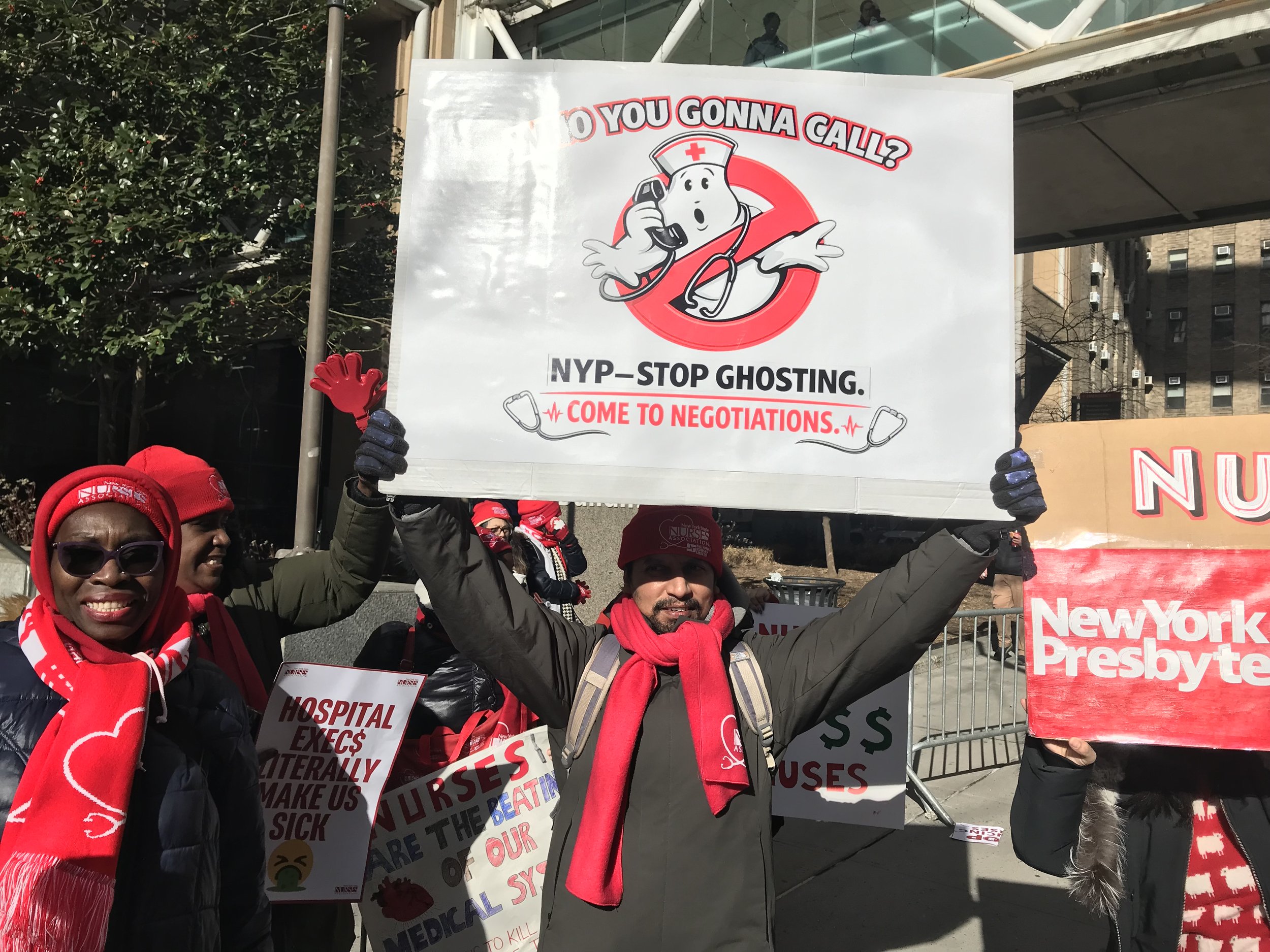
Striking nurses call on hospital bosses to get to the bargaining table. P
By Steve Wishnia
The hundreds of striking nurses picketing outside NewYork-Presbyterian Hospital January 12 were loud. Their chants, cheers, and shouts resounded under the three-level bridgeway connecting the hospital’s buildings. But they weren’t talking about money.
The three main reasons almost 15,000 New York State Nurses Association members went out on strike that morning, according to the union and various nurses, are inadequate staffing, trying to preserve their health care and pensions, and gaining protections against violence on the job. The walkout, at four of New York’s wealthiest private hospitals—NewYork-Presbyterian in Washington Heights, the Montefiore complex in the Bronx, and Mount Sinai Hospital and Mount Sinai Morningside and West in Manhattan—is the largest by nurses in the city’s history.
Tristan Castillo, an emergency-room nurse at Mount Sinai West on Tenth Avenue, says she and her coworkers have had to deal with as many as 14 or 15 patients at a time, when the optimum is one to four. Management is threatening to discontinue or drastically cut health benefits, according to the union, and nurses are more likely to be attacked on the job than police officers.
“Nurses have been punched in the mouth and lost teeth,” Sophie Boland, a nurse in NewYork-Presbyterian’s pediatric intensive-care unit and a member of NYSNA’s bargaining committee, told Work-Bites.
Management, meanwhile, accuses the union of being greedy. “Unfortunately, NYSNA decided to move forward with its strike while refusing to move on from its extreme economic demands, which we cannot agree to, but we are ready with 1,400 qualified and specialized nurses—and prepared to continue to provide safe patient care for as long as this strike lasts,” a Mount Sinai Hospital spokesperson said.
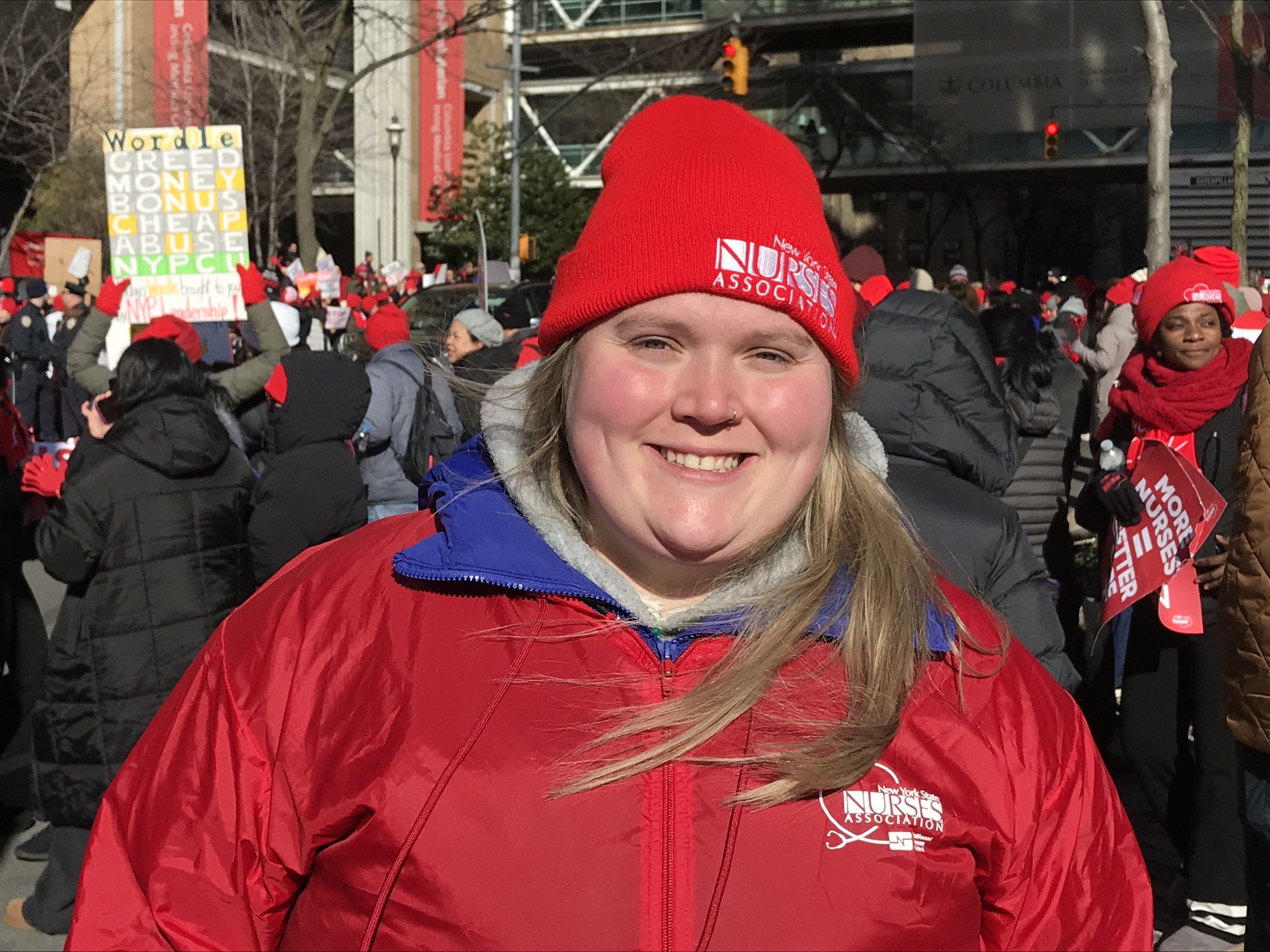
Sophie Boland, a nurse in NewYork-Presbyterian’s pediatric intensive-care unit and a member of NYSNA’s bargaining committee.
NYSNA charged that the hospital chains had “responded with retaliation, intimidation, and stalling, and flaunted the more than $100 million they’ve collectively spent on temporary replacement nurses.” The union has filed unfair labor practice charges with the National Labor Relations Board.
Mount Sinai claimed later in the afternoon that “we had close to 20 percent of our nurses come to work today.”
“The strike is not just about wages and benefits, but about who benefits from the health-care system,” Mayor Zohran Mamdani told reporters at NewYork-Presbyterian. “There is plenty of wealth in the health-care system.”
He noted that the hospital’s CEO, Steve Corwin made $26 million in 2024, while Montefiore’s Dr. Philip Ozuah got $16 million. According to NYSNA’s analysis of the three networks’ federal tax forms for nonprofits, the CEOs’ average compensation went up by more than 50% between 2020 and 2023.
Eleven other private hospitals, eight in the city and three on Long Island, reached tentative contract agreements with NYSNA during the 10 days after it issued its strike notice Jan. 2. They are mostly “safety-net hospitals” where a large percentage of patients are uninsured or on Medicaid. But, the union said, they “agreed to improve safe staffing, fully fund health benefits for nurses, protect nurses from workplace violence, and guarantee wage increases equitable with what nurses at the wealthy academic hospitals win.”
“The richest hospitals in the city did not,” NYSNA President Nancy Hagans said.
‘Completely disrespectful’
“All parties must return to the negotiating table and not leave,” Mamdani said, “and bargain in good faith.”
That is exactly what management has not been doing, nurses and the union say.
When bargaining began last August, management spent the first month refusing to meet in person, let union members watch as spectators, or meet in the hospitals’ facilities, Boland told Work-Bites. After NYSNA gave its 10-day notice, they didn’t come in for three days. On Jan 11, the last day before the deadline, a few dozen union members had been waiting since the morning, but management didn’t come in until 7 p.m., and stayed “not even an hour.”
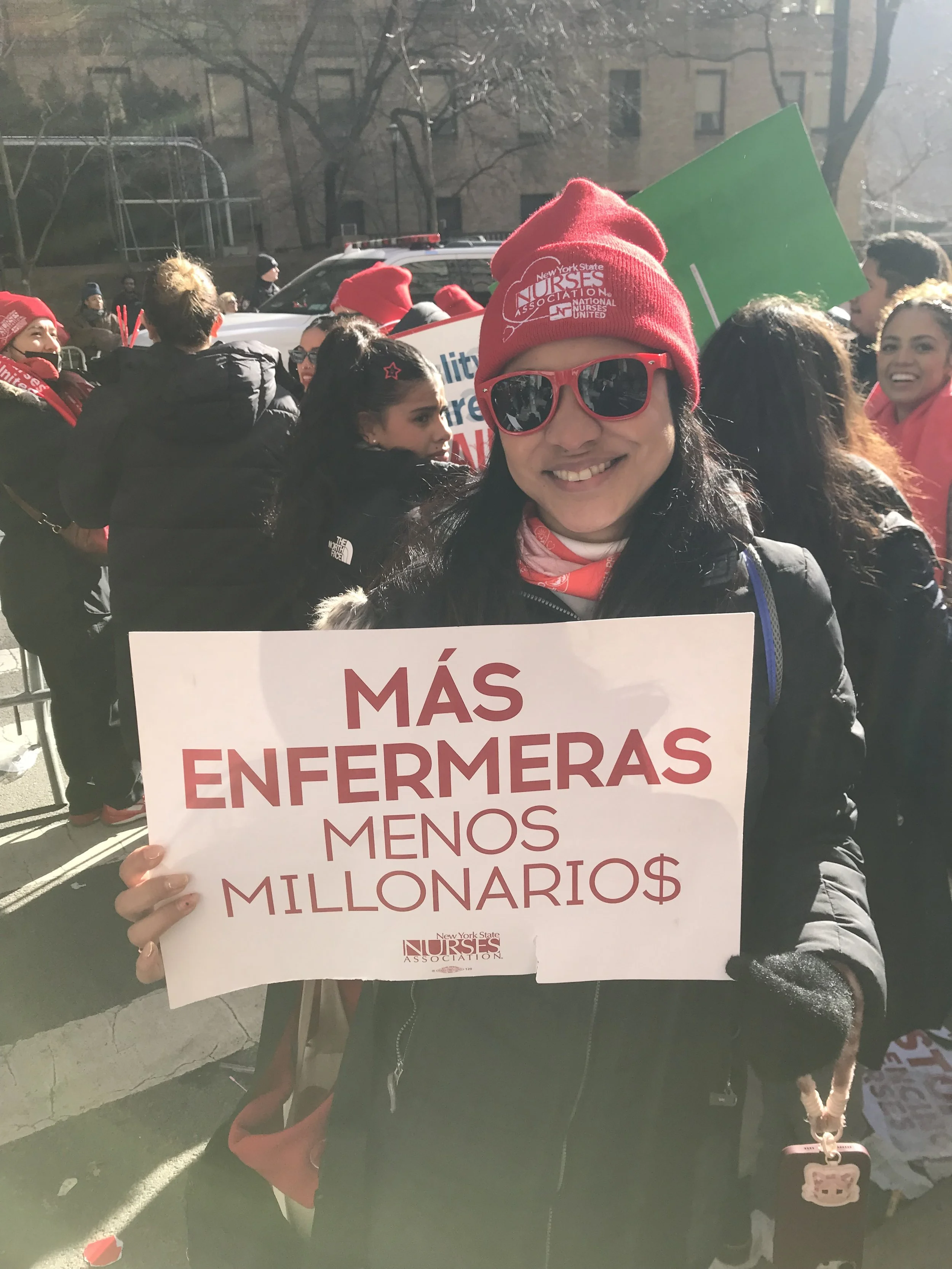
“More Nurses, Fewer Millionaires.”
“We gave them counterproposals. They came with no proposals,” Boland says. “It was completely disrespectful.”
Management has refused NYSNA’s proposal to continue nurses’ health insurance as is for the next three years, according to the union. They haven’t presented one of their own, but have threatened to either eliminate or drastically cut workers’ coverage, or to force workers to pay their own premiums.
“They’re holding it hostage,” says Castillo, a union delegate at Mount Sinai West. “They don’t want to budge.”
“It was clear even last week that they were finished bargaining,” NewYork-Presbyterian nurse Beth Loudin told the picketers and press. “They’ve decided for 44,000 nurses that we don’t deserve care.” If these hospitals canceled coverage, NYSNA says, it would also affect almost 27,000 nurses at other hospitals statewide who are enrolled in the union’s health benefit plan.
Loudin said she’d depended on her insurance to pay for the birth of her baby last year, and it also covers her husband, an immigrant.
“We’re exposed to illnesses every single day,” says Sarin Grey, an emergency-room nurse at Mount Sinai West.
Stiffed on Staffing
Nurses won staffing-ratio minimums in 2023 after a three-day strike at Montefiore and Mount Sinai. But in some units, “they put in the regulations, but they haven’t followed through,” says T.D., a veteran nurse in NewYork-Presbyterian’s wound-care unit.
The cardio-thoracic ICU was badly short-staffed for a year, enough for an arbitrator to award nurses back pay, says Boland. But management is appealing that ruling in the federal courts.
In the pediatric cardiac ICU, which treats “children from all over the world,” understaffing was “critical and severe.” The arbitration case there is still open after three years, she says. She calls management’s strategy “delay, delay, delay.”
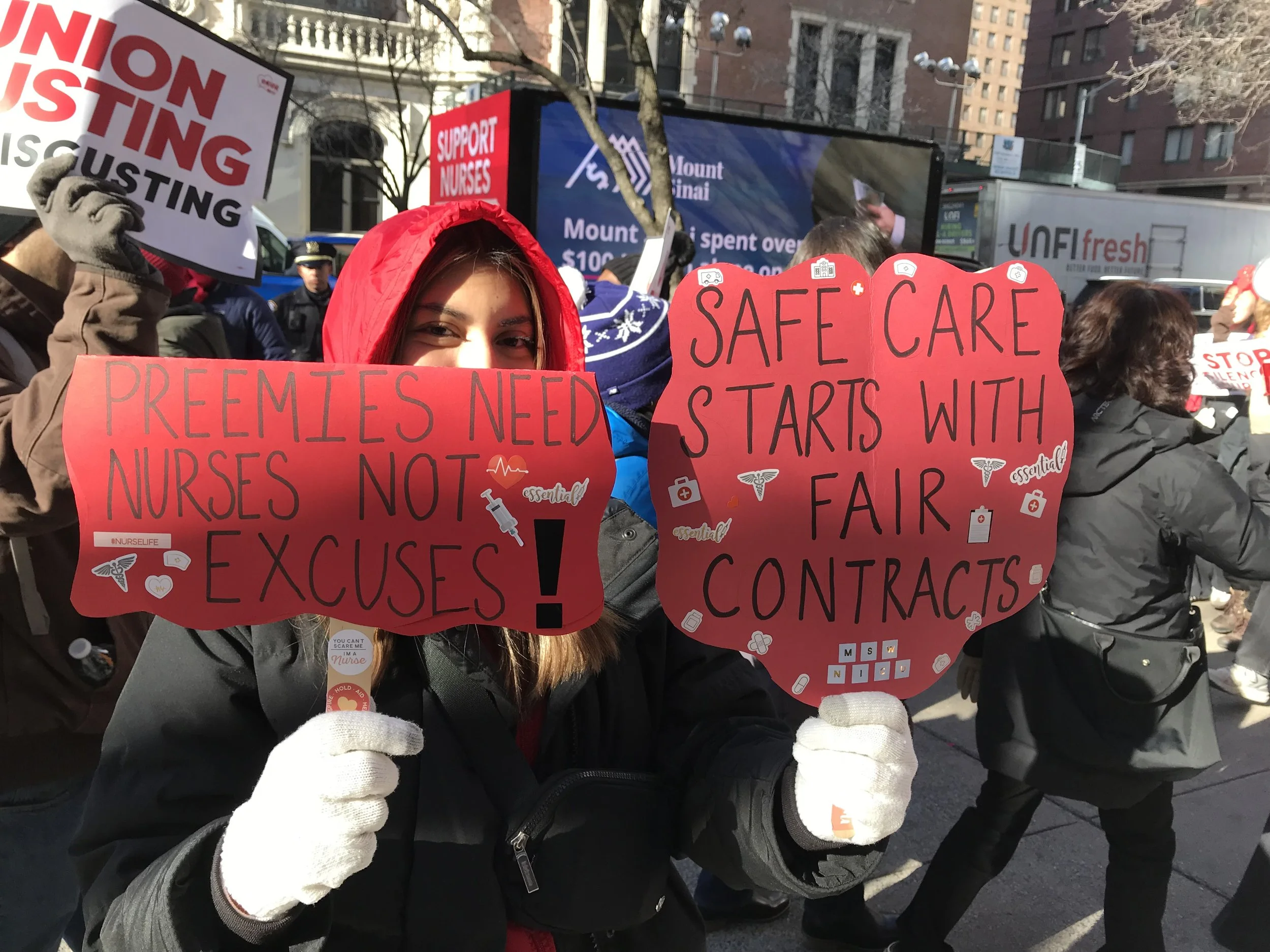
Some 15,000 New York City nurses went on strike on Jan. 12. and remain out at the time of this writing.
That also applied to protecting nurses from violence. Nurses in the pediatric emergency room asked to have a plexiglass shield put around the nursing station there after an assault. Management told them it was looking into sourcing the plexiglass, Boland says.
That was more than a year ago.
Management is also “actively union-busting, but sort of under the table,” Boland says. The method, she explains, has been to close down services that are not particularly lucrative and replace them with nonunion operations. NewYork-Presbyterian closed its pediatric-infusion unit, which treats children with autoimmune diseases and cancer, and now sends them to a nonunion facility in Westchester County. It closed the midwifery center, but then Columbia University, which is affiliated with the hospital, opened a nonunion one. And when it laid off 15 experienced nurse-practitioners last May, it replaced them with trainee doctors.
Mount Sinai West’s picket line was smaller, a couple hundred people orbiting inside a police barricade on the inner two-thirds of the sidewalk, but festive. They chanted “Who cares? We care!” while jangling small red bells, cheering as a passing ambulance blared its siren in solidarity, and dancing to a trio of guitar, drums, and Trinidadian steel pan.
Castillo says understaffing not only overwhelms nurses’ ability to do the medical-procedure part of their job, it deprives them of the moments of spare time when they can give patients a bit of personal caring, to alleviate their anxiety.
“We want our patients to feel confident and safe,” she says. “It makes all the difference.”