
Public Housing Tenants Again Sue to Stall Demolition; NYCHA Says Ousting Chelsea Elderly Is for ‘Greater Good’
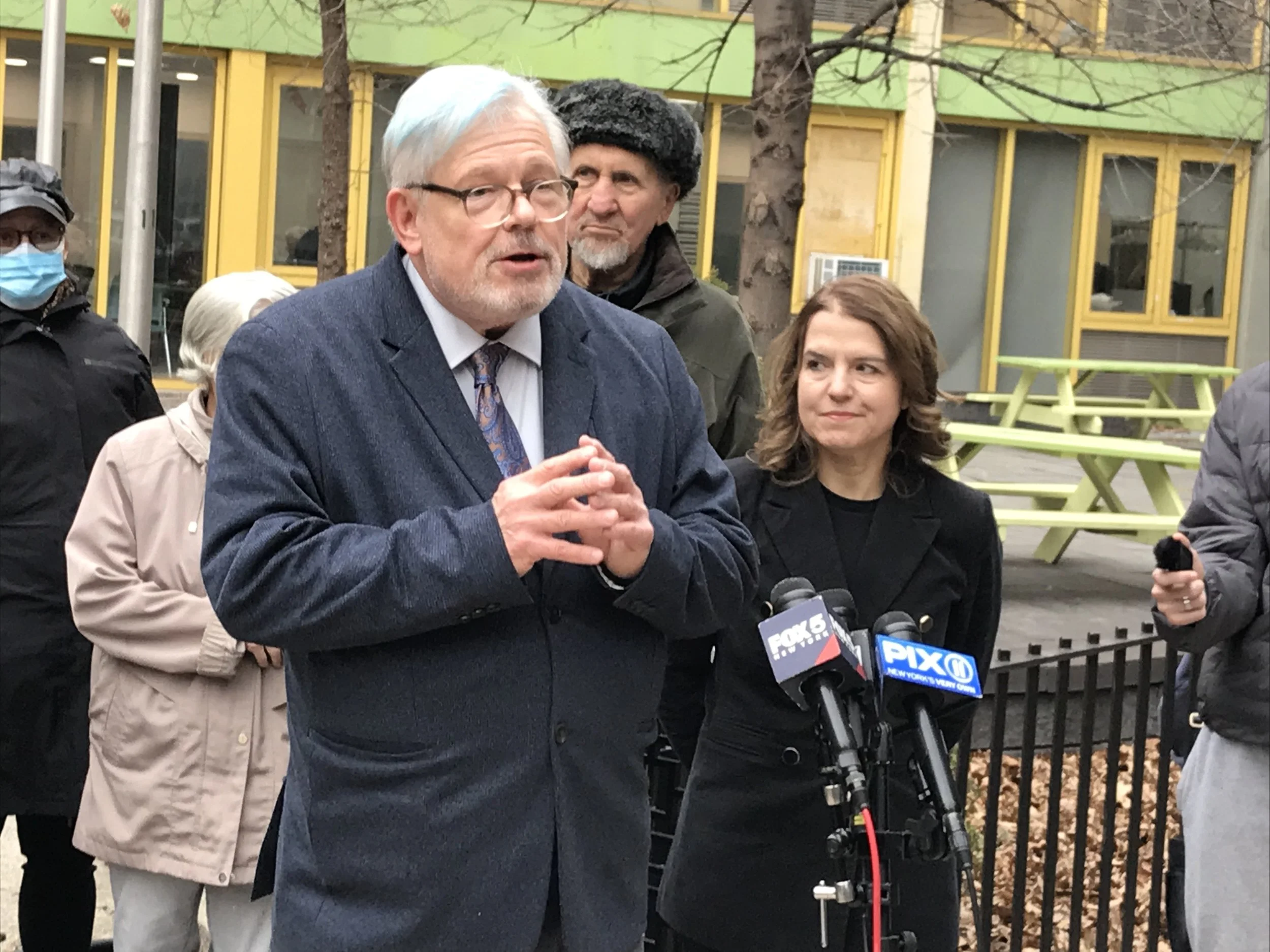
Former State Sen. Tom Duane said he was “heartened” that Mayor Mamdani had visited tenants of the notorious predatory-equity landlord Pinnacle on his first day in office, but added, “I would very much like Mayor Mamdani to come take a look at this.” Photos/Steve Wishnia
By Steve Wishnia
With the impending expiration of a stipulation that the New York City Housing Authority won’t begin demolishing two Chelsea public-housing developments, another tenant challenge to the plan is wending its way through the courts.
A lawsuit filed in late December by residents of the Fulton and Elliott-Chelsea Houses and Tom Duane, the neighborhood’s former state senator, argues that NYCHA’s plan violates the state’s Public Housing Law in several ways. The plan would convert the two developments into Section 8 housing run by a subsidiary of Hudson Yards developer the Related Companies, which, over the next 15 years, would tear down the buildings and replace them with a mix of new public-housing apartments, luxury units, and supposedly “affordable” housing. A Related subsidiary would collect rents and federal subsidies.
Specifically, the suit claims that the amendments added to the law in 2010 to enable NYCHA to receive private investment require that the developments must be managed “at all times” by a nonprofit “wholly owned” by NYCHA, and that they prohibit segregating low-income tenants in separate buildings and mandate letting tenants stay in their current apartments. It also argues that the plan is unlawful because it has not gone through the city’s Uniform Land Use Review Procedure (ULURP), which is required for major construction projects.
The plaintiffs are seeking a preliminary injunction halting the plan. But a Jan. 14 hearing on that in New York State Supreme Court focused mainly on technical issues, primarily whether the suit had been filed within the four-month deadline for an “Article 78” lawsuit challenging a state or local government administrative decision.
Elizabeth Knauer, the lawyer representing NYCHA, argued that the tenants had no justification to sue, because they’d filed too late and NYCHA’s plan was legal. The 2010 law’s limits on privatization, she said, were a one-time measure to obtain federal funds, and the project did not have to go through ULURP because it was not a “project.”
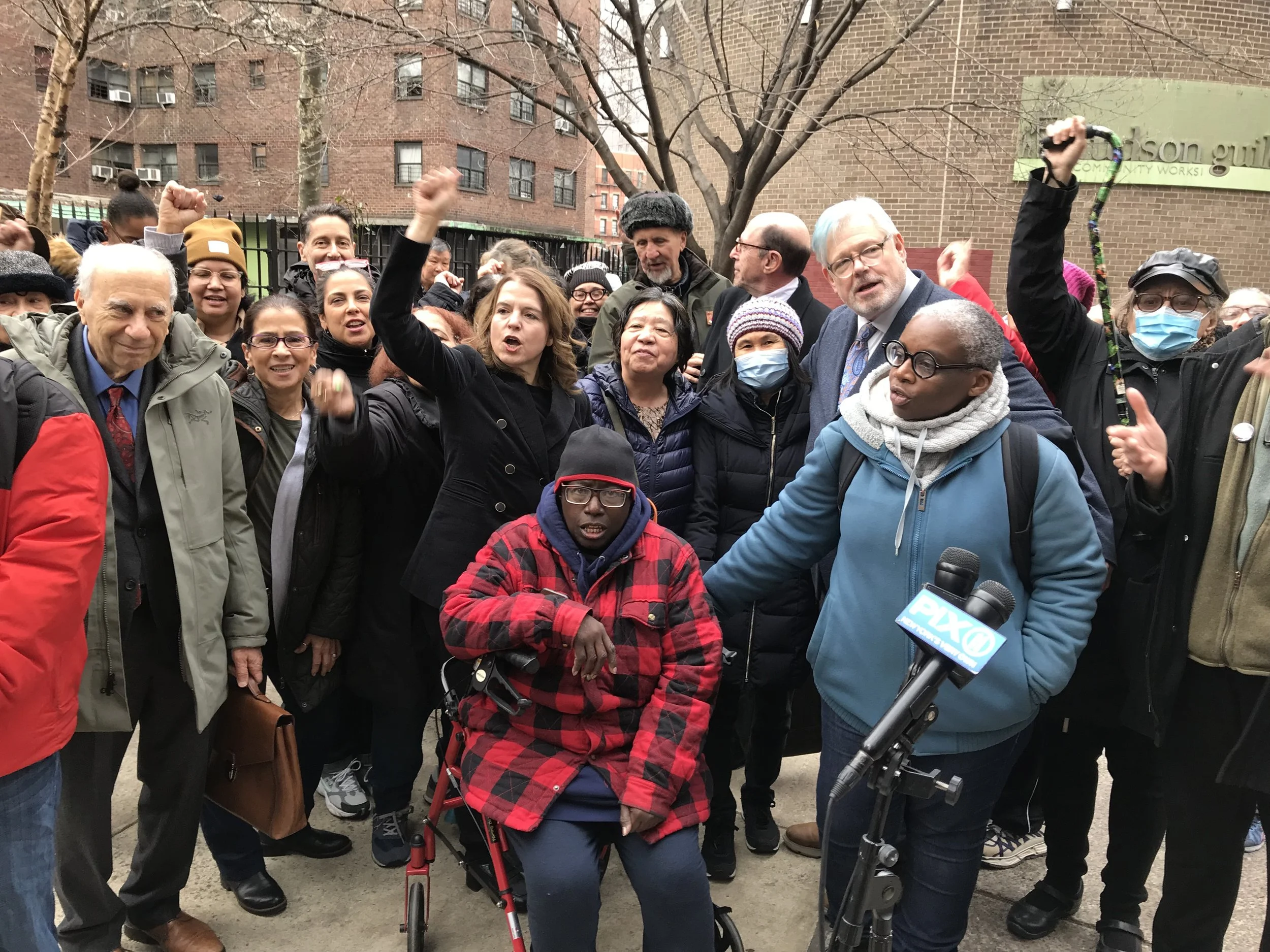
NYCHA tenants and supporters continuing to fight the privatization and demolition of the Fulton and Elliott-Chelsea Houses rally in Chelsea this week.
“Demolition and replacement,” converting “more smaller buildings to fewer large buildings,” she told the court, are “not a new plan or project.”
The plan would gradually demolish the 11 buildings in the Fulton Houses and eight in Elliott-Chelsea, relocating the more than 2,000 households living there into six new buildings as they are completed. Related would also construct 15 buildings of private housing. The first buildings torn down would be the Fulton 11 building and the Chelsea Addition senior building, with the 120 households living there shuffled into vacant apartments elsewhere in the developments before being moved into the new buildings.
Knauer told the court that there would be no “irreparable harm” to the elderly tenants being moved around. Ultimately, she said, the issue is the “greater good” of preserving public housing through private investment, not that a few individuals should be allowed to stay in their apartments.
John Low-Beer, the lawyer representing the tenants, argued that the plaintiffs had filed on time, because the “injury is occurring only now.” A temporary stipulation that NYCHA won’t begin demolishing Chelsea Addition ends Feb. 1.
Judge David B. Cohen asked him where funding to renovate the developments would come from if they were not privatized. Low-Beer said that a Pratt Institute study of 24 NYCHA developments that received private funds for repairs in the Rental Assistance Demonstration program found that 18 had remained under public management.
What happened to the other six, the judge asked. Low-Beer had to admit they’d been privatized.
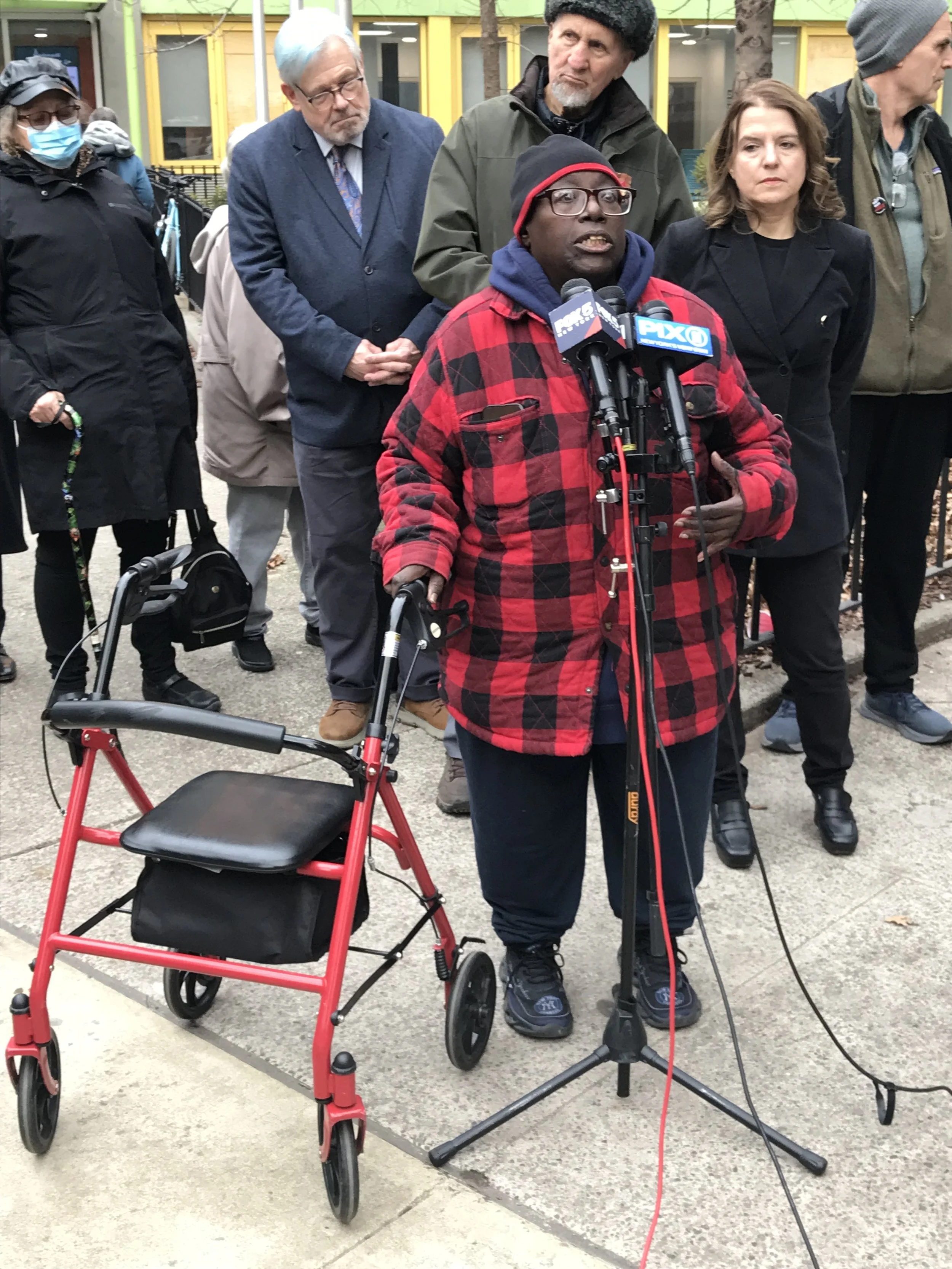
Chelsea Addition tenant Dorris Ruffin, 67 is fighting bone marrow cancer as she continues fighting for her home.
Cohen also asked why the court should stand in the way when the federal government seems to want to get out of the public-housing business and the developer is ready to rebuild. He also said that rehabilitating the buildings was no longer a viable option.
“That is the most disingenuous claim NYCHA has made,” Low-Beer responded.
Privatization: Segregation or Financial Necessity?
Low-Beer later told a rally and press conference outside the Chelsea Addition that the tenants had presented “strong legal claims,” but NYCHA was “placing technical legal obstacles in our way.”
Renee Keitt, head of the Elliott-Chelsea tenant association, called the plan the result of a “segregated process,” which would result in the development’s residents being “contained” in three high-rise buildings.
“You have made a choice,” she said. “The choice is that we are disposable. We are not.”
When Mayor Zohran Mamdani talks about renters, she added, “we need to be included.”
Duane called the NYCHA plan “a well-intentioned project that went off the tracks.” Originally, he said, it was intended only for rehabilitating the buildings, with Related’s proposal including some infill construction. “Related said ‘we can do it,’ but we’re getting demolition, eviction, and destruction.”
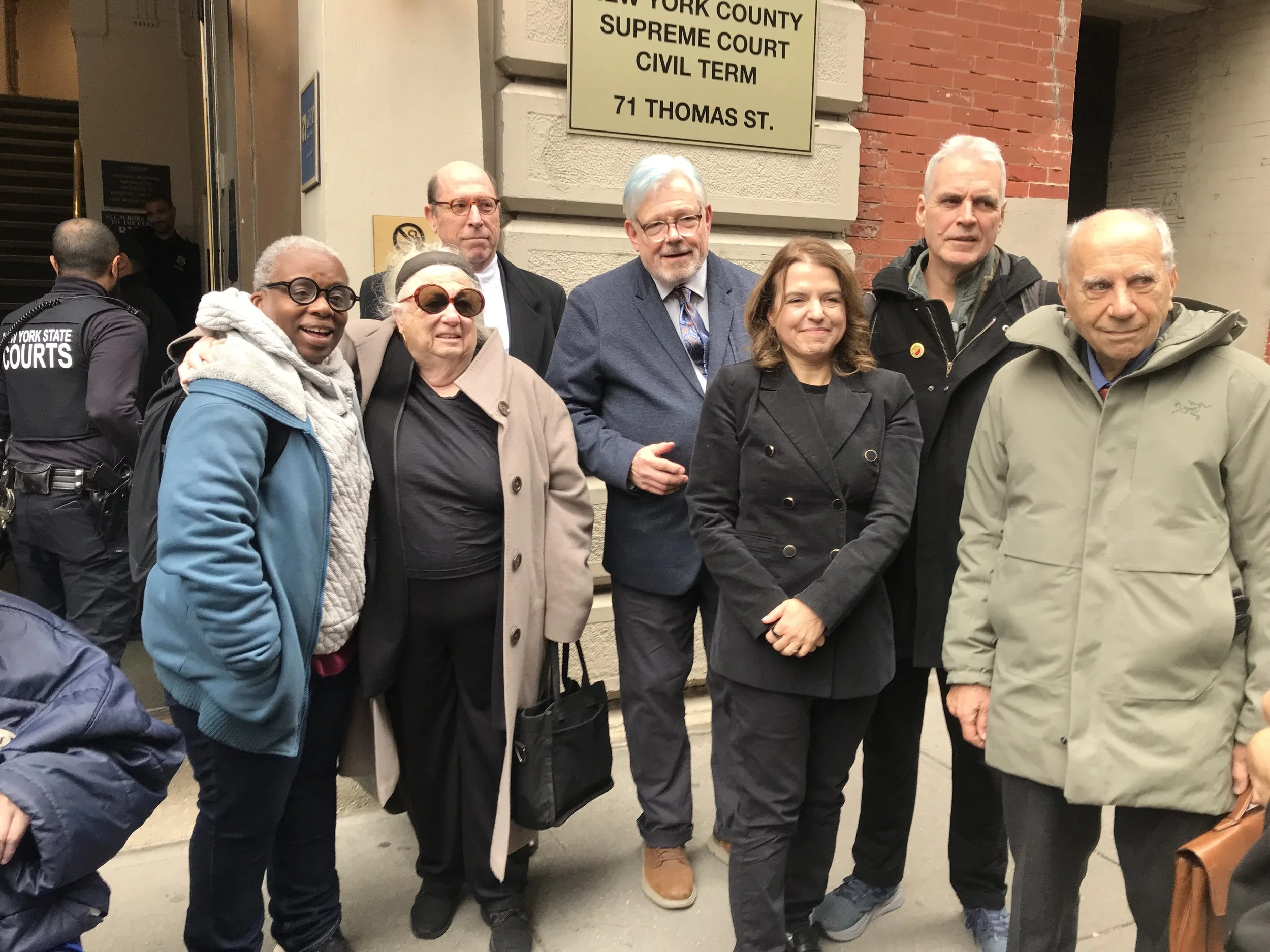
Elliott-Chelsea tenant leader Renee Keitt [left] joins Tom Duane [center], Layla Law-Gisiko, John Mudd, and John Low-Beer outside the courthouse.
NYCHA told the Community Service Society in November 2023 that after it had approved Related’s initial proposal, the company and its partners concluded that rehabilitating the buildings would cost more than twice as much as originally estimated.
“Related Companies is driving this, and NYCHA is eager to go along,” Chelsea Democratic district leader Layla Law-Gisiko told the gathering. She said NYCHA had estimated demolition and new construction would cost $2.4 billion, while rehabilitation would cost $1.5 billion and be completed “much faster.” The authority has not responded to her Freedom of Information Law requests to see the data behind those estimates, she added.
“The goal of the project is to not proceed with the cheapest option. It is to be receptive to residents who want a better quality of life and new buildings with fully functional and reliable mechanical systems and infrastructure,” NYCHA told Work-Bites.
With an estimated $80 billion needed for renovations “in the face of surging costs, mounting physical needs, and decades of federal disinvestment,” it said, changing the developments “from traditional public housing assistance to the more stable, federally funded Project-Based Section 8 program” will bring in “double NYCHA’s current federal subsidy.”
Section 8, a rent subsidy for tenants in privately owned buildings, pays the landlord the difference between 30% of the tenant’s income and the “fair market rent” for the area. For a studio apartment, that rent is currently $3,310 a month in Elliott-Chelsea and $3,560 in the Fulton Houses.
Harassment—and a Dream
Meanwhile, Keitt told Work-Bites, Related’s property manager, Related Affordable Management, is continuing “to do a full press” to try to get the remaining tenants out.
“People have come at all times of the morning and night, harassing me and knocking on my door,” said Chelsea Addition resident Doris Ruffin, 67, leaning on her red and black walker. She is being treated for myeloma, bone-marrow cancer, and undergoing dialysis because of failing kidneys, she added. In the relocation apartment she was offered, she said, “the kitchen is so small I can’t turn around. I can’t put my bed in the room.”
Duane said he was “heartened” that Mayor Mamdani had visited tenants of the notorious predatory-equity landlord Pinnacle on his first day in office, but added, “I would very much like Mayor Mamdani to come take a look at this.”
Both he and Keitt say that better management, accountability and oversight, would make public housing much more viable. In his experience as a City Councilmember representing Chelsea, Duane told Work-Bites, he saw the quality of individual managers made “all the difference in the world.”
The alternative to pushing people out for luxury housing, Keitt told the group, is to “dream big, like was done in 1934. That’s why we have public housing. Private developers will not do it.”
How would that be paid for, she was asked.
“One, pass the stock transfer tax,” she answered. “And stop giving money to developers. If you’re giving money to Hudson Yards, why aren’t you giving it to housing and hospitals? We are basically subsidizing a $70 billion company.”