
Editor’s Note: This is Part II of Phil’s first-person account of a truly unusual decertification fight that took place at a Brooks Brothers shirt factory located in Garland, North Carolina during the mid-1990s. Click here for Part I.
As we resumed our seats at the bargaining table, Hodges asked if we’d had a chance to review the company’s package.
“As much as possible within a short period of time,” I replied. “Where do you come off trying to eliminate seniority from the job bidding language? That’s at the heart of every union contract, including the other two Brooks Brothers plants.”
“We’re interested in having a meritocracy here,” responded the attorney. “Don’t you believe the most qualified person should be entitled to a job?” he asked with a contrived tone of surprise in his voice.
“And who defines most qualified? This just opens the door for favoritism and discrimination against union activists. It makes years of loyal service count for nothing. Your client needs to understand this: I’m not signing any contract without good seniority language. I’ll shut this fuckin’ place down before that happens.”
“Are you really so naïve that you think the union could outlast us in a strike, especially in this part of the country?” asked Matthew with a smirk.
“No, I’m not. But there’s other ways to shut down a company that don’t involve a strike. Soon you will learn about this…if you push your luck.
“There’s two other articles in your proposal I’d like to address at this time. We’re not interested in exchanging the pension for a 401(k) —”
“I’m shocked to hear you say that,” Hodges interrupted. “401(k)’s are the retirement vehicle of the future. They give employees a choice about how to invest their funds instead of leaving it up to strangers in New York. I thought the union was about freedom of choice for workers.”
“You know damn well why I’m taking this position. Workers have to partially fund their account and when it runs out in their old age, they’re left with nothing except Social Security. A defined benefit pension plan lasts for life. Your only interest in a 401(k) is that it’s a lot cheaper for the company.”
“You know damn well why I’m taking this position. Workers have to partially fund their account and when it runs out in their old age, they’re left with nothing except Social Security. A defined benefit pension plan lasts for life. Your only interest in a 401(k) is that it’s a lot cheaper for the company. You might have noticed we proposed an increase in company contributions to the union pension. But since you raised the subject, we amend our proposal to offer a voluntary 401(k) to complement the pension.”
“Why don’t we call it quits for today and set a new date,” said Matthew with irritation. “We don’t seem to be getting anywhere.”
“One more point. The union strongly rejects the notion of mandatory overtime being scheduled without notice at the end of a shift.”
“And what the hell are we supposed to do if a machine breakdown or some other problem causes production to fall short and we risk missing a customer’s deadline?” shouted Matthew, pivoting in his chair to face me.”
“And what the hell is a single mother with children in daycare supposed to do if she’s had no time to arrange for someone else to pick them up…leave them out in the street to fend for themselves?”
The next meeting was set for a week later on May 16.
I began the following day by writing a leaflet intended as a last-ditch effort to thwart the decertification drive:
WHAT DOES BROOKS BROTHERS REALLY WANT?
We all know management has been telling people how much better life would be without a union and has their patsy running around the plant with a petition. The union met with the company for the first round of negotiations and they proposed:
NO wage increases
NO more seniority
NO pension
NO notice required for mandatory overtime
This is what they really want or they wouldn’t have put it in writing. Management always gets whatever they want, unless there’s a union to stop them!
The leaflet included a cartoon drawn by my illustrator girlfriend, depicting Leslie trying to get a reluctant worker to sign her petition. One of the first steps in fighting a decertification is transforming the petitioner’s image from an authority figure into the object of ridicule.
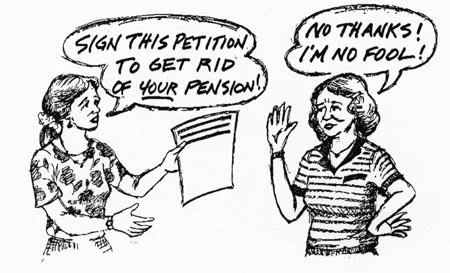
Patricia Ford’s illustration at it appeared in the union leaflet.
I also filed charges with Region 11 of the National Labor Relations Board [NLRB], alleging that Leslie was working as an agent of management in an illegal effort to decertify the union, workers were being threatened with plant closure if the union remained and enticed with false promises if it didn’t. While all of this was not only true but blatantly transparent, we currently didn’t have sufficient evidence to prove it to the Board’s satisfaction.
Unions are at a disadvantage when employer sponsored decertifications result in an election. Management interacts with workers daily and wields enormous influence through fear rather than loyalty. But during the Clinton administration, it was relatively easy for an experienced organizer to buy time for further investigation while building leverage on other fronts.
Filing charges of serious unfair labor practices was sufficient to halt an election while the Board interviewed witnesses on both sides. Following-up with a steady barrage of amended charges containing new allegations could extend the process indefinitely. As only management has the necessary skills to run a decertification campaign in a large factory populated by semi-literate workers, their subterfuge sets the stage for a game of dirty pool to be won by any means necessary.
“While Obama’s accomplishments should not to be overlooked, he was an Ivy League intellectual with little interest in workers’ rights or unions. But in 1995, time remained on our side if we used it well.”
The procedure became more challenging in 2014 when the Obama appointed Labor Board changed the rules, requiring unions to include a detailed offer of proof when filing charges under these circumstances, listing witnesses and a summary of their testimony, upon which to base a decision about promptly scheduling an election. While Obama’s accomplishments should not to be overlooked, he was an Ivy League intellectual with little interest in workers’ rights or unions. But in 1995, time remained on our side if we used it well.
The committee and I entered the conference room on the scheduled morning and found management already seated at the table. Hodges wasted no time getting down to business. “I’ve got a copy of the unfair labor practices you alleged to the Board last week. Aren’t you being a bit hasty filing charges this early in the process? We’ve come here to bargain in good faith ―”
“If you consider the booklet you handed out last week, and allowing an anti-union employee to run around the plant with a decert petition, to be acting in good faith, you’d better go back to law school.”
“Very well then,” Hodges continued. “What evidence do you have to support these allegations?”
“Do you think I just fell off the turnip truck and I’m gonna participate in a discussion of our case to help you conjure up a defense? If you want more information, I suggest you contact the agent in charge and see what, if anything, he’s prepared to reveal at this time.”
“To move these proceedings along then, we’re prepared to amend our position on wages and offer an hourly increase of ten cents to every employee with a clean disciplinary record over the past twelve months,” said the attorney, sliding a document with signature lines at the bottom across the table. “Perhaps you’d like to caucus with your committee to discuss our offer.”
“That won’t be necessary, but I commend you for having a sense of humor this early in the morning.”
“The trifling gesture was intended to deprive the union of an opportunity to expand its charges to include bargaining in bad faith. At this early stage of engagement, the Board considers even minute revisions to indicate that negotiations are underway.”
The trifling gesture was intended to deprive the union of an opportunity to expand its charges to include bargaining in bad faith. At this early stage of engagement, the Board considers even minute revisions to indicate that negotiations are underway. We spent the next several hours reiterating objections to each other’s proposals and then adjourned.
The counter-move for union reps at this juncture is to preempt the employer’s ability to declare impasse. When management can demonstrate to the Board that the parties are irrevocably deadlocked to the extent that further discussion would be futile, they are permitted to implement their last proposal. Hodges, who fancied himself clever, no doubt had this in mind. But impasse cannot be declared in the face of unanswered or debated information requests, necessary for the union to evaluate the company’s position.
The most serious problem in every clothing plant is ergonomics. Women hunched over sewing machines making small, fast repetitive motions for eight hours per shift, wear out cartilage and connective tissue in their hands and wrists, sometimes developing back injuries as well. I prepared a detailed document requesting:
OSHA 200 (accident and injury) logs for the past three years
Precise measurements of the distances involved in the layout of each work station, including placement of chairs relative to sewing machines and the movements necessary to reach for supplies
Documentation of all ergonomics training and evaluation during the past three years
The Material Safety Data Sheets for every chemical used at the plant
Whatever the company’s responses, they could remain the subject of ongoing discussion, in turn generating further information requests, for the next decade.
I received a brief letter from the NLRB notifying me that the decertification petition had been filed but the election would remain on hold pending investigation of unfair labor practices, and requesting the presentation of witnesses.
During that era, prior to the NLRB’s diminished status as a government agency, resulting in massive budget cuts, investigators often visited outlying communities located several hours from their office to take witness affidavits. Several days later I ushered a dozen workers into conference rooms at a local hotel to provide their testimony. Afterward the lead agent invited me into the hallway for a private discussion. “It’s very clear to me what’s going on here,” he said, “but we haven’t got enough solid evidence to convince the regional director and general counsel. I hope you’re able to find it.”
Bruce called over the weekend to ask how things were going with the charges. “We just presented our first group of witnesses and the lead agent is sympathetic,” I responded. “But this has been the most carefully managed decert campaign I’ve ever seen. Usually my best resource is the mistakes made by over-confident members of management. But this little pissant of an attorney has prepped them well. There’s no evidence of management being present while the petition was being circulated and they only coerced nonmembers into signing. I keep getting updated with new circumstantial evidence and hearsay reports about what supervisors said that I can use to amend the charge and drag this out, but as things look now, we’re not gonna win this fight at the Board.”
“Just keep on pitching and I’ll see what I can do in my end,” he told me.
The next bargaining session was set for a month later, based on claims of schedule conflicts by both Matthew and Hodges. That worked for me as my assignment was spread out across the state and most of Mary Ann’s shops were in the Charlotte area. An organizer was assigned to remain on the ground, continuing our investigation and maintaining morale.
Bruce called again at 11 p.m. during the last week in May. “Marks and Spencer owns a large warehouse in New Jersey to service its supermarkets. We’ve got organizers at the gate handing out leaflets. To be honest with you, we probed that operation last year and there isn’t a chance in hell we can organize it. But the company doesn’t know that. I’m waiting for my contact at the corporate office to reach out and ask what it will take to make this go away. Hopefully, the new owners will speak with the plant manager in Garland and twist his arm to get the petition withdrawn and then negotiate a decent contract. Until then, just keep up the pressure any way you can.”
The parties reconvened on June 13. Before greetings had even been exchanged, Matthew burst into a tirade about the growing volume of information requests. “Do you know how much of my valuable work time you’re cutting into? You know we take pride in running a safe workplace!”
“Then prove it by starting with the OSHA 200 logs. You’re way overdue and those won’t take long to assemble.”
We occupied the rest of the session talking in circles, arguing about minutia in contract language with no movement on economics. The existing contract was set to expire in several days and as the meeting ended, Hodges surprised me by presenting a short memorandum extending the agreement for another month. I assumed my comments about ways to shut down a plant without a strike had given pause to the attorney and his client. I signed the document which simplified matters for the union as well.
I bid the committee good evening as management departed, then leaned back in a comfortable lounge chair off to the side in the conference room. Feeling utterly drained, I extended my legs and slouched at a forty-five degree angle in my blue pinstripe suit, closing my eyes while trying to summon enough energy for the drive home.
I was suddenly disturbed by Matthew’s voice addressing me with an authoritative tone. “We’ve booked a private conference room on the fifth floor and you’re going to come with us now so we can cut a deal.” I opened my eyes and saw Hodges standing beside him as they towered over me.
“Not interested,” I replied through the fog of exhaustion. “This gets negotiated across the table.”
“Not acceptable!” Matthew barked. “We’ve been playing games long enough! Come with us now because we intend to cut a deal tonight!”
I momentarily felt vulnerable, caught off-guard by the imposing plant manager as I reclined on the verge of sleep. His timing couldn’t have been more precise. But reassembling my wits, I realized there was nothing he could do about my refusal. He wasn’t stupid enough to put his hands on me, despite body language to the contrary.
“I’m not interested. Call me to discuss another date.”
“The date is now! We make a deal tonight, even if it takes until dawn.”
“Who the fuck do you think you are, shouting orders at me?” I said, sitting up straight and willing the fatigue out of my composure.
“How about I put in a call to Bruce Raynor right now? How would you feel about that, eh?”
“I think it’s an excellent idea. Do it. You’re wasting my time.”
My two antagonists turned their backs and exited the room. During the drive home I figured the corporate office must have spoken with Matthew who now realized that getting me to sign a lousy agreement which would further divide the local and fuel the decert was his one remaining option.
Ten days later, I received a call from the NLRB informing me that the petition had been withdrawn. The plant was closed during July 4th week and negotiations resumed on July 11.
The meeting was surprisingly cordial considering what we’d been through the past couple of months, as if the rewind button had been hit and the process was starting anew. By noon management had withdrawn all of its concessionary proposals and after lunch, economic bargaining became serious. There was still ground to cover at 5 p.m. and the parties agreed to break for dinner and then continue. Shortly before midnight a tentative agreement was reached that included:
An annual 40 cent hourly raise, retroactive to the original contract expiration
An increase in the employer’s pension contribution
A decrease in workers’ share of health insurance premiums
Joint engineering and ergonomic studies
The settlement was unanimously ratified by union members two days later.
The next month, Leslie was fired. She was of no further use to management and privy to all their dirty secrets: a fate common among anti-union ringleaders, following a failed decertification attempt.
Phil Cohen spent 30 years in the field as Special Projects Coordinator for Workers United/SEIU, and specialized in defeating professional union busters. He’s the author of Fighting Union Busters in a Carolina Carpet Mill and The Jackson Project: War in the American Workplace.