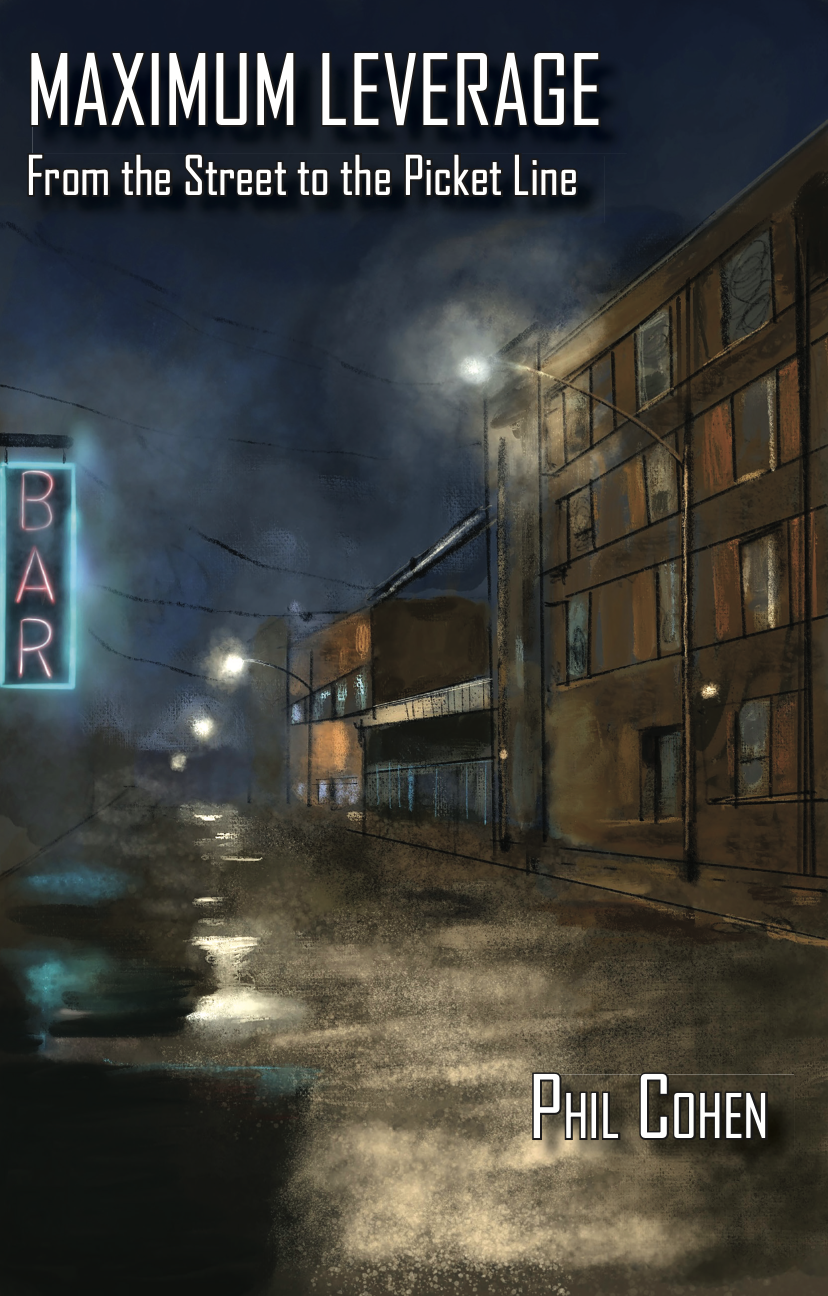
Phil Cohen’s Maximum Leverage: From the Streets to the Picket Line is out now from Hard Ball Press.
By Joe Maniscalco
It’s just after 9 p.m. in the fall of 1992 and union organizer Phil Cohen is inside a dingy cement-block building in Cornelius, North Carolina wondering if he’s quick enough to pull the .38 special in his shoulder holster before the two irate Klansmen in front of him start shooting.
The pulse-pounding vignette is just one of many harrowing encounters Cohen recounts in Maximum Leverage: From the Streets to the Picket line—the legendary labor organizer’s ultra-gritty new memoir from Hard Ball Press.
“As the engagement spiraled downhill, I noted Buddy’s hand twitching within a thigh pocket of his hunting trousers,” Cohen writes. “Lloyd and James both had one hand resting on their hip beneath an open jacket. I was carrying a .38 special in a shoulder holster, taking in the room to see whose hand would move first. Time slowed and began unfolding in freeze frames.”
Cohen spent 30 years in the field as Special Projects Coordinator for Workers United/SEIU specializing in, but not limited to, beating back union-busters in the Deep South. Back in ’92 the union had dispatched Cohen to break the KKK’s stranglehold on Local 2500 in Cornelius, North Carolina and do an internal rebuild.
He pulled it off and did just that.
Other high-stake assignments saw Cohen parachuting into all manner of strikes, walkouts, shutdowns, decertification drives, and more—each time managing to come out victorious, if not a little bit worse for wear.
“I’m here for one reason,” he tells a group of textile workers in a chapter devoted to a particularly hostile contract dispute in Allentown, Pennsylvania, “and that’s to fight.”

Phil Cohen, author, Maximum Leverage: From the Streets to the Picket Line
The upcoming battle with management will be a roller coaster ride, Cohen then tells the squeezed textile workers. “You’ll have to hold on tight and keep your wits about you. Always expect the unexpected because it will come out of nowhere and hit us in the face,” he declares.
That also just happens to be an extremely apt way to describe all of the events that unfold inside Maximum Leverage’s pages. In Cohen’s hands readers not only get the anatomy of the aforementioned labor battles broken down in forensic detail—including the strategies employed to win them—you get the blood, sweat, and tears, too.
Maximum Leverage drops readers directly onto the shop floor, arms locked with fellow hard-pressed workers, uniformed goon squads closing in fast, and never retreats.
“The art of defeating hostile employers involves attacking on multiple fronts simultaneously, in ways they least expect, until executives come to feel like medieval lords trapped in a castle, surrounded by Vikings at every gate,” Cohen observes.
Maximum Leverage’s significance to the current crop of labor organizers couldn’t be more apparent. This is a book to inspire, animate, and inform.
But Maximum Leverage’s relevance and appeal extends far beyond the confines of today’s labor movement and the many challenges facing trade unionists and unorganized workers alike across the country.
As the movie posters for Martin Scorsese’s 2002 Gangs of New York movie famously declared—“America was born in the Streets.” And that’s exactly where Cohen's riveting new memoir is birthed, too.
Maximum Leverage opens far from that remote field in Cornelius, North Carolina directly on the streets of New York City. It’s the early 1970s and the stories Cohen has to tell about his days as teenaged gypsy cab driver trying scratch out a living pack all the wallop of another Scorsese gem depicting the same era—Mean Streets.
Unlike the movies, however, Cohen’s chronicles set against one of the wildest eras in the annals of New York City history are all true to life. They actually happened, and Cohen is somehow still here to tell the tale.
“I pulled the door shut and executed the most remarkable driving maneuver in the history of New York,” Cohen relates in one of Maximum Leverage’s many remarkable passages. “I backed up through a red light, jammed the car into forward, and ran the light again, making a hard left from the far right lane onto 52nd Street, as one of the drivers put his fist through my side view mirror.”
There’s an aspect to that particular hair-raising episode and Cohen’s many other escapades behind the wheel that end up making them just as profound as they are entertaining. As Cohen notes, they all contributed to the kind of labor organizer he would one day become.
“I always had an instinct for survival and playing the system, sometimes using it to keep other street kids alive or out of prison,” he says in the prologue to Maximum Leverage. “I never imagined that one day these qualities would evolve into a career in the labor movement that inspired thousands of people and changed their lives.”
Maximum Leverage brings the lives and struggles of many of those hardworking people into vivid and unforgettable relief. Whether you’re in a union or not, this is one helluva ride from start to finish, and one you don’t want to miss.
Get your copy of Phil Cohen’s Maximum Leverage: From the Streets to the Picket Line here.