
Memo to Mamdani: ‘Affordable’ Housing Costs Too Much for Most People in Harlem
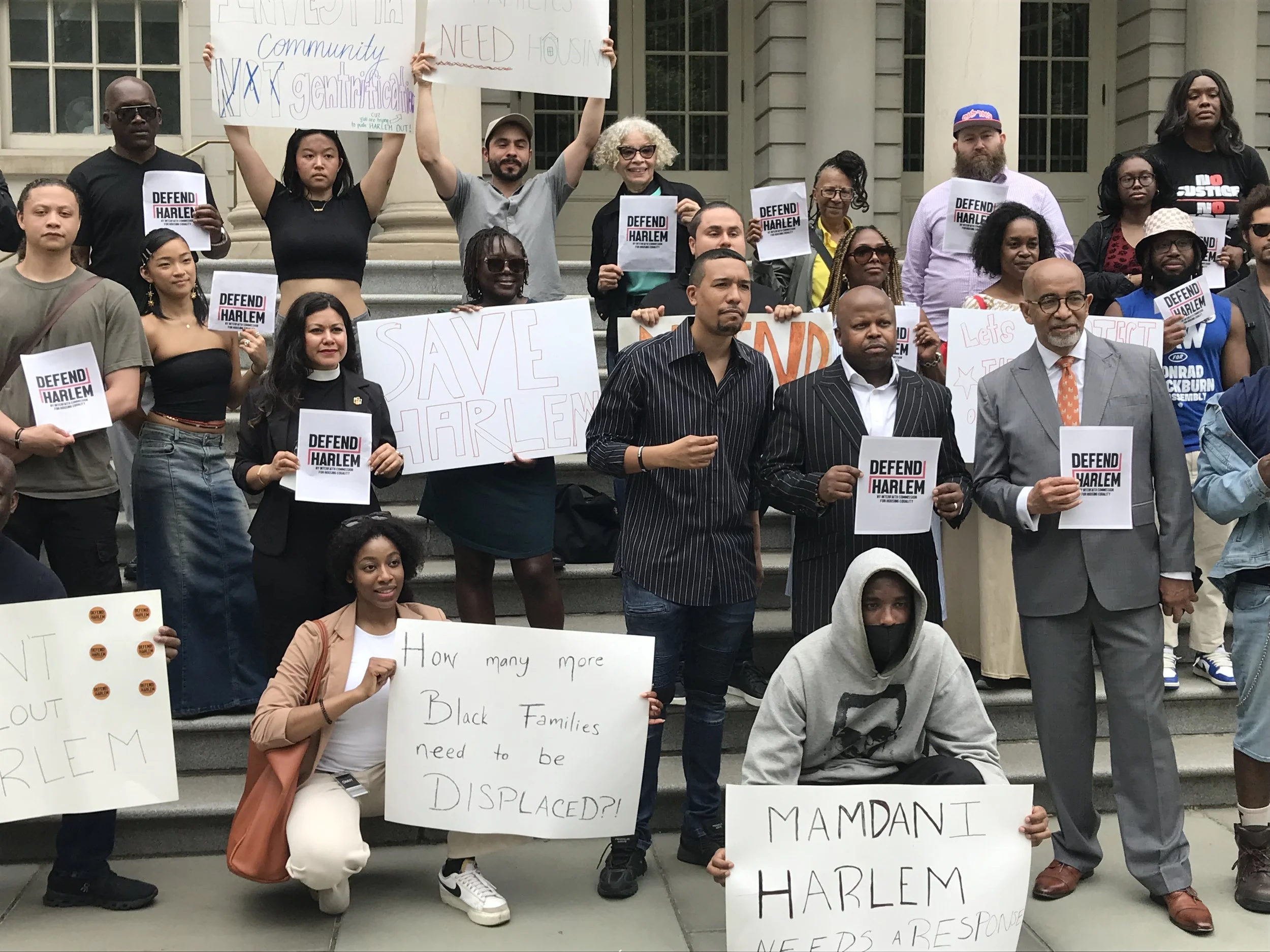
“Mamdani, Harlem Needs a Response”: Community activists assembled on the steps of City Hall this week are hoping for a meeting with Mayor Zohran Mamdani to talk about truly affordable housing. Photos/ Steve Wishnia
By Steve Wishnia
Saying that a 1,000-unit Harlem development approved by the City Council last year does not include housing neighborhood residents can actually afford, about 25 people rallied on the steps of City Hall May 27 to demand that the city require it to include 400 apartments for working-class people.
The 1.5 million New Yorkers who make $35,000 to $65,000 a year are not included in this kind of housing, the Rev. Dedrick Blue, chair of the New York Interfaith Commission on Housing Equity, told the group. “We want to protect the nurses’ aides, the restaurant workers, the Uber drivers,” he told the group.
The three buildings in the One45 development at West 145thStreet and Lenox Avenue, approved unanimously by the Council on July 14, 2025, are slated to contain 338 “affordable” apartments, based on percentages of the area median income (AMI) for the city and its northern suburbs. There would be 90 units of senior housing for people who make around 50% of AMI ($59,400 for a single person, $67,850 for a couple); 126 units for households around 60% of AMI ($71,280 for one person, $101,760 for a family of four); and 122 units at 80% of AMI ($95,040 for one person, $135,680 for a family of four).
The median household income for Central Harlem, the rally’s organizers emphasized, is $50,830, according to estimates by New York University’s Furman Center from 2023.
“We want true affordability. Putting up this project with no true affordability is like pouring gasoline on a fire that’s already burning in Harlem.”
“We want true affordability,” said Rev. Greg Merriweather, pastor of Mount Olivet Baptist Church. “Putting up this project with no true affordability is like pouring gasoline on a fire that’s already burning in Harlem.”
The neighborhood median income also does not show the gap between longtime residents, predominantly Afro-American and generally poorer, and newcomers, mostly white and more affluent.
Given the neighborhood’s experiences with urban renewal in the 20th century and gentrification in the 21st, Rev. Merriweather told the rally, residents’ fear of being pushed out is “not based on hypotheticals. It’s based on history.”
Despite the Council’s go-ahead, construction has not yet started. One delay came when the Rev. Al Sharpton’s National Action Network did not agree to leave its headquarters, on the 145thStreet side of the site, until after it received an eviction notice in January.
Developer Bruce Teitelbaum told The Real Deal, a real-estate trade publication, in February that he would be willing to increase both the unit counts and the share of affordable apartments, but that he would need public subsidies to do that.
Teitelbaum had cancelled a previous development proposal in the face of opposition from then-Councilmember Kristin Richardson Jordan, who’d demanded that more than half the apartments be reserved for households making less than 30% of AMI. Teitelbaum ran the property as a truck parking lot for a few years until Councilmember Yusuf Salaam sponsored the rezoning needed to go through with the current plan.
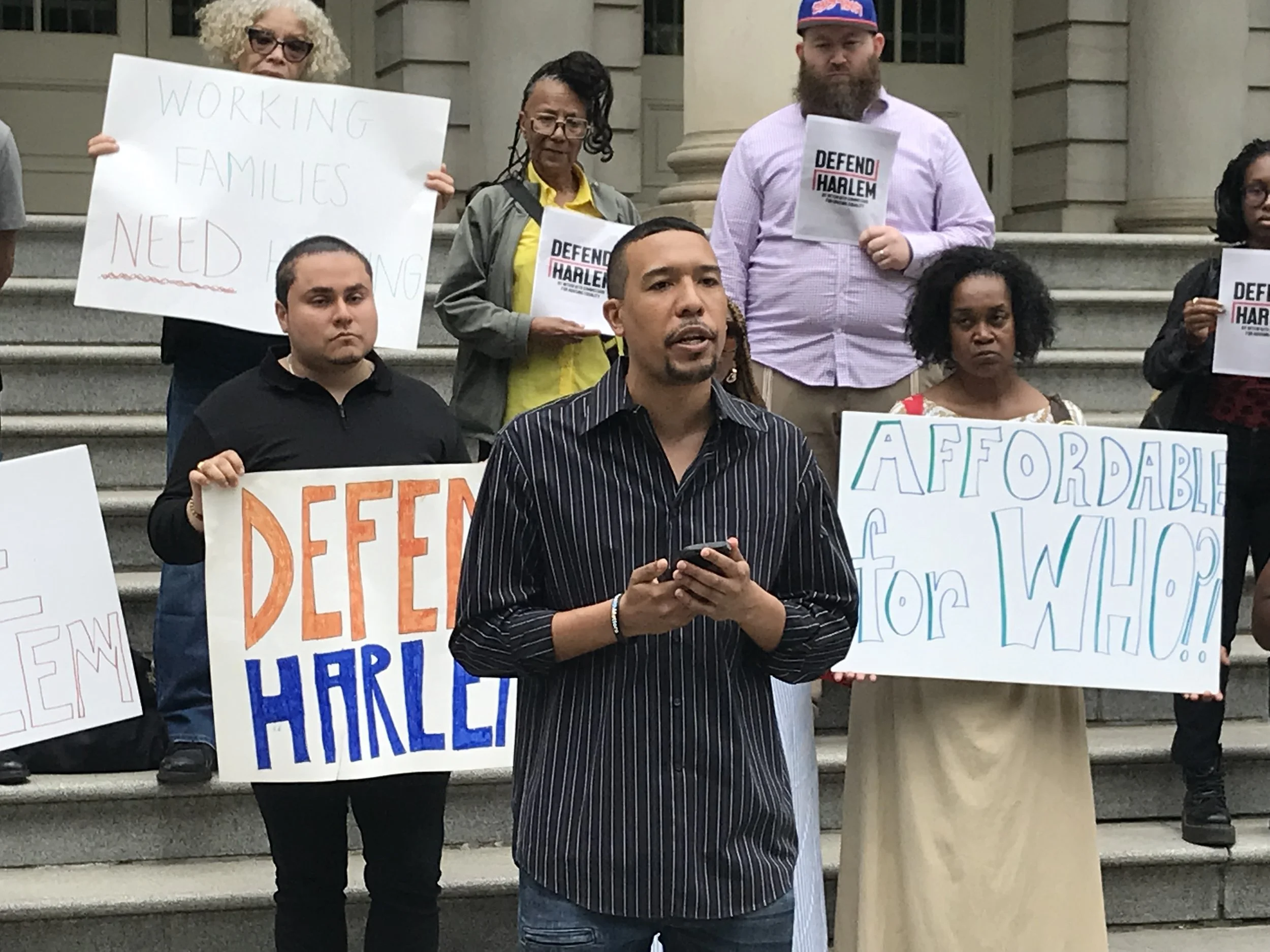
Kai Cogsville of the Defend Harlem campaign calls on Mayor Zohran Mamdani to include subsidies for the One45 housing development.
For the last few decades, especially since Mayor Bill de Blasio’s administration, the city’s main method of creating so-called “affordable” housing—more accurately, “below market rate” housing—has been to use zoning and subsidies to leverage trickle-down from luxury development. But as developers want and need to make a profit, producing housing that people who make less than 60% of AMI under that method is next to impossible without significant subsidies to make up for the lower rents, according to officials in previous mayoral administrations and nonprofit groups involved with housing.
The rally’s organizers have pinned their hopes on persuading Mayor Zohran Mamdani to offer subsidies, as part of his announced desire to create 200,000 new apartments for people who make less than $70,000.
“We are simply asking Mayor Mamdani to include One45 in that,” Kai Cogsville of the Defend Harlem campaign told the rally.
The mayor’s proposed wealth tax would be “where you get the money for it,” he told Work-Bites afterwards.
On the other hand, Rev. Blue said he’s been unable to get a meeting with Mamdani, even though he’d served on the mayor’s transition team for housing.
Still, participants saw the mayor as an ally, not an obstacle. “I voted for him,” said Rev. Mira Sawlani of Riverside Church. “It seems like Mayor Mamdani wants to fight this battle with us,” said Conrad Blackburn, a socialist and union public defender who is challenging incumbent Assemblymember Jordan Wright for the Democratic nomination in the 70thDistrict, which covers most of central Harlem.
Neither the mayor’s press office nor Councilmember Salaam’s office responded to requests for comment from Work-Bites.
Other solutions?
Mayor Mamdani’s “Block By Block Report” on housing policy, released May 26, offers relatively limited proposals for building genuinely affordable rental housing. It says the city will appropriate enough money over the next two years to subsidize 16,000 units of housing for people making less than 50% of AMI, with more than half of those earmarked as “extremely low-income”—$34,000 for a single adult to $48,000 for a family of four. It also wants to increase funding for supportive housing and find ways to attract new investment.
Housing affordability is “a major crisis in our country,” said Rev. Blue. But with a 1998 federal law prohibiting local governments from building more public housing than they already have, and aid not forthcoming from the Trump regime, “states have to take the lead.”
Conrad Blackburn wants to increase community ownership, through measures such as community land trusts and the proposed Tenant Opportunity to Purchase Act, which would give tenants the first chance to buy their building if it is put up for sale. “Either the government steps in or we empower the community,” he said.
Blackburn is most enthusiastic about plans to create a state social-housing authority, which would develop housing outside the market, such as nonprofit co-ops like Electchester in eastern Queens and Penn South in Chelsea. “I really believe that is the way forward,” he said.
There is one obstacle to that, however, said Blue, who formerly worked with Harlem Congregations for Community Improvement (HCCI), which, since its founding in 1986, has developed more than 3,000 units of affordable housing.
“Where do you find the property?” he asked.
Land in the city was much more available and cheaper in the 1945-1975 era, which saw hundreds of thousands of units built in public housing, nonprofit co-ops, and the state’s Mitchell-Lama program.