
Will Mayor Mamdani Rescue New York City EMTs and Paramedics?

Ballooning response times are putting both the public and FDNY EMS first-responders in jeopardy. Photo courtesy of Vecteezy.com.
By Joe Maniscalco
New York City is in contract negotiations with FDNY EMS unions, and if that sounds boring or hum-drum it’s only because City Hall wants it to appear that way. In reality, the talks represent a golden opportunity for the Mamdani administration to distinguish itself from preceding ones and do what previous mayors have spectacularly failed to do in the past—rescue FDNY EMS before it’s too late.
FDNY EMS is in crisis, and it has been for a long while. But response times are now approaching 11 minutes and 30 seconds; retention rates are in the toilet; and city EMTs and paramedics unable to sustain themselves while attempting to save lives are rapidly breaking down, or leaving.
“I hear from members who are literally one paycheck away from losing their homes or apartments,” Lt. Alicia Elkadi recently told Work-Bites. “I had a member working in the Bronx who was suicidal and struggling to survive—to wake up [each day]. But we’re so short-staffed, I’m telling him—listen, I need you to log onto an ambulance.”
Studies have long determined that EMS providers have higher rates of suicide than the general public—and those figures are widely regarded as underreported. At least fourteen FDNY EMS personnel have succumbed to suicide since 2020.
Elkadi is an increasing rarity among FDNY EMS’ ranks—a veteran first-responder with 20-years on the job. Most of her younger colleagues leave after just five years on the job because of the inadequate pay and super-human demands.
“The only reason I am still at this job is because I am in a dual income household,” the married mother of two said. “I can only do it because of my husband’s salary who is also a first-responder—he has 22 years on the job with the NYPD almost tripling my paycheck.”
Take a look at that dynamic closely and it’s easy to see it as a microcosm of the larger struggle for pay parity FDNY EMS first-responders have been waging for the last 30 years.
“Does it make me feel a bit inadequate? Of course,” Elkadi said. “You want to be able to be an equal to your spouse in helping with the bills. I’m definitely not there—and I hold rank. I’m a supervisor. My husband isn’t—and he still demolishes my paycheck.”
Roughly speaking, FDNY EMS first-responders can expect to earn somewhere between $59,000 to $86,000 after five years on the job. Contrast those numbers to the solidly six-figure salaries both cops and firefighters command over the same time period.
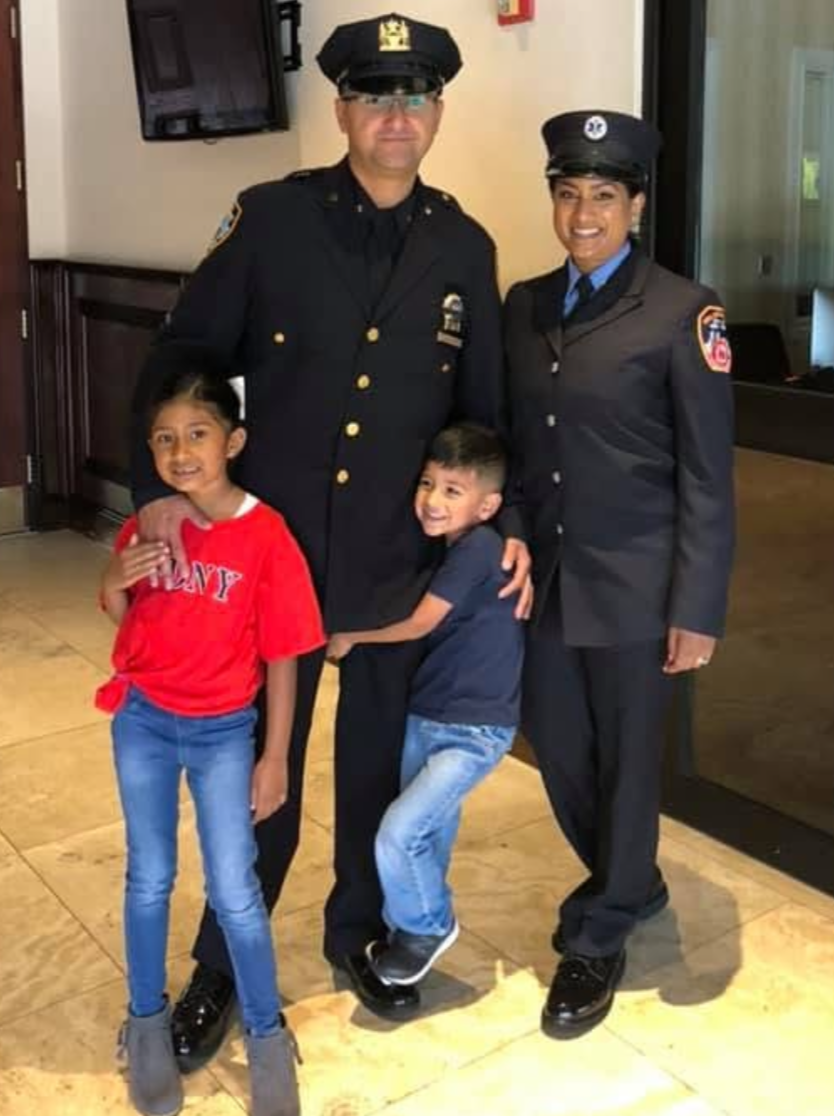
Lieutenant Alicia Elkadi shares a special moment with her family.
Optics and the public’s lingering misconceptions about what EMTs and paramedics actually do on a daily basis play a significant role in the ongoing disparity, according to Elkadi.
Shootouts and explosions play out on the public stage in dramatic fashion— much more so than the unfortunate office worker who suffers a cardiac arrest at their desk.
“We’re not working on the patient in the middle of the street unless we have to,” Elkadi said. “One of the things we do right away is get the patient into the ambulance where we provide everything the Emergency Room would do for a cardiac arrest. We’re not doing this out in the open. People don’t realize that—people are under the impression that we are just ambulance drivers, that all we do is drive the patients to the hospital. We do so much more than that.”
When the stars align and technical expertise and know-how are enough, EMTs and paramedics save lives. Those are the good days. But the days are not always good and call volumes have grown impossibly heavy.
Earlier this week, retired FDNY EMS Local 2507 President Oren Barzilay reported that the department and its participating partners have so far responded to more than 1 million medical calls this year alone.
Council Member Joann Ariola [R-32nd District] also introduced new legislation this week that would require the city to start sending out special alerts when FDNY EMS is experiencing delays due to high call volumes.
“If there are dozens of emergency calls sitting in a queue because there simply aren’t enough ambulances available to answer them, New Yorkers have a right to know,” she told the Queens Daily Eagle.
That legislation, of course, would do nothing to assuage the mental and emotional anguish now afflicting hard-pressed New York City EMTs and paramedics.
“We know cell damage in the brain occurs within four to six minutes—and we’re doubling and tripling that time to get there,” Elkadi said. “That sucks, that’s a lot for us to take in and live with ourselves. But within a few minutes we have to clear it out of our heads and go on to the next job—and then do it again. The call volume is so high that we don’t have a moment to take in the horror the we see on a daily basis.”
It’s the reason, the highly decorated lieutenant also said, why the suicide rate for FDNY EMS first-responders is so high, “why our divorce rate is so high,” and “why we’re overweight and we do not take care of ourselves.”

Lieutenant Alicia Elkadi puts on a brave face back at the base station.
What would help, according to Elkadi, is for elected officials—maybe even Mayor Mamdani himself—to go spend a day at the academy or do a ride along with FDNY EMS first-responders and “truly listen” to what they are experiencing.
“When you call 911, you always expect us to show up,” Elkadi said. “If you’re always having that expectation, why try to learn more about it? When you see it for yourself it’s different—they’ll see us helping people and saving lives.”
Right now, the lives of FDNY EMS first-responders are under serious threat on multiple fronts. In addition to the stress and emotional turmoil stemming from inadequate pay and short-staffing, city EMTs and paramedics have become extremely vulnerable to physical assault on the job.
In 2022, FDNY EMS Lt. Alison Russo, 61, was stabbed to death less than a block away from her base station in Astoria, Queens. In 2017, EMT Yadira Arroyo, a single mother of five, was run over and killed in the Bronx.
Elkadi routinely answers cardiac arrest calls solo, and says nothing has changed since the tragic killings of Russo and Arroyo.
“We’re the only people to go out on our own,” she said. “Other ranks have a partner. Even in the NYPD no one is going out there by themselves. We’re so short-staffed I am going out to the most dangerous areas of the South Bronx and Brooklyn by myself because [the city] can’t afford to have a partner with me. I don’t know what else needs to happen for them to open their eyes to see how desperate we are.”
The high rate of attrition also means more experienced FDNY EMS members like Elkadi find themselves having to constantly train new people.
“We’re constantly having to help them become skilled at the job,” Elkadi said. “But at the same time, I’m secretly hoping they get out. I’m secretly hoping they get another job. They’re young. This is their time to gain the experience, to make money, and start their own families.”
Elkadi estimates that as many as 70% of FDNY EMS first-responders in the field today actually have less than five years on the job.
“Think about that,” she said. “On your worst day ever, you call 911 and you’re more than likely going to get one person who has a year on the job and their partner who’s being mentored probably has three months on the job.”
FDNY EMS first-responders represented by Local 2507 have been working without a contract since 2022. But the dire straits confronting them today clearly extend far beyond any pact.
The only question remaining now is whether or not Zohran Mamdani will be the mayor to change that.
“It’s frustrating to say the least,” Elkadi said. “We definitely need to be a priority because we need rescuing, too.”