
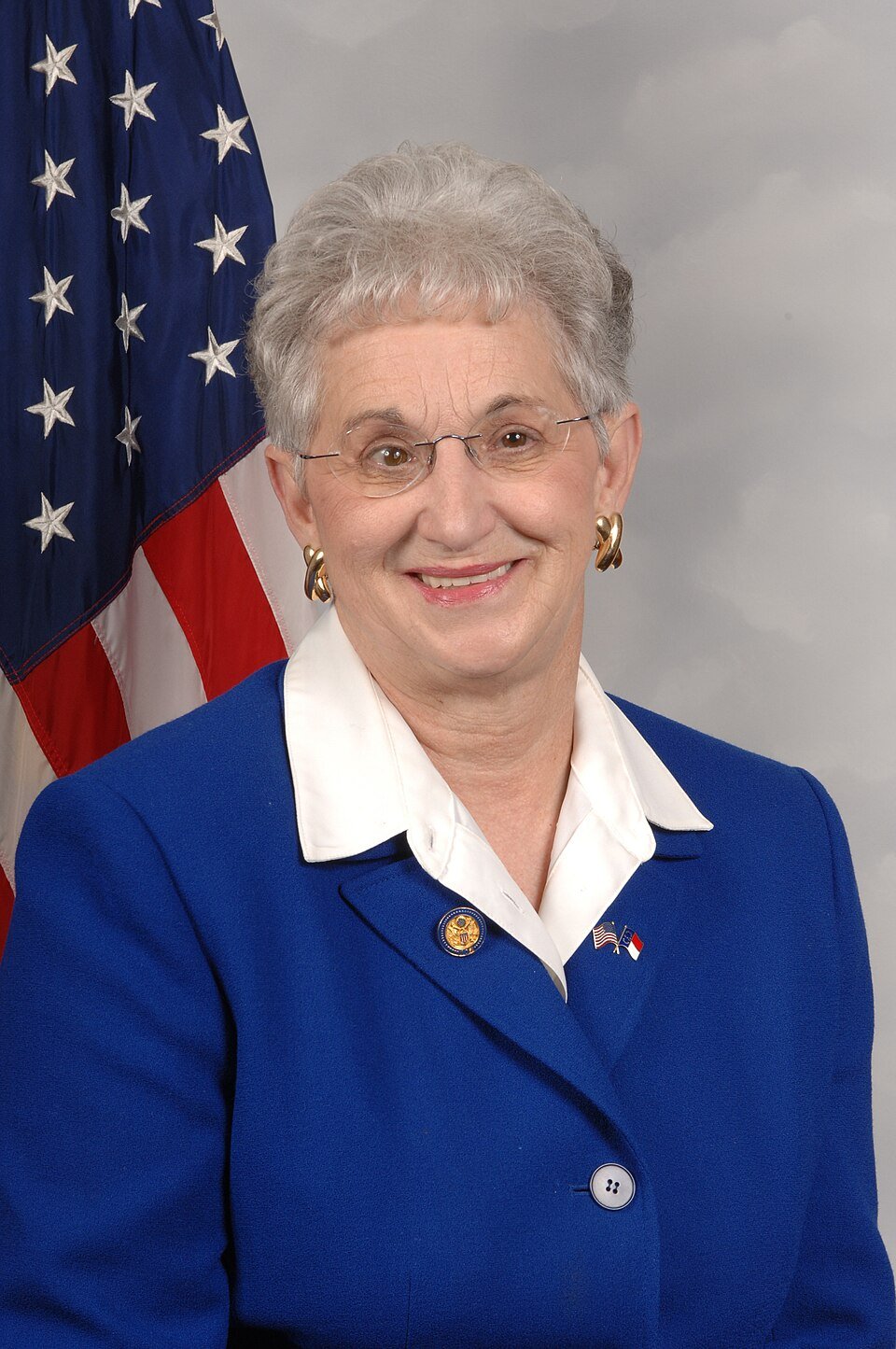
North Carolina Republican Virginia Foxx will have to do her union-busting elsewhere now that’s she’s lost the House seat she’s held for more than 20 years.
By Steve Wishnia
One of the loudest and most powerful anti-labor voices in Congress, North Carolina Republican Virginia Foxx, has been defeated in her bid for a 12th term in the House.
Foxx conceded to Chuck Hubbard, a retired reporter for a weekly newspaper in the small town of North Wilkesboro, on Nov. 22, after a recount showed him still ahead by a 330-vote margin. The district is split between the city of Greensboro and several rural counties along the Virginia border; Hubbard won more than 70% of the vote in the Greensboro metropolitan area, accounting for half his total.
In her two terms as chair of the House Committee on Education and the Workforce, from 2017-2019 and 2023-2025, Rep. Foxx peppered reporters’ inboxes with denunciations of “union bosses.” She changed its name from the Education and Labor Committee when the Republicans regained control of the House in 2023. The announcement said the word “labor” was “something out of a Marxist textbook” and “creates a sense of enmity between employees and employers which union bosses and left-wing activists seek to stoke for political gain.”
Foxx called the Protecting the Right to Organize Act, which would have prohibited state laws against union shops and ended the Taft-Hartley Act’s ban on secondary boycotts, the “radical, job-killing PRO Union Bosses Act” and a “coercive, socialist” scheme to “expand forced unionism.” (The House passed the bill in 2020 and 2021, but facing a filibuster, it went nowhere in the Senate.)
When the House passed the Butch Lewis Act, a bill to rescue about 200 multiemployer pension funds whose impending collapse threatened to cut off retirement benefits for 1.3 million people, Foxx blamed the crisis on “reckless mismanagement by union leaders” and said the legislation “gives more gasoline to the arsonist who started the fire.” When the Biden administration finalized the aid program in 2022, she said it showed they intended “to bow to Big Labor’s interests.”
Those plans, which covered people who work for multiple employers, most commonly in trucking, construction, mining, and entertainment, were generally in trouble because the number of active workers contributing declined, such as from the deregulation of trucking in the 1980s, or because their investments were battered in the 2008 recession.
Foxx also crusaded against measures to limit the number of workers classified as “independent contractors.” She argued that defining them as employees under the federal Fair Labor Standards Act, people who had to be paid minimum wage, was a Depression-era relic that “would expose businesses to increased risk of operational burdens and litigation, while resulting in reduced opportunity for workers and higher priced goods for consumers.”
In October 2021, Foxx was one of three House members who argued that the federal Occupational Safety and Health Administration did not have the authority “to mandate that private-sector employees take vaccine injections into their bodies.” She also signed a message claiming that OSHA’s authority to set emergency temporary standards to protect workers from exposure to “grave danger” did not apply to contagious and potentially lethal viruses or bacteria.
Foxx became chair of the House Rules Committee in 2025, but remained on the Education and the Workforce Committee. Her replacement as chair, Tim Walberg (R-Mich.) was not an improvement. On Nov. 19, when the Department of Labor weakened a Biden-era rule on when workers can legally be considered independent contractors, Walberg hailed it as a victory protecting workers’ “freedom to choose how they earn a living.”
On Nov. 13, the committee held a field hearing in Charlotte, N.C. on putting “workers in charge” in the workplace. Rep. Mark Harris (R-N.C.) defined that as requiring a majority of all workers to get union representation, “not simply a majority of those who cast a ballot.” The witnesses, from anti-union advocacy groups and union-busting law firms, praised the state for having laws that say public employers don’t have to bargain with unions and prohibit union contracts that require workers represented to pay dues. (North Carolina vies with South Dakota for the ranking as the least-unionized state, with only 2.5% of its workers union members and 3.1% represented by unions.)
Hubbard’s platform vowed to fight corruption and protect Medicare, Medicaid, and Social Security. It said Congress “must act” to address the rising cost of basic needs, such as health care, housing, child care, groceries, and utilities; raise the minimum wage; and “shift the tax base more to rich people and wealthy corporations.”
“In the richest country on Earth, working hard should be enough to at least live a comfortable life and be able to get ahead,” it said. “While that might have been true for our parents, it is certainly not true for us or our children.”
He also ran an ad that went viral, a clip from a town-hall speech describing how his lesbian daughter had called him, crying, on the day Trump was elected, saying “These people hate me.” “I will do whatever, whenever, however I can to protect the LGBTQ community and make sure they’re not bullied,” he said.
Foxx, arguing against a hate-crimes bill in 2009, said that it was “a hoax” to say that the brutal gay-bashing murder of Matthew Shepard in 1998 in Wyoming happened because he was gay. She said it happened during a robbery.
The ranking Democrat on what will presumably be renamed the Education and Labor Committee is Bobby Scott of Virginia, who was the PRO Act’s lead sponsor. Suzanne Bonamici of Oregon and Jahana Hayes of Connecticut are also running to be its chair.