
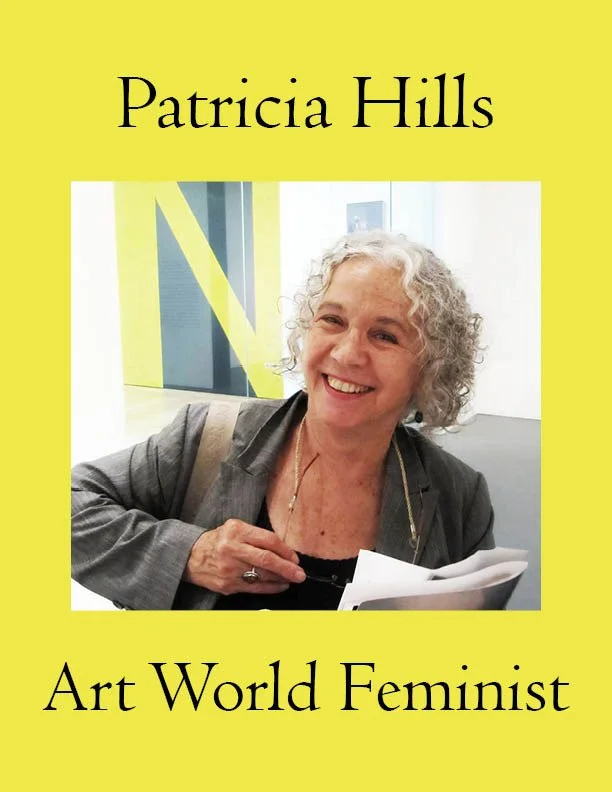
‘Art World Feminist’ is out from at Hard Ball Press.
By Joe Maniscalco
Eighty-nine-year-old academic and author Patricia Hills spent her entire professional career opening up American museums and cultural institutions to the exact kinds of “divisive narratives” and “improper ideology” the Trump administration has now pledged to purge.
Long before MAGA made fascism fashionable again in the U.S., however, Hills was making up her own mind about her country of origin and women’s places in it. The daughter of a career military physician who moved the family often, Hills spent her childhood bringing vivid memories of U.S. Navy warships belching out black smoke in Pearl Harbor on the morning of Dec. 7, 1941 to every new classroom she entered.
It was a time in the U.S. when “Manifest Destiny” still went hand-in-hand with misogyny, however, and respectable womenfolk like Hills, PhD and professor Emerita at Boston University’s History of Art & Architecture Department, were expected to marry equally respectable menfolk and start popping out babies, and not a whole lot else.
“The script was: I would graduate from college, get married to a promising man, and have children—and let’s throw in the house in the suburbs, station wagon and Irish Setter dog,” Hills writes in Art World Feminist, her exceedingly warm but equally uncompromising autobiography now available at Hard Ball Press. “For most of my teen years I assumed this was my path, and I developed skills to cater to and finesse the male ego.”
Hills would soon put those deft survival skills to good use, bravely setting her sights on democratizing the nation’s still stultified and backward museums and cultural institutions.
But first she needed to free herself from a series of dead-end jobs in San Francisco and land a job at a real art museum. That happened at the dawn of the 1960s when Hills became a curatorial assistant at the Museum of Modern Art in New York City.
Art World Feminist spans the decades like any good Netflix documentary, thoroughly immersing itself in each era before spring-boarding to the next in a continuous through line that is consistently packed with drama and pathos.
By 1973, Hills was setting the art world on its ear curating what was then a groundbreaking exhibition at the Whitney Museum of American Art exposing the myth of “Manifest Destiny” as nothing more than propaganda for settler colonialism. Or what the Trump administration would have us now define as “divisive narratives” and “improper ideology.”
Hills later went on to champion the works of Alice Neal, Jacob Lawrence, and other American masters the art world’s old boy’s club had sought to marginalize at all costs—and Trump is now attempting to marginalize once again. In all, Hills curated seven major exhibitions for the Whitney between 1972 and 1986.
There’s more than one way to take the piss out of the patriarchy—and as Art World Feminist so effectively demonstrates, Hills did it her way. In mining the particular, Hills uncovers the universal. As she says, “The book does talk about my experiences, but it really taps into the experiences of many other women of my generation.”
Art World Feminist is as successful as it is because it explores the many battles women of Hills’ generation had to fight the patriarchy both in the workplace and on the home front—and may yet again.
Those battles may have started breaking free from domineering dads and carving out careers in male dominated fields, but they did not end there—and neither does Hills’ absorbing, working class narrative.
Hills is equally moving chronicling her struggle as a member of the “sandwich generation”—having to be caregiver to both her growing children and aging parents—as she is relating her political awakenings and complicated relationship with the aforementioned Alice Neel.
The personal is always political—in Hills’ hands, however, it also never ceases to be quintessentially human.
Art World Feminist offers readers an illuminating and intimate look at the inner workings of the cultural institutions and museums now under so much fire under Trump 2.0. But it is equally good at exploring the life of a truly remarkable and inspiring individual who refused to accept the script she was handed.
Listen to WBAI Labor And Healthcare Confidential Host Marianne Pizzitola interview Patricia Hills about Artworld Feminist.