

Work-Bites correspondent Eilean Faltin was on the streets of Paris during this fall’s student uprisings.
Thanks to all for reading! This special international report from Work-Bites correspondent Eilean Faltin represents our ongoing commitment to help cultivate the next generation of muckraking journalists dedicated to the public good. Eilean Faltin is a first-year student at the University of Edinburgh in Scotland and was in the thick of student uprisings in Paris, France before filing this report for us. If you value this reporting and would like to help keep Work-Bites on the job AND GROWING, please consider becoming a “Work-Bites Builder” today for just $3.00 per month. Work-Bites is a completely independent 501c3 nonprofit news organization dedicated to our readers — and we need your support!
By Eilean Faltin
On my first day at the University of Edinburgh, my teachers told me that classes were cancelled for the next five weeks because of strikes over massive budget cuts. Despite barely stepping foot into a lecture hall, I immediately became part of a fierce battle against the university’s unpopular leadership, as well as the wider student revolt against austerity erupting all across Europe.
Soon after in October, my friends and I joined hundreds of thousands of other students and workers protesting in Paris where I saw many drawing a clear connection between the rise of fascism and the underfunding of education.
In their “Revendications de la jeunesse” [Demands of the Youth], the French Student Union demanded more places and jobs in higher education, the repeal of higher fees for international students—and an end to police violence against students.
Ostensibly done in the name of savings, the austerity measures sparking the uprisings, were responsible for overcrowded, understaffed and decaying schools, at the same time students were being saddled with higher tuition costs.
All of this, I would come to understand, was part of an underlying pattern of privatization and consolidation of governance stretching all the way back to 2007 and the passage of the Liberties and Responsibilities of Universities Law—a measure that expanded the powers of university presidents and cut the size of governing boards. The so-called “financial autonomy” that universities gained directly led to increased competition and reliance on the market.
It also explained a lot about what I was experiencing at the University of Edinburgh as the five-week strike wore on.
Edinburgh As a Case Study
In September, 3,000 University of Edinburgh staff began a five-week strike over management’s move to cut £140 million from the University’s budget. The cuts meant the closure of 90 degree programs and cost nearly 1,000 jobs, with up to 1,800 more at risk by the Edinburgh University and College Union’s estimate—a move that the UCUE called “academic vandalism.”
The University said that it was forced to make the cuts because it was heading towards a financial deficit. The administration cited several factors for its problems, including underfunding by the Scottish government and falling international student enrolment due to an increasingly “hostile environment” around immigration. It was easy for the administration to point to a sector-wide crisis as major universities across Scotland simultaneously began to wave the white flag and impose austerity measures.
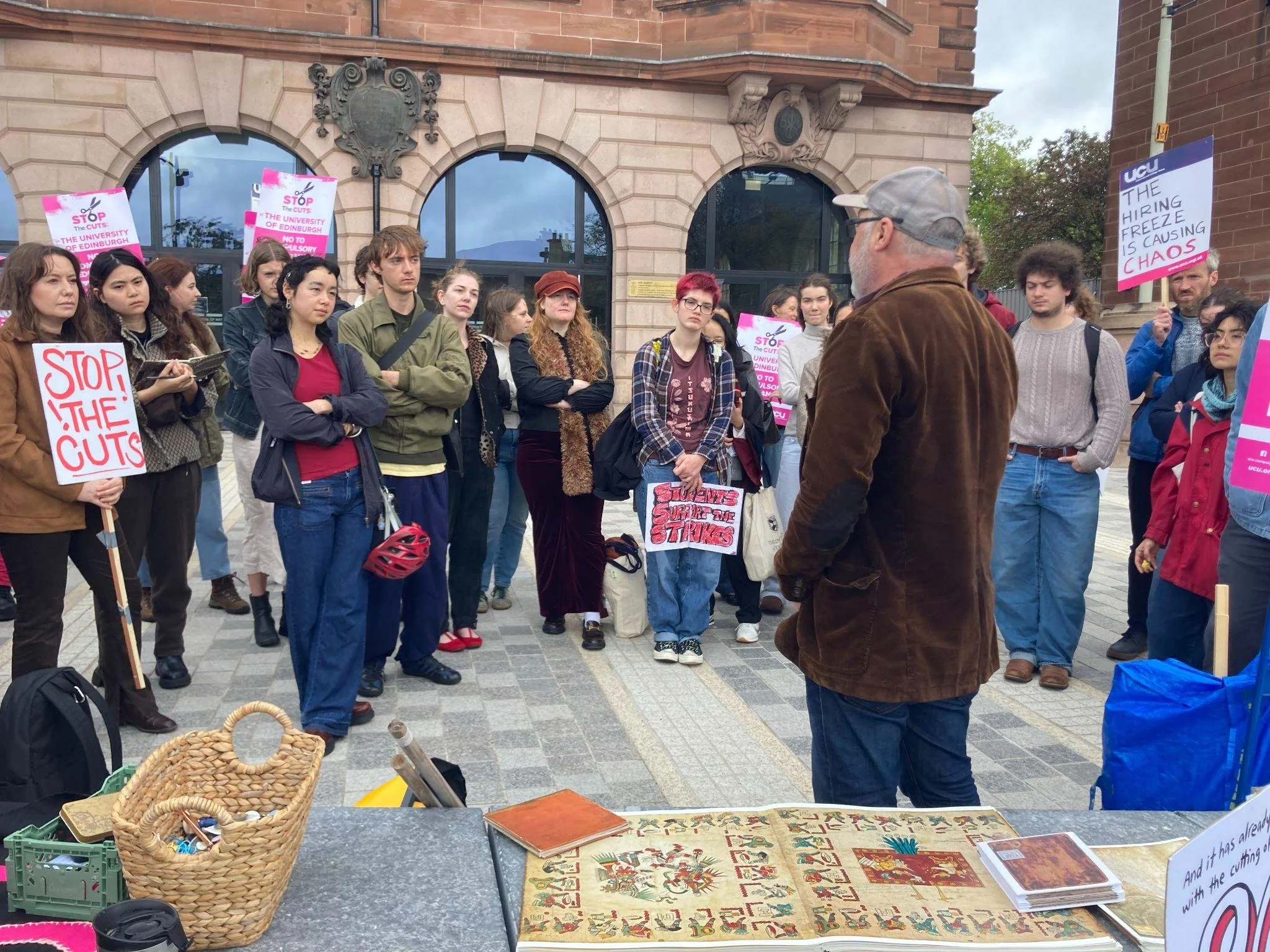
Students attend a University of Edinburgh teach out during the five-week strike.
Although the financial pressures were real, many students and staff remained skeptical of the narrative. Firstly, they said, the University had yet to actually hit a deficit. In its financial report, the administration said that because expenditures were rising faster than income, the University of Edinburgh would eventually hit a deficit if they did not make the cuts.
The UCUE pointed out that increased expenditure wa driven largely by capital investment (specifically buildings, of which the University owns 550, making it the largest private landlord in the city), showing a rise in capital expenditure from £113 million in 2020 to £207 million in 2025.
As MSP [Member of Scottish Parliment] Maggie Chapman argued at an anti-austerity rally held outside Scottish Parliament later in October, “Staff and students didn’t cause the financial crisis, they should not be made to pay for it.” Instead, UCUE representatives claim that the real culprit is an “investment strategy (that) has systematically prioritized capital and buildings over staff and students…characterized by inaccurate and unexplained projections to justify overwork and budget cuts.”
Build, Baby, Build?
This strategy is perhaps best exemplified by the Edinburgh Futures Institute (EFI), a gargantuan and architecturally lauded building bought by the University in 2016, for which construction lasted eight years and went £100 million over budget. And yet, as one striking Sociology lecturer described, “If you walk through the building on any given day, the rooms are mostly empty.”
If the University’s finances are so precarious, why would they make a purchase like this, especially if it is, at best, inessential to academic work? As Reily, a PhD student in Global Environmental Politics and Society explained, “The acquisition and development they’re doing is part of a global trend called the Amenities Arms Race, where universities buy up buildings and land to offer more amenities to students so that they can increase tuition.”
“Capital expenditure works as an advertisement to draw students in while actively reducing the quality of education that they’ll receive,” said Eddie Martin, a teaching fellow whose Master’s program in Science Communication and Public Engagement was recently closed.
As a first-year Geography student myself, I’ve been affected by this strategy: I’m set to pay over £30,000 per year to study at Edinburgh. Like many international students, I’ve signed onto major, life-altering debt in exchange for what I was sold as a world-leading academic institution. When I arrived, I found that some of the things I was most excited about were no longer available: all Portuguese courses had been cut, Geography field trips (which were a major selling point of the program) were significantly reduced, and the Centre for African Studies was effectively dissolved.
The Amenities Arms Race doesn’t just affect staff and students, but also the broader community. Reily added that the University’s spatial expansion “encroaches on Edinburgh natives, raising prices and eventually ousting working class people.” This month it was announced that Summerhall, a thriving Edinburgh arts complex and event space, would be partially demolished to make way for more student housing. Meanwhile, hundreds were evicted from St Margaret’s House, a creative hub that houses artists and community groups, to make way for even more student housing.
Pulling All the Strings
So who’s guiding this strategy? Largely, the University Court, a 24-person body which hosts, alongside staff and student representatives, a majority of external members. These members include people like Sarah Cummings, a real estate contractor, Hugh Mitchell, a former Shell executive, David Ovens, a venture capitalist, and a host of other prominent business people who are not primarily motivated by education in their professional life—but by profit.
As Jamie Allinson, a striking lecturer in Politics and International Relations quiped, “The Court is like the bourgeoisie of Edinburgh. They make these decisions and won’t listen to reason.”
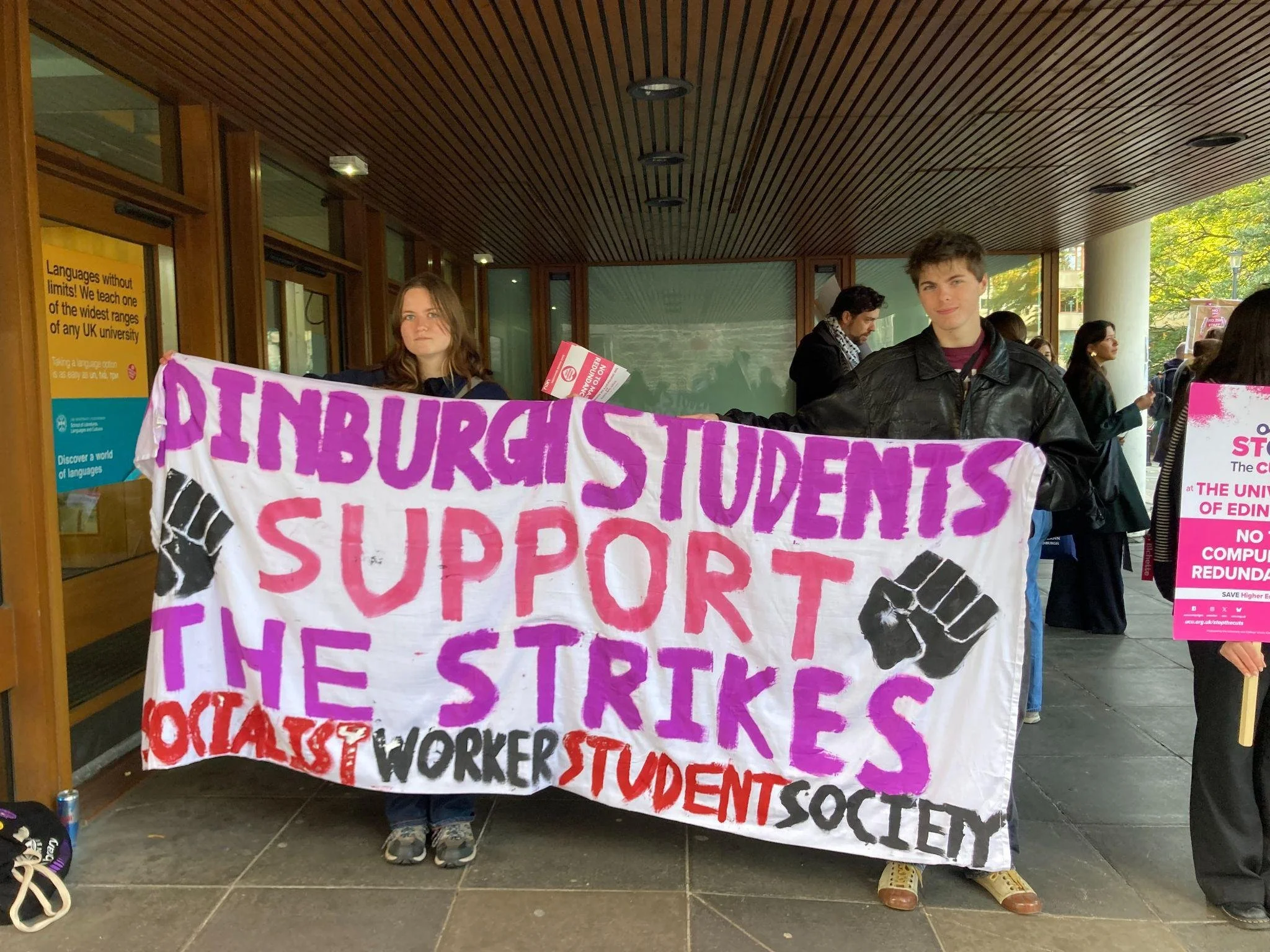
University of Edinburgh students show support for the recent five-week strike against austerity.
The closure of 16 courses in Celtic and Scottish studies, including the only two honors courses in the field, particularly enraged a lot of people. In an article for The National titled, “Why are we cutting the study of Scotland?” writer Megan Davidson points to the University’s duty to its citizens as a principal Scottish academic institution. “Universities are generational institutions,” she writes. “Their responsibility cannot simply be to balance this year’s books.”
Although Principal and Vice-Chancellor Peter Mathieson claimed that unions were “weaponizing” students by refusing to teach—students (seeing that their education is directly implicated by mismanagement) overwhelmingly supported the strike, which Mathieson dismissed out of hand. “I was a student once and we were all anti-establishment,” he said. “Of course (they’re) going to blame the establishment.”
Flexing Student Muscle
Throughout the strike, students formed networks of solidarity with striking staff, including the Student Staff Assembly, which hosted a coalition of lecturers, tutors, and professional staff, alongside students from the College of Arts, the Scottish Society, Justice Palestine Society, and hundreds of others, as well as students from other Scottish universities.
Through these weekly Assemblies, students and staff (including myself) also formed numerous working groups, and organised a community kitchen for striking staff, media campaigns, fundraisers, and a series of “teach-outs.” Teach-outs are informal classes held on picket lines, which function to “reclaim learning” during strikes. They took many forms, from information sessions on the strike itself and the University’s capital investments, to Scottish literature classes, Marxist reading groups, ceramics workshops, and film screenings.
I was involved with a working group of international students, who were looking for ways to resist paying tuition fees. Many expressed feelings of being treated like “cash cows”— making significant personal sacrifices to study at Edinburgh without being valued by the University in turn. In an open letter, we emphasized the fact that collectively, international students contribute £600 million pounds annually to the University, and yet are not treated as stakeholders, and made subject to “reckless administrative decisions” that put our education in jeopardy.
Staff and students also drafted and published our own list of demands addressing the systemic issues underlying the cuts. The demands outlined expanded power for the University Senate, including power of proposal and veto power in decisions that affect the University’s academic mission. They also demanded the release of more detailed financial models behind the cuts, for Senior management to stop acting in secrecy, and the immediate resignation of Mathieson and his closest collaborator University Provost Kim Graham.
The demands also called for divestment, the continuation of a years-long and escalating military divestment movement at Edinburgh and across higher education. The University of Edinburgh has invested £70 million in companies like Amazon and Alphabet, which provide technological infrastructure to the Israeli military. This does not include the University’s indirect investment, which remains undisclosed. This year, the University also joined the Defence Universities Alliance, an initiative to “enable UK academia to lead in defence innovation.”
In 2024, the movement for divestment on campus gained major traction among both staff and students, culminating in hunger strikes and encampments during graduation. In response, University management created the Responsible Investment Advisory Group (RIAG), which recommended divestment from companies involved in AI-based targeting. Two years later, however, the University has yet to divest.
As the administration refused to budge, staff and students’ methods became increasingly militant. On Tuesday, October 20, students began occupying University buildings including the Gordon Aikman Lecture Theatre and 40 George Square. The next day, the Student Staff Assembly opened its doors to the general public, hosting speakers including Q Mannivannan, a member of Scottish Parliament, and Alice Cohen-Mordadec, an organizer with the largest French Students Union, who shared tactics being used by French student organizers against austerity.
The strike officially ended on Oct. 30.
Zooming Out: Education Under Attack and the One Big Beautiful Bill
Student protests in France and at the University of Edinburgh reflect a movement across Europe led by students who feel disrespected and abandoned by our institutions. Although demonstrations across Spain, Albania, and Austria stem from distinct situations and histories, students are calling for similar things: accountability, transparency, and representation. Grievances around higher education are funneling into broader anger around the cost of living and governmental corruption.
We’re faced with a narrative that says that higher education “must” be run like a business to survive in a capitalist society, that our institutions are doing the best they can in an unstable world. But if students are held back from meaningfully participating in decision-making processes at our institutions, and power continuously shifts to business-minded boards, how can we be sure this is true? The suspicion that conflicts of interest are at play is not far-fetched.
In an Instagram graphic, University of Edinburgh Lecturer of Illustration Fionnuala Doran shares the findings of a report into university management in New South Wales in Australia, which found that due to the “ascendancy of corporate management of universities,” they have “swung too far towards corporatization at the expense of their fundamental public mission of education, research, and service to the broader community.” It seems the same patterns are playing out worldwide. Maybe what we need isn’t to cut budgets, but to subvert marketization and enforce scrutiny on an international scale.
On top of cuts and strikes, I was alerted over the summer that due to Donald Trump’s One Big Beautiful Bill Act, I, alongside many other U.S. students, would no longer be receiving a federal grant to help with tuition fees.
College students in the U.S. face the highest educational costs in the world, leadership that protects the Trump administration, the constant threat of mass shootings, on top of widespread job losses and program closures echoing those in Europe.
The need for intervention is stark. Yet, U.S. students have not joined Europe’s recent surge of resistance—this could be due to the 2024 crackdown on protests, mounting federal pressure and immigration risk, a chronological disparity, or a cultural lack of solidarity.
Now, with tensions rising across the country over stories like the rape of Jane Doe at Cornell University and the unresolved death of Nolan Wells in Mississippi, U.S. colleges’ complicity in violence is being progressively unmasked—and the question remains whether their students will join the global surge of resistance, or be left in defense mode, reacting to shocks as they continue to happen.