
NYC App-Based Drivers: ‘The Law Doesn’t Protect Us From These Giant Companies That Just Suck Our Blood!’
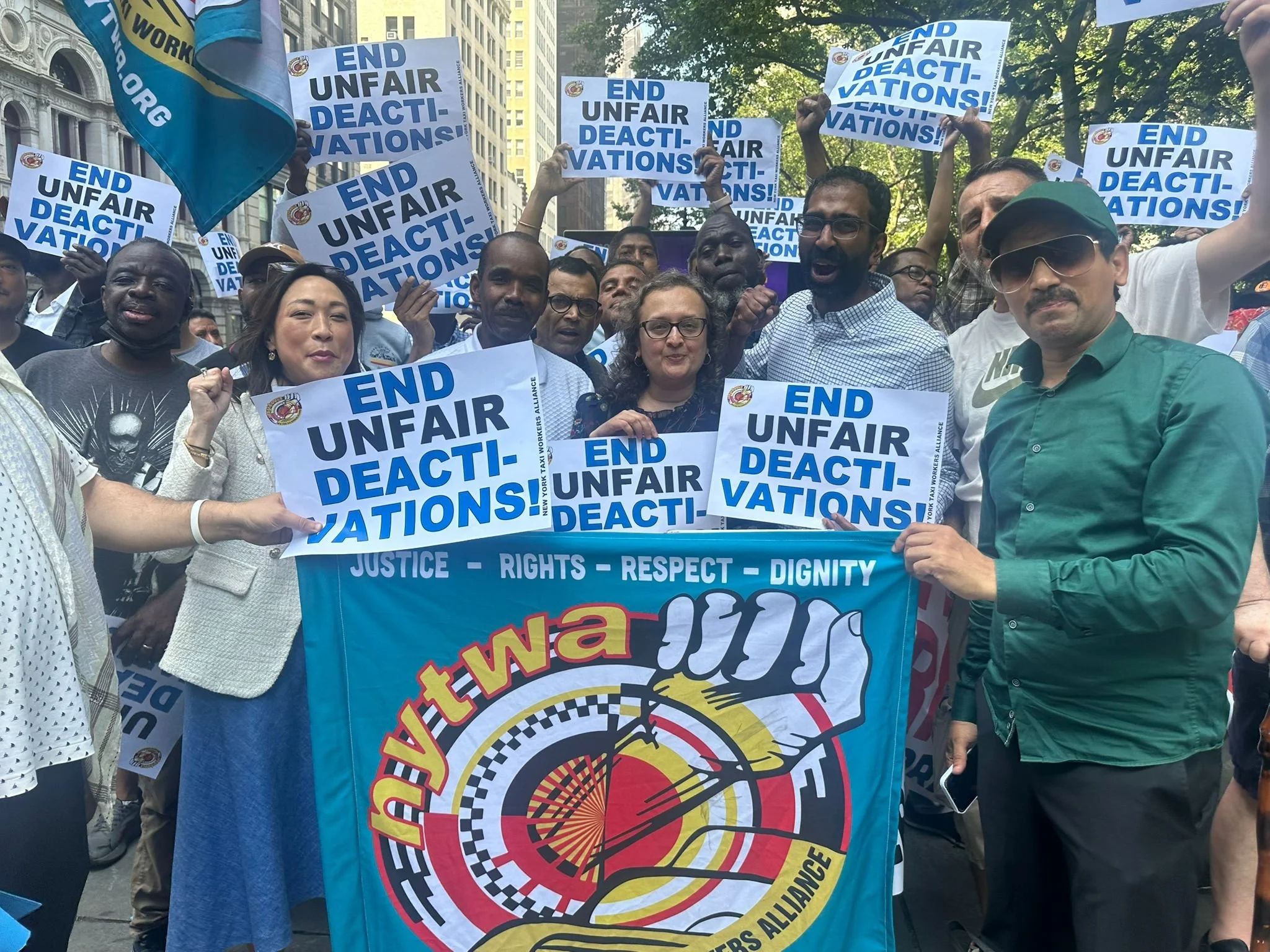
The New York Taxi Workers Alliance rallied outside the gates of City Hall in June to protest unfair deactivations.
Editor’s Note: This story has been updated to include a further comment from New York Taxi Worker Alliance Executive Director Bhairavi Desai.
By Steve Wishnia
More than two-thirds of Uber and Lyft drivers who were “deactivated” say they did not receive any notice before their access to the apps was cut off, according to a survey of 341 fired drivers conducted by the New York Taxi Workers Alliance (NYTWA) and the Asian American Legal Defense and Education Fund (AALDEF).
Many of those drivers said they were never given any details of what the accusations against them were, AALDEF said in “Deactivated Without Cause: The Data Behind Unjust Firings of Drivers,” a report released Oct. 28.
“Most deactivated drivers were longtime, high-performing workers with excellent ratings and no records of misconduct. Yet without warning, they were suddenly locked out of their accounts and cut off from their income,” the report said. “In many cases, the companies cited vague ‘customer complaints,’ withheld key details, and denied drivers any meaningful opportunity to respond.”
More than four-fifths of the deactivated drivers surveyed said they had been working for either or both of the apps for more than five years. At Uber, 74% had customer ratings of at least 4.8 out of 5 when they were deactivated; at Lyft, 85% did.
“Drivers are losing their livelihoods based on allegations.”
Among them, 37% at Uber and 43% at Lyft reported that they had been cut off for alleged customer complaints. Among those, 42% at Uber and 33% at Lyft said they were not told when those incidents had occurred. Among those deactivated for “multiple complaints,” 67% at Uber and 75% at Lyft said they had not been warned about the previous complaints.
“Drivers are losing their livelihoods based on allegations,” Elizabeth Koo, interim director of AALDEF's Economic Justice for Workers program, said at an online press conference Oct. 28, with more than 300 drivers watching. One driver who responded to the survey said a passenger who had vomited in the back seat accused him of sexual harassment—a zero-tolerance violation—after he stopped the car and asked her to throw up outside.
Drivers can appeal being deactivated. Possible avenues include contacting the companies by phone or email, arbitration, using an in-app option, seeking help from NYTWA, and working with advocates from the Independent Drivers Guild, an International Association of Machinists affiliate which has been partially funded by Uber. But among 154 respondents who had appealed to Uber, 95% were still deactivated. Among the 86 who appealed to Lyft, 98% were.
“It’s a basic issue of work and dignity,” NYTWA head Bhairavi Desai said: Drivers should know what the charges are against them and have an opportunity to defend themselves.
Lyft & Uber denials
Uber and Lyft both disputed the report. “This survey isn’t grounded in reality and its findings aren't representative of NYC rideshare drivers on our platform,” a Lyft spokesperson told Work-Bites. “Unnecessary deactivations negatively impact our business model, so we engage in thorough review processes and aim to only deactivate drivers to protect the safety of our community.”
An Uber spokesperson said that “restricting a driver’s access to the platform is always a last resort,” but it’s done to ensure that riders “can have a safe and reliable experience.” They said fewer than 2% of Uber drivers in the city experienced a permanent deactivation in the first half of 2025, “largely due to fraudulent activity and safety incidents.” (That would amount to about 1,500 in six months, if counted as a percentage of the roughly 80,000 active rideshare drivers.)
Lyft’s investigation and appeals process is all online. Its safety team contacts the complainant and witnesses, goes through messages between the rider and the driver, route data, and more, and issues judgment. If the driver appeals, another safety-team member reviews the evidence presented. The company argues that complainants should not be required to testify at a hearing, because that could force “victims of a crime to relive traumatic events and provide testimony against their driver, or risk that driver being allowed to remain on the platform.”
“We aim to strike the balance between providing enough information to allow the driver to respond and not providing so much detail that the rider may be identified. We developed our processes in accordance with women’s safety advocates.”
Uber announced June 30 that it had begun notifying drivers when the company receives a complaint about them: It posts banners on drivers’ home screens in the app for seven days. If they click on it, it will say something like, “A rider reported that you asked them inappropriate personal questions on Apr. 25.” The driver can then fill out an online form to describe their side of the story.
That process provides limited information about the nature of the complaint. “We aim to strike the balance between providing enough information to allow the driver to respond and not providing so much detail that the rider may be identified,” the Uber spokesperson told Work-Bites. “We developed our processes in accordance with women’s safety advocates.”
The Independent Drivers Guild dismissed the AALDEF report as “erroneous data on rideshare app deactivations.” It calls NYTWA a “taxi medallion owners association.”
“It’s unclear where the taxi owners came up with these 341 survey responses — but it appears they may have been victims of some kind of fraud,” IDG President Brendan Sexton said in a statement. “The real numbers are clear: More than 4,000 New York City rideshare drivers were successfully reinstated last year alone through our union-won, driver-led process. That’s 90% of all cases opened.”
The Uber spokesperson said they couldn’t confirm that 4,000 figure, but “IDG submits cases for drivers who were deactivated more than a year ago, so it could include old cases too.” An IDG spokesperson said drivers are often “permanently” deactivated for problems such as late vehicle inspections or missing licensing paperwork, but can be reactivated once those are cleared up. False accusations by riders are harder to handle, but can be disproved by evidence such as dash-cam footage.
NYTWA, which has advocated for yellow-cab drivers, individual medallion owners, and rideshare drivers, generally considers the IDG a company union at least partially funded by Uber.
“The Uber-funded IDG has given up on any pretense of organizing drivers and, like any other company union, has turned to gaslighting the very workers they claim to represent,” Desai added. “Instead of addressing the crisis of unfair deactivations that Uber and Lyft drivers face, and the lack of recourse, Uber-funded IDG is pretending that the drivers' lived experience isn't happening.”
Losing your livelihood
Lyft driver Saif Aizah, one of the 341 in the survey, told the press conference that he’d lost more than half his income since being “unfairly” deactivated by Uber.
He said in a statement released by NYTWA that neither Uber nor the IDG had helped him, although Uber representatives had told him he shouldn’t have a problem getting reactivated, as a highly rated driver with more than 12,000 trips.
“I’m drowning in so many debts,” Aizah said. “I’m in the process of filing for bankruptcy.”
He added that he’d been unable to pay the $2,600 rent on his family’s home this month, and showed a bill warning that his electricity would be cut off if he didn’t pay almost $750. He’s still paying for his car loan, insurance, and maintenance.
“I feel like crying right now,” he said. “The law doesn’t protect us from these giant companies that just suck our blood.”
“I lost $30,000 on a car, and my daughter had to drop out of college.”
Unlike other places, rideshare driving in New York is not a side hustle, said AALDEF legal director Niji Jain. It was the main source of income for 95% of the survey’s respondents, and 88% of them had bought cars to do the job.
“I lost $30,000 on a car, and my daughter had to drop out of college,” one driver told the survey.
Intro 276 debate
The survey is part of the debate over Intro 276, a bill introduced in the City Council that would prohibit the “wrongful deactivation” of app-cab drivers. The companies would have to give them advance warning and prove that there was a good reason to fire them, they had been told why in writing, and that the investigation had been fair—although they could still deactivate drivers immediately for “egregious misconduct” such as driving with a suspended license.
Uber and Lyft are now “prosecutor, judge, and jury,” and drivers are “found guilty before they have a chance to prove their innocence,” Councilmember Shekar Krishnan (D-Queens), the bill’s lead sponsor, said at the press conference.
Lyft and the IDG are both strongly against the bill. Uber has not overtly opposed it, but has proposed changes to water it down.
The AALDEF report backs “just-cause legislation,” saying it is needed “to ensure that “no driver is deactivated without legitimate reason, transparency, or due process.”
The report, says Krishnan, shows “how fundamentally one-sided and unfair the deactivation fight is.”
Last year, the NYTWA with hundreds of NYC app-based drivers conducted a one-day strike to protest Uber and Lyft locking them out of their apps to avoid triggering an increase in the drivers’ share of fares.