
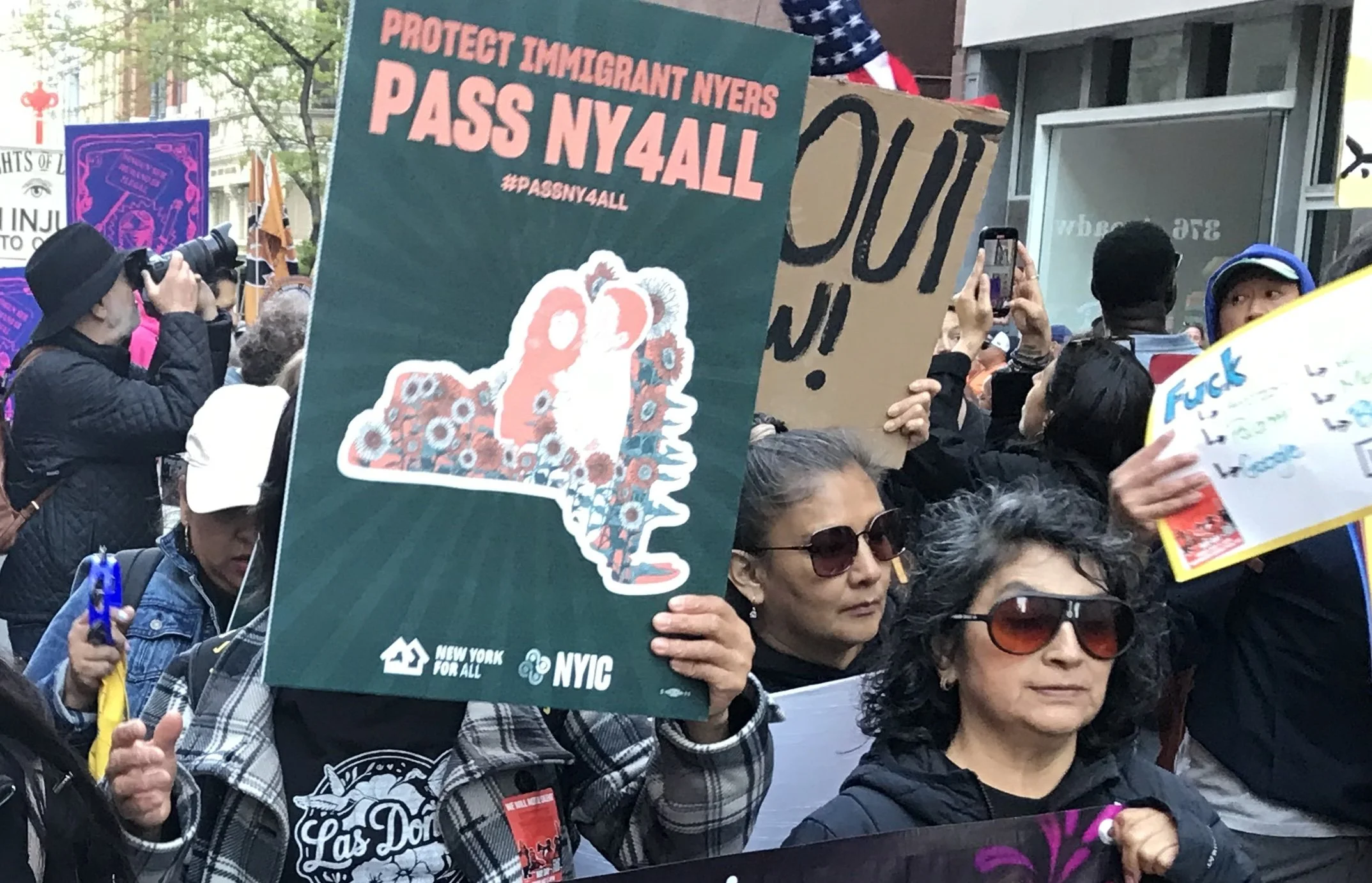
NYIC workers, some seen here at this year’s May Day March, are calling on the organization to recognize NYIC United by June 12.
By Steve Wishnia
Workers at the New York Immigration Coalition, cohost of the union-led International Workers’ Day May Day March, have asked the organization to recognize their newly formed union, NYIC United.
Office and Professional Employees International Union (OPEIU) Local 153 announced June 9 that 80% of the NYIC’s roughly 50 staffers had signed union cards, and 70% had signed a letter requesting that the coalition recognize the union voluntarily, instead of waiting for a formal staff vote on it. The union has given the coalition a deadline of noon on June 12.
“We talk a lot about labor rights. We should have them in the office,” Bella Norvig, a civic engagement associate, told Work-Bites.
Given the immigrant-rights group’s purpose, says political engagement associate Victor Flores, “we see no reason why” its leadership wouldn’t agree to voluntary recognition.
NYIC has not yet responded to the union’s deadline.
The coalition, founded in 1987, encompasses more than 200 groups and has several offices in the state. Its work includes civic engagement including voter registration and know-your-rights information, connecting immigrants to social services, and efforts to “strengthen immigrants’ fundamental civil rights” and “fight against out-of-control immigrant enforcement agencies.”
It is campaigning for the New York for All Act, a bill introduced in the state Legislature that would prohibit state and local law enforcement from collaborating with immigration enforcement and restrict when state employees can ask for or disclose information about a person’s immigration status.
“I’m really happy I ended up here,” said Flores, the son of two Salvadoran immigrants who has worked at NYIC since October. When he graduated from college last year, he recalled, “I was looking for a sense of purpose.”
But the workload and political context are intense, leading to burnout and high turnover, he explained. He believes a union would help ease that.
The union campaign began late last winter. Norvig, who wasn’t involved at first but who had been talking to coworkers about how a union would be a good idea, was asked to join the organizing committee in March. The campaign went public in late April, and quickly collected signed cards from a majority of workers.
It’s about more than getting time off after a spate of crisis-level work, Flores told Work-Bites, although the coalition’s leadership should “recognize the amounts my colleagues are sacrificing,” he said. Workers have knowledge that should be used in planning, he says, rather than a “piecemeal approach of putting out fires.”
“We want to be part of some of these decisions,” said Norvig. The union is also seeking pay equity and transparency on health-care expenses and promotion and evaluation processes, she adds.
Both the coalition’s work and their union are deeply personal for a lot of NYIC United members. Flores said the idea of a union was foreign for his parents, who did farm labor and child care.
“At an organization made by immigrants, experts, and advocates, the most organic step forward for NYIC is the one in lockstep with union-strong families to bring true equity to our homes and workplace, the way to sow into our communities,” Jahaira Roldan, manager of organizing and strategy at the coalition’s Albany office, said in a statement released by Local 153. She is the daughter of an Ecuadorean hotel housekeeper and Hotel Trades Council member.
Immigrant-rights policy manager Devashish Basnet, who came to the U.S. as a child from Nepal, is the son of a New York State Nurses Association member and has benefited from two federal programs under assault from the Trump regime’s ethnic-cleansing campaign: Deferred Action for Childhood Arrivals, which enables some people who came here as children to work legally, and Temporary Protected Status, which allows immigrants from 13 countries to stay and work in the U.S. because war or natural disasters make it dangerous to return.
“I have come to understand that the stability, safety, and dignity my mother and my family have experienced is due to my mother’s union job, despite having vulnerable immigration statuses,” Basnet said in the Local 153 announcement. “I am proud to work at an organization that champions immigrant justice and I believe that with a collective voice at the table, we can strengthen our work and deliver stronger protections for our communities.”