
NYU ‘Falls Flat’ Without Us: More than 900 NYU Professors to Vote on Strike Authorization
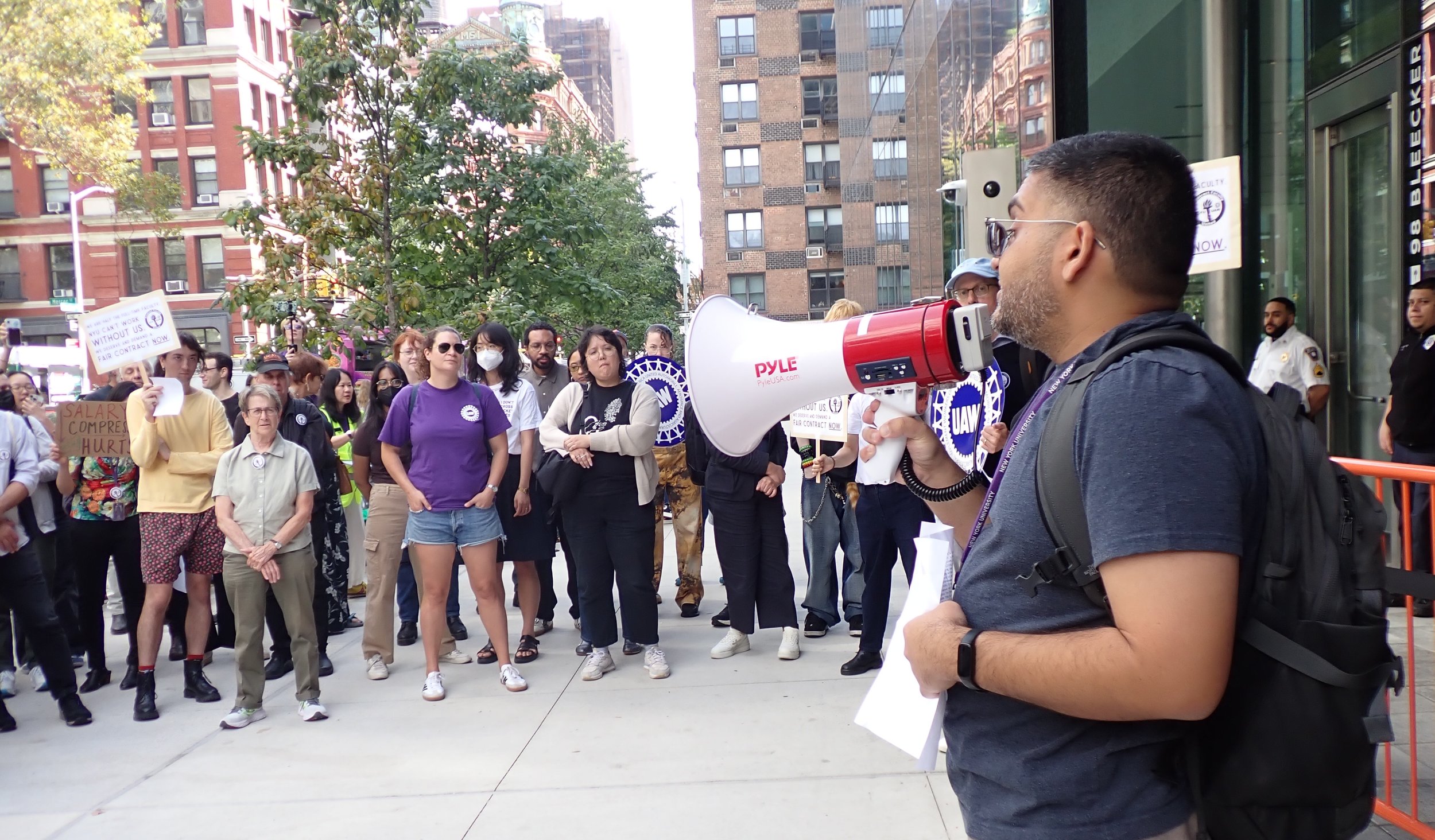
NYU professors are about to begin voting on whether or not to strike. Above: NYU Engineering Professor Ahmed Ansari addresses fellow CFU members at a Sept. 30 rally. Photos/Steve Wishnia
By Steve Wishnia
Fifteen months after they began talks for their first union contract, more than 900 professors at New York University will begin voting on whether to authorize a strike on Monday, Feb. 9.
Their Contract Faculty United (CFU) union’s bargaining committee called for the vote on Feb. 2, after becoming frustrated with the pace of negotiations. The union, a United Auto Workers affiliate, represents 930 full-time, non-tenure track professors and librarians at NYU—about half its full-time faculty and one-fifth of its teaching staff. It won a representation election in February 2024 and began the contract talks that November.
“We were hopeful that the administration would make real progress,” engineering professor Benedetta Piantella, a member of the bargaining committee, said in the statement announcing the strike vote. “Unfortunately, we were wrong.”
The vote will run until February 20. It needs a two-thirds majority to authorize the bargaining committee to call a walkout.
“I fully intend to vote yes,” math professor Andrew Sanfratello told Work-Bites.
The CFU represents contract faculty, who have full-time positions but do not have job security. Depending on which of NYU’s 12 schools they work for, they are hired on contracts ranging from nine months to eight years and must get their contract renewed to keep their job, says bargaining-committee member Jacob Remes, a professor of labor history and disaster studies since 2016.
These professors do the bulk of teaching, Sanfratello says, especially the large introductory lecture-hall classes—such as calculus, in his case. Tenured professors, especially the best-known, generally teach smaller upper-level or graduate seminars.
“We’re the ones providing the service to the students—without us, the whole college system falls flat. Teaching is our expertise.”
“We’re the ones providing the service to the students,” he says. “Without us, the whole college system falls flat. Teaching is our expertise.”
Teaching ability and knowledge of the subject are related but separate skills, Sanfratello explains. The people doing the teaching are the ones thinking most about the best way to get a precalculus class to understand how to work with quadratic equations, for example.
The university administration “doesn’t seem to recognize” that that’s as legitimate as research, he adds. “We don’t feel that we’re respected for the amount of work we do.”
Bones of contention
Individual members’ work situations vary widely across NYU’s 12 schools, from film to engineering, Remes tells Work-Bites. But the union’s main issues are compensation, including child care; job security and academic freedom; protections against their scholarly work being scraped up for artificial intelligence; scheduling and workload; and protections for international faculty and staff.
The administration is seeking a six-year contract. On Jan. 30, it increased its pay offer from yearly raises of roughly 2.5% to 3%, Remes says.
“For over three months, NYU has been urging CFU to agree to an impartial mediator to help us reach a fair contract,” university spokesperson Joseph Tirella said in a statement. “At a time of real financial uncertainty across higher education, NYU has made generous proposals that would place NYU’s unionized contract faculty at or near the top of what unionized contract faculty are paid at other institutions. Both sides owe it to NYU’s students – and to the faculty themselves – to try mediation now and work toward a fair agreement without unnecessary disruption.”
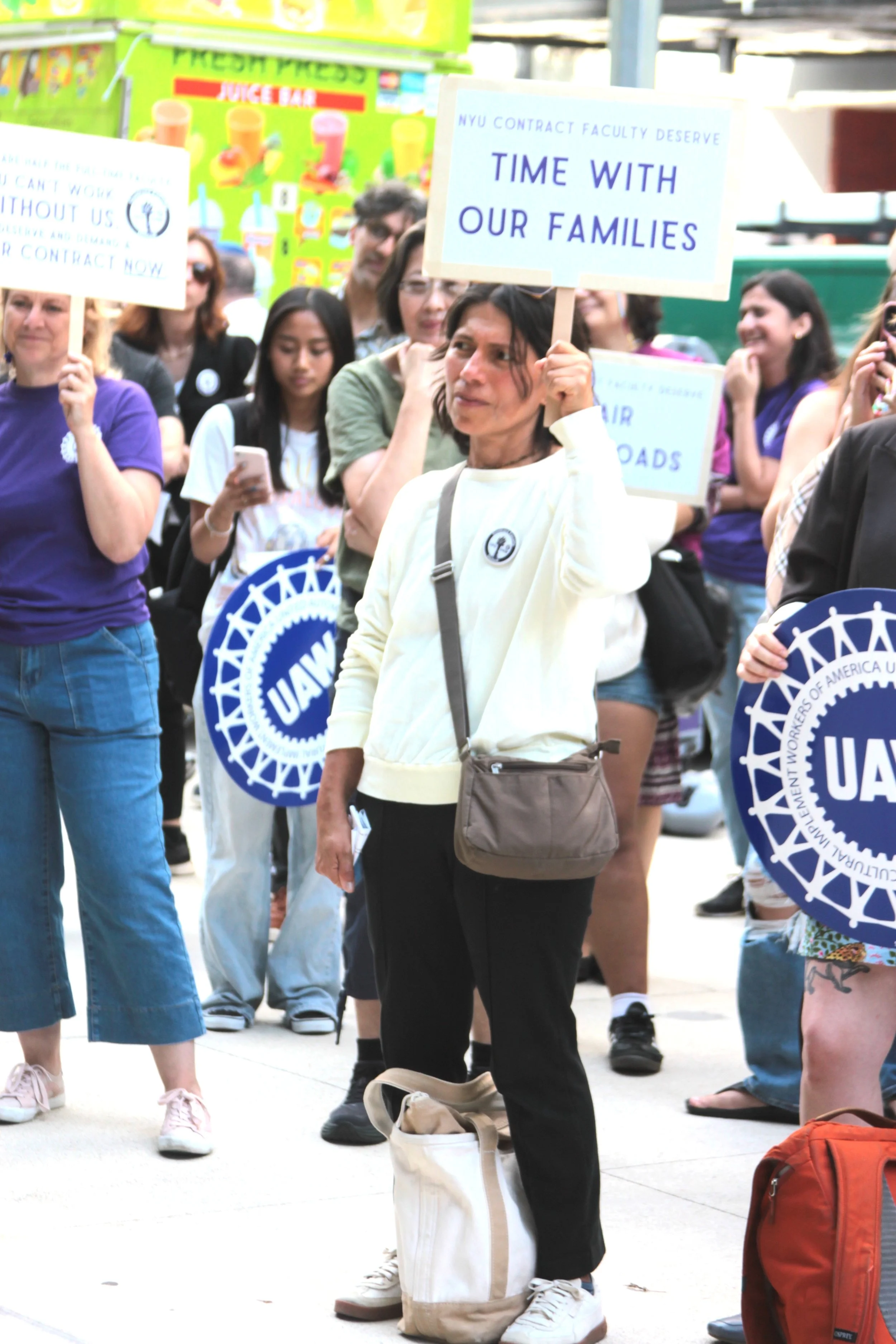
NYU has dragged out contract talks with professors for nearly a year-and-a-half.
On Feb. 3, the day after the strike-authorization vote was announced, NYU President Linda G. Mills and provost Gigi Dopico sent a message to all university employees claiming that it had offered the union “a 20% increase to the current minimum salary for contract faculty.” They said the CFU’s “exorbitant” demands would increase base salaries “by nearly 50% on average in year one of the contract alone,” and they would “continue to grow at least 6% per year.”
They added that it was “unjustifiable” for the union to schedule a strike-authorization vote “without first exhausting every means of coming to an agreement available to both sides.”
On Feb. 4, the CFU responded with a statement that the administration’s offer would give only nine professors a 20% raise next year, and more than half the 930 members would get only 3%.
The administration is “still refusing to agree to a number of crucial protections,” it said.
For example, it “is seeking to abolish reappointment and promotion committees”—the peer-review process in which faculty committees in various departments or schools recommend who to promote or rehire. That process ensures academic decisions are made by academics instead of donors, says Remes.
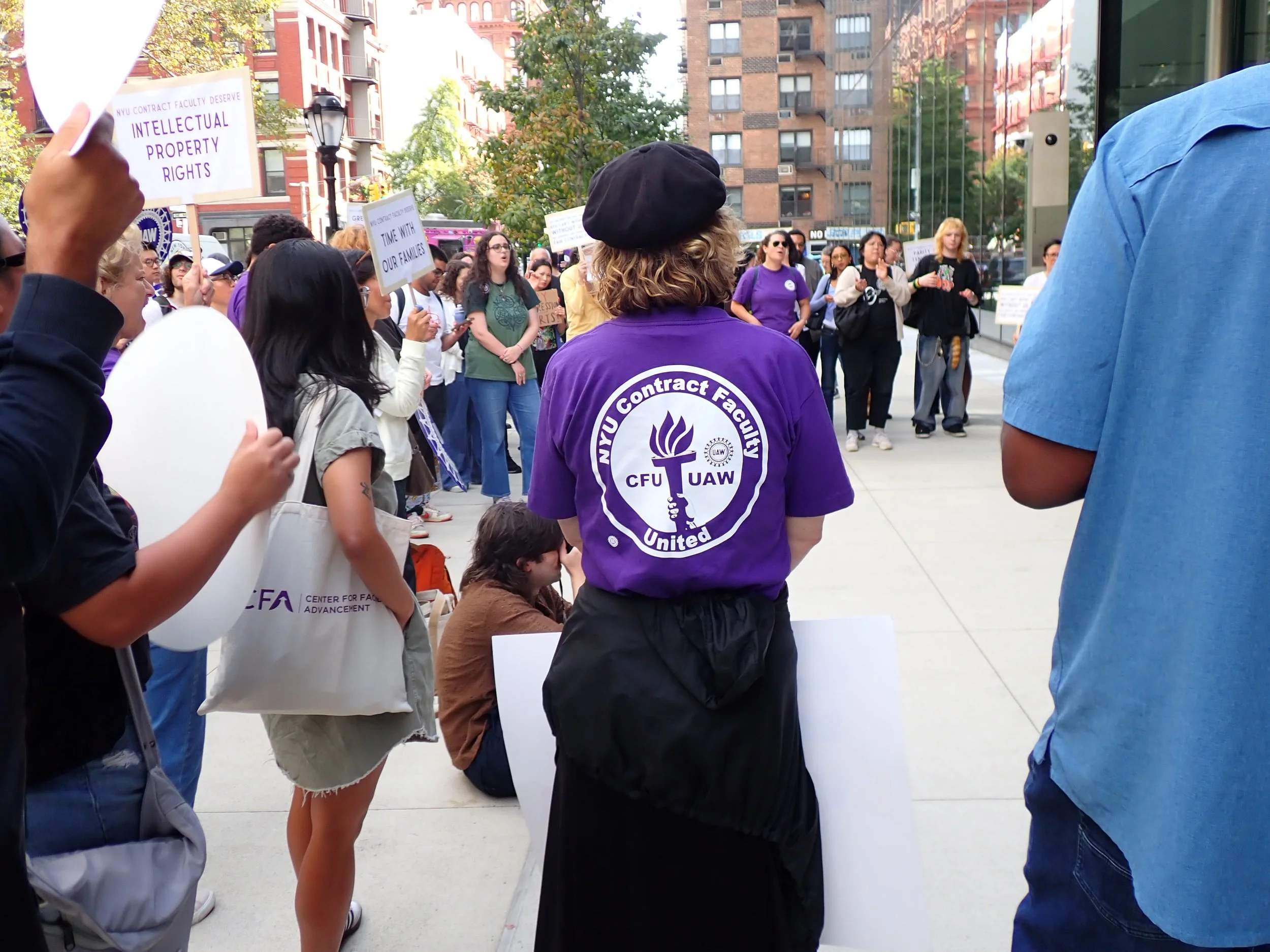
Unionized NYU professors say the institution has been unwilling to address their core demands.
The union added that the university has “refused to agree to meaningful job-security provisions that would protect our academic freedom” and “won’t negotiate over common-sense guardrails against AI replacing instructional work.”
It also called the administration’s offer for professional-development expenses “paltry”: one grant of up to $1,250 a year for faculty with no other research funding. That’s not enough to attend even one conference, says Remes.
The union also said that it was “misleading” for the administration to claim it had refused mediation.
“What we’ve said is that we do not believe it would be useful at this stage,” the CFU statement said. “Mediation tends to work best when the two sides are relatively close and need help coming up with solutions to address intractable disputes over a small number of core issues. We remain far apart on a large number of topics of high importance to our members. If the administration is not prepared to make major movement on core demands, mediation will simply mean we rehash existing positions in a different room.”
Remes said that the letter had stiffened CFU members’ resolve. The American Association of University Professors, which represents tenured faculty, has said it will instruct its members not to cross picket lines if there is a strike, as have the unions representing part-time faculty and graduate workers.
“None of us are eager for a strike,” Remes adds. “One of the things we’re fighting for is the integrity of an NYU education.”