
NYU Faculty Sets March 23 Strike Deadline
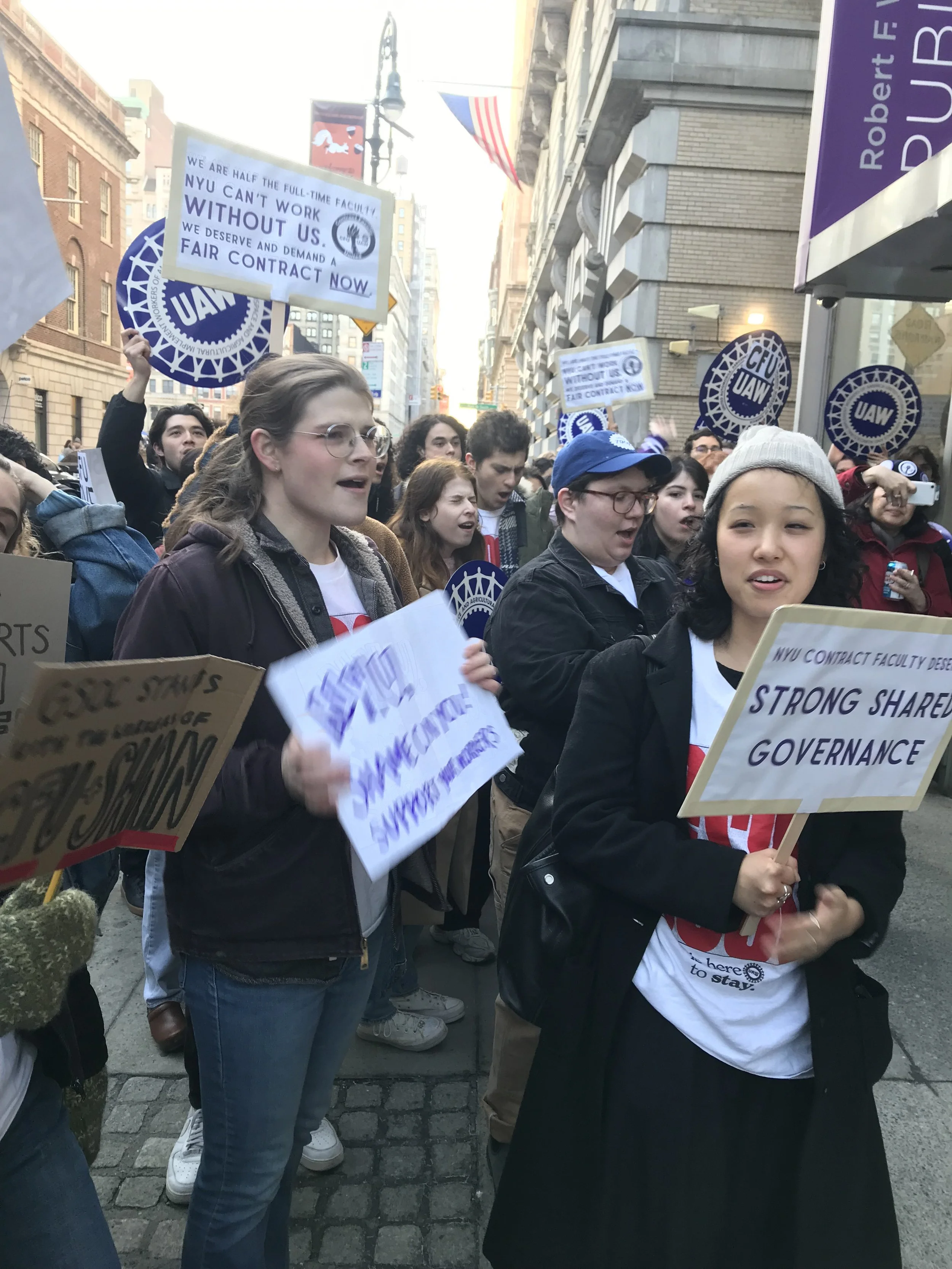
After spending the last 16 months in search of a contract, unionized faculty at New York University have set a strike date for March 23. Photos/Steve Wishnia
Editor’s Note: This story has been revised to reflect a statement from NYU.
By Steve Wishnia
Faculty at New York University who work on contracts will go on strike Monday, March 23 if they can’t reach a deal with the university by then, their union announced Feb. 27.
Management has “delayed, obfuscated, and repeatedly refused” to address problems, Elisabeth Fay, a member of the Contract Faculty United-UAW’s bargaining committee, told a group of about 100 people after they emerged from an NYU building near Union Square. “We are tired of waiting. We got some movement in our session today, but not enough.”
“We are prepared to withdraw our labor,” she concluded.
The administration offered to raise the minimum salary for contract professors, Fay said, but did not address “compression”—the situation in which longtime faculty often make lower salaries than recently hired professors, because their pay increases have been too small to keep up with the market. The administration, she added, also wants to replace peer-review committees, in which groups of professors recommend who gets retained or promoted, with individuals making recommendations directly to the dean.
The union represents 930 full-time professors and librarians who work on contract. They voted to join CFU in 2024, and have been negotiating for their first contract for 16 months. On Feb. 23, they voted 627-67 to authorize a strike.
The CFU has also filed an unfair-labor-practice complaint with an arbitrator. It accuses the university of bargaining in bad faith because it won’t discuss union demands for housing and retiree health-care benefits. “They said they won’t negotiate,” union spokesperson Jacob Remes told Work-Bites.
“We have just offered CFU-UAW members the highest minimum salaries of any unionized full-time contract faculty in the country, with a commitment that every bargaining unit member would ultimately earn six figures,” an NYU spokesperson said in a statement. “On top of this, we are offering all members immediate raises, five consecutive years of guaranteed salary increases, guaranteed 10 percent raises at promotion, formal equity reviews, and health and welfare benefits identical to those currently enjoyed by all full-time faculty and administrators. For more than four months, we have called on the union to join us and bring in an impartial mediator to reach a fair contract. There is no excuse for more delay.”
The university says it’s offering a five-year deal with a minimum base salary of $90,000 and 3% annual increases.
The union said in a message to members after the meeting that the administration was offering “no significant raises for 73% of us, a median raise of only 3%, and no fix to salary compression whatsoever.”
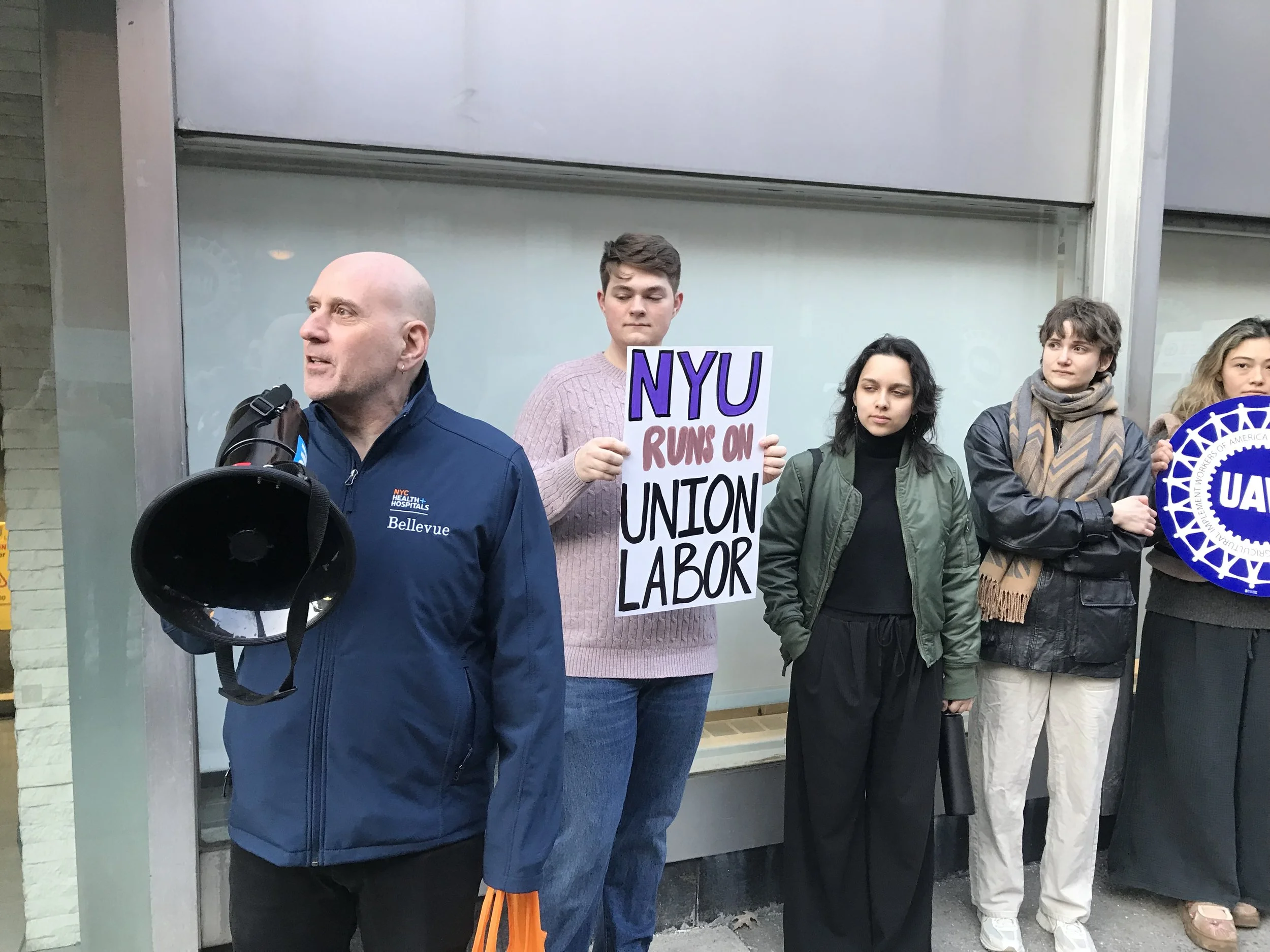
City Council Member Harvey Epstein [with bullhorn] rallies with NYU faculty members.
The administration, it added, is still refusing to address overwork, still refusing to protect international faculty from deportation, and still trying to end peer review for reappointment and promotion.
‘Casualization’ of academic work
Contract faculty, called “clinical” professors at NYU, make up about half of its full-time faculty. They occupy a middle tier in the academic-labor hierarchy: They don’t have the job security of tenure-track professors, but are less precarious than adjunct professors. They typically work on contracts of three to six years.
“The casualization of labor is as old as capital itself. It’s really sad to see universities taking on the corporate ethos of squeezing labor.”
Brandon Hogan, who teaches political philosophy at NYU’s School of Liberal Studies, has been working there for 18 years and been promoted to full professor—but he’s still working under a six-year contract.
“The casualization of labor is as old as capital itself,” he told Work-Bites. “It’s really sad to see universities taking on the corporate ethos of squeezing labor.”
The union’s four core demands revolve around compensation, job security, academic freedom, and “a meaningful role in university governance.”
“We do everything our tenured colleagues do, but without the job security that comes with tenure, or the compensation,” says Johann Jaeckel, a clinical associate professor of economics. “The administration must realize that our working conditions are the students’ learning conditions. An investment in contract faculty is an investment in the quality of education at NYU.”
Job security is an integral part of academic freedom, says Remes. “The heart of academic freedom,” he contends, is that faculty experts should be the ones to decide what gets taught and by who.
The administration has argued that those decisions are managerial duties, he says.
NYU denies that it wants to eliminate peer-review committees. “There is no change to shared governance on academic and pedagogical matters,” it says in a fact sheet on the talks.
Hogan says in his experience, both “the climate of faculty governance” and what is said in the classroom are “radically different” at universities where most faculty have tenure. “You’re less likely to speak up when your job is on the line.”
The rally was joined by City Councilmember Harvey Epstein (D-Manhattan); former city comptroller Brad Lander; supporters from the University Clerical, Administrative, and Technical Staff union, and undergraduate residential assistants.
The RAs, who signed their first union contract in December as Student Workers at NYU (UAW Local 7902), are supposed to get $2600 a semester, split into semi-monthly payments—but “five paychecks later, we haven’t gotten a cent,” RA Emily Lopez told the crowd.
Dan Maron, a junior RA, said the administration is “telling us it’s procedural and IT delays.”
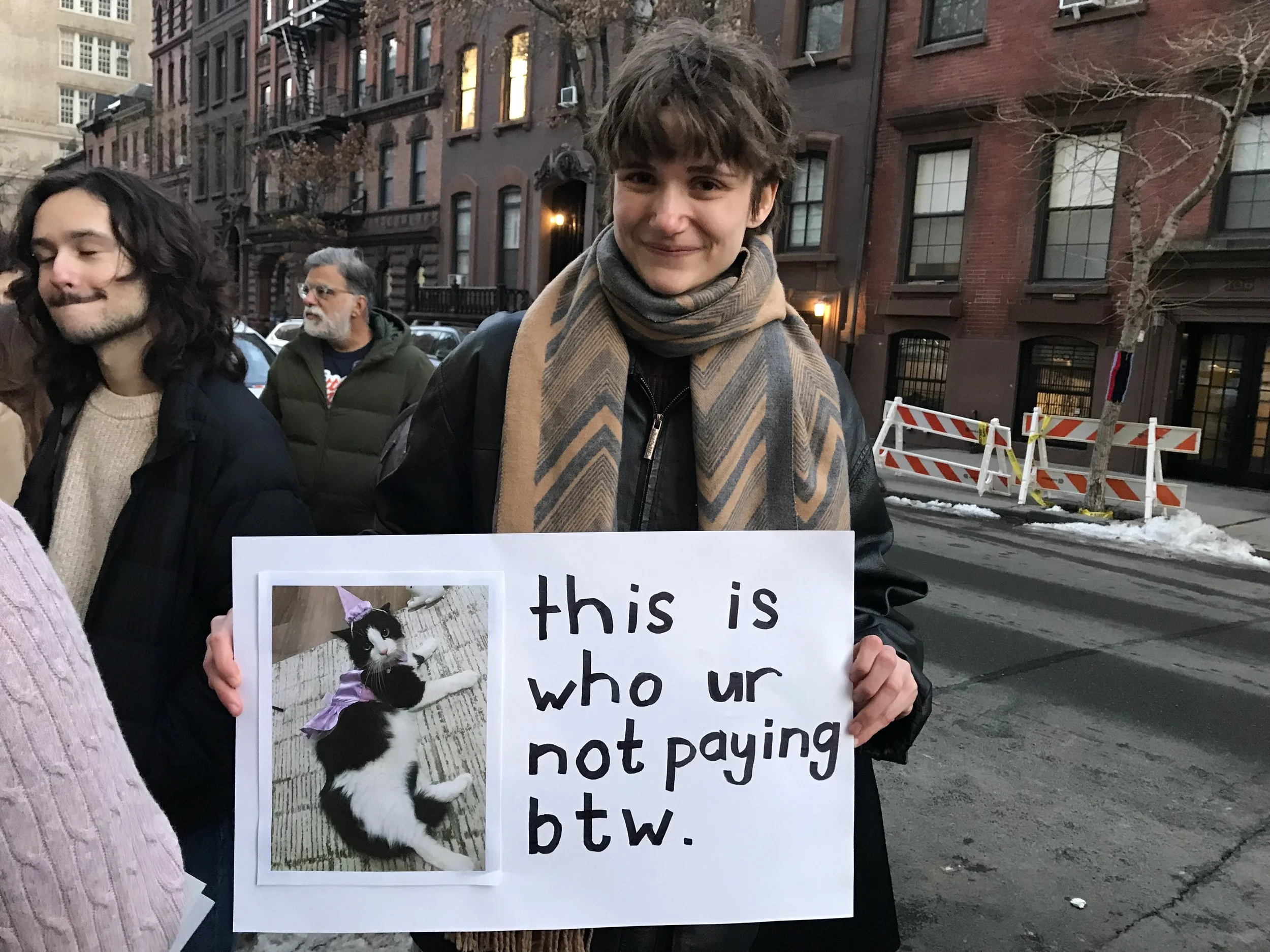
Ollie Mundahl carried a sign with a photo of her black and white cat and the message “this is who ur not paying btw.”
NYU President Tells Faculty to Cross Picket Lines
“This is not a decision we made lightly,” the CFU said in its message to members. “We had hoped that after our overwhelming strike vote, the administration would come prepared with serious offers that responded to contract faculty’s demands.”
“They have not heard us,” it concluded. “They have three weeks to get the message. If they don’t, half of NYU’s full-time faculty will strike on March 23.”
Meanwhile, a Feb. 25 message sent to all university staff, faculty, and administrators by President Linda Mills and Provost Gigi Dopico warned that while unionized contract faculty members have “the right to make their own decision” about whether to continue teaching if there is a strike, those “who are not in the CFU-UAW bargaining unit are required to continue carrying out their responsibilities.”