
NYSNA Faces Backlash Over ‘Sellout’ Tentative Agreement to End Historic Strike
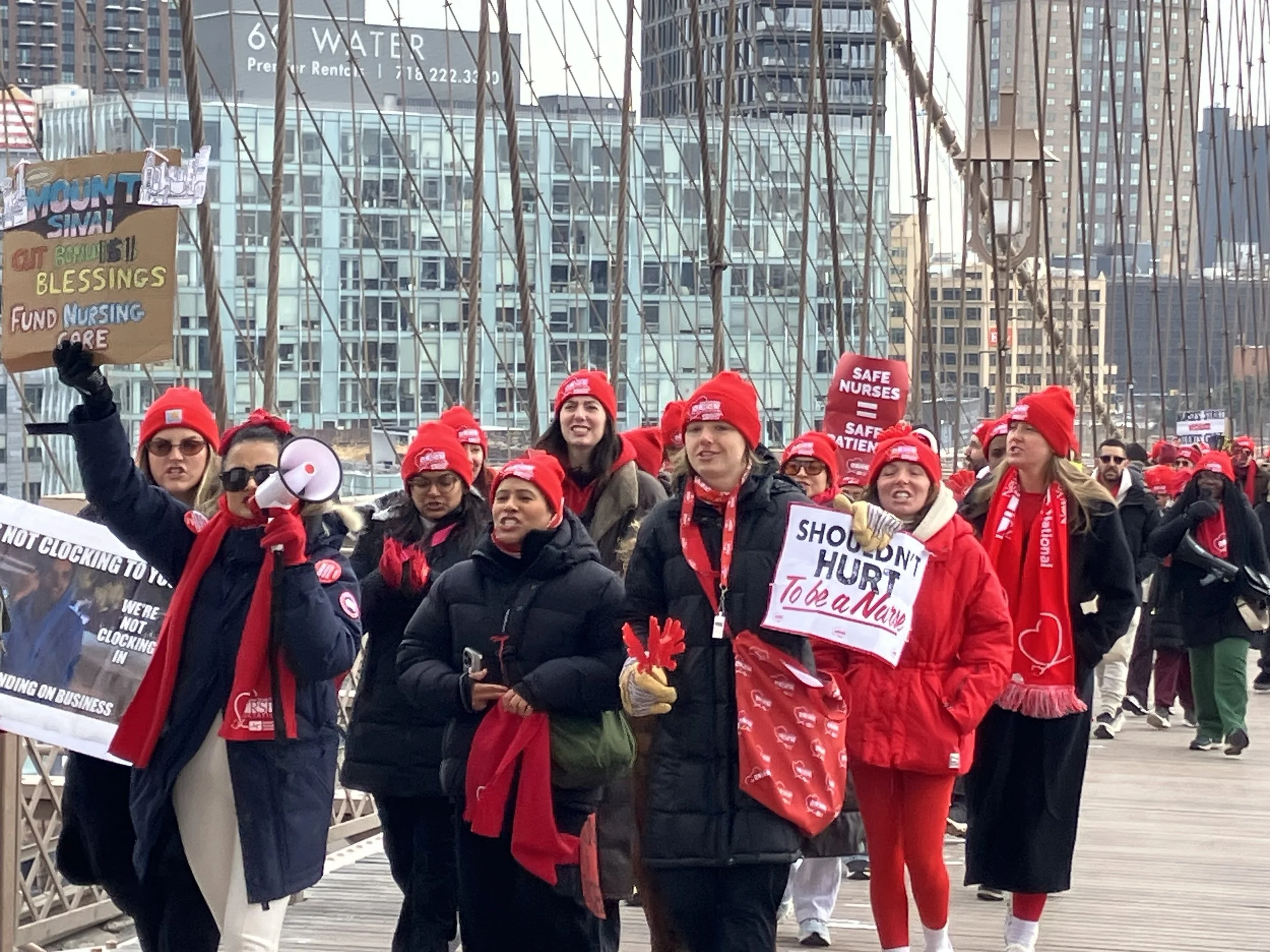
Striking NYSNA nurses marched over the Brooklyn Bridge on Feb. 3. This week, many are charging union leadership with forcing a weak contract on rank and file members. Photo/Joe Maniscalco
By Joe Maniscalco
Striking New York City nurses stormed over the Brooklyn Bridge on the 23rd day of their historic walkout last week convinced of the fight’s importance to the rest of American labor movement today, and generations of nurses to come.
This week, they are winding down that strike under a cloud of controversy with many objecting to what they see as a lack of transparency among the upper echelons of the New York State Nurses Association [NYSNA] and a “sellout contract” being forced down the throats of rank and file members.
Some on social media are calling on NYSNA President Nancy Hagans to resign.
NYSNA declared victory in the monthlong strike on Monday, Feb. 9 with an announcement that striking nurses at Montefiore, Mount Sinai Hospital and Mount Sinai Morningside and West had reached a tentative agreement to end the historic walkout.
Nurses at Montefiore, Mount Sinai, and Mount Sinai Morningside and West reportedly began voting on the pact the same day. Nurses at NewYork-Presbyterian were given the agreement to vote on the following day—bypassing the nurses’ executive committee which opposed the deal and sparking angry pushback.
“Of course, everyone is horrified, aghast—because how could they do that? We have procedures in place. We’re a democratic union…we all get a say in everything,” Instagram user Krizia_daya said in a Feb. 10 post. “So, how could NYSNA upper management get with Presbyterian to say, okay, the nurses are gonna now vote when our nurses are actually still outside picketing?”
Voting on the tentative contracts covering all the hospital systems involved in the punishing monthlong strike is supposed to wrap up today— Wednesday, Feb. 11 with NYSNA announcing the results immediately after the results are in.
If and when the tentative agreement gets enough votes to pass, NYSNA says most nurses can return to work by Valentine’s Day—Feb. 14. But it remains unclear exactly how many striking nurses will actually be able to return to work by that date.
Mount Sinai CEO Brendan Carr previously released a statement alluding to a “safe transition back to staffing with Mount Sinai’s nurses who were on strike.”
“Once NYSNA shares the results of the ratification vote, assuming the new contract is approved, we’ll start the safe transition back to staffing with Mount Sinai’s nurses who were on strike,” he said. “We will share detailed logistics on how the process will work for affected individuals.”
Three nurses previously fired from their posts at Mount Sinai on the eve of the strike will not be among them, however. Their cases are reportedly still in arbitration.
According to NYSNA, the tentative agreement with the hospital bosses includes “enforceable safe staffing standards” and an increase in “the number of nurses to improve patient care.”
Many opposed to the tentative agreement are not convinced, however. Safe staffing was the major reason New York City nurses gave for going on strike Jan. 12—beyond pay raises and attacks on their healthcare.
“We need more nurses in the hospital,” Sophia Dames, a Post-Acute Recovery Unit RN at Mount Sinai Hospital told Work-Bites before marching over the Brooklyn Bridge on Feb. 3. ‘If we are a unit that needs 20 nurses, we need to have 20 nurses—not 9 nurses, not 10 nurses. When you are understaffed you are putting your patients in danger. That’s why everybody is here today—to protect our patients and to protect our communities.”
Another striking Mount Sinai nurse who requested anonymity told Work-Bites, if NYSNA doesn’t persevere and continue fight “the generation behind me is gonna suffer more.”
“What [hospital bosses] really want to do is get rid of unions,” she said. “And if we don’t fight what’s gonna happen to our children or grandchildren? People say don’t indulge politics in this—but it’s about politics.”
Governor Kathy Hochul issued an executive order ahead of the historic nurses strike making it easy for NYC’s private hospital bosses to bring in travel nurses to do the jobs of striking union nurses—at a cost of over $100 million. The governor repeatedly extended the executive order over the course of the strike.
The last extension expired on Feb. 10.