
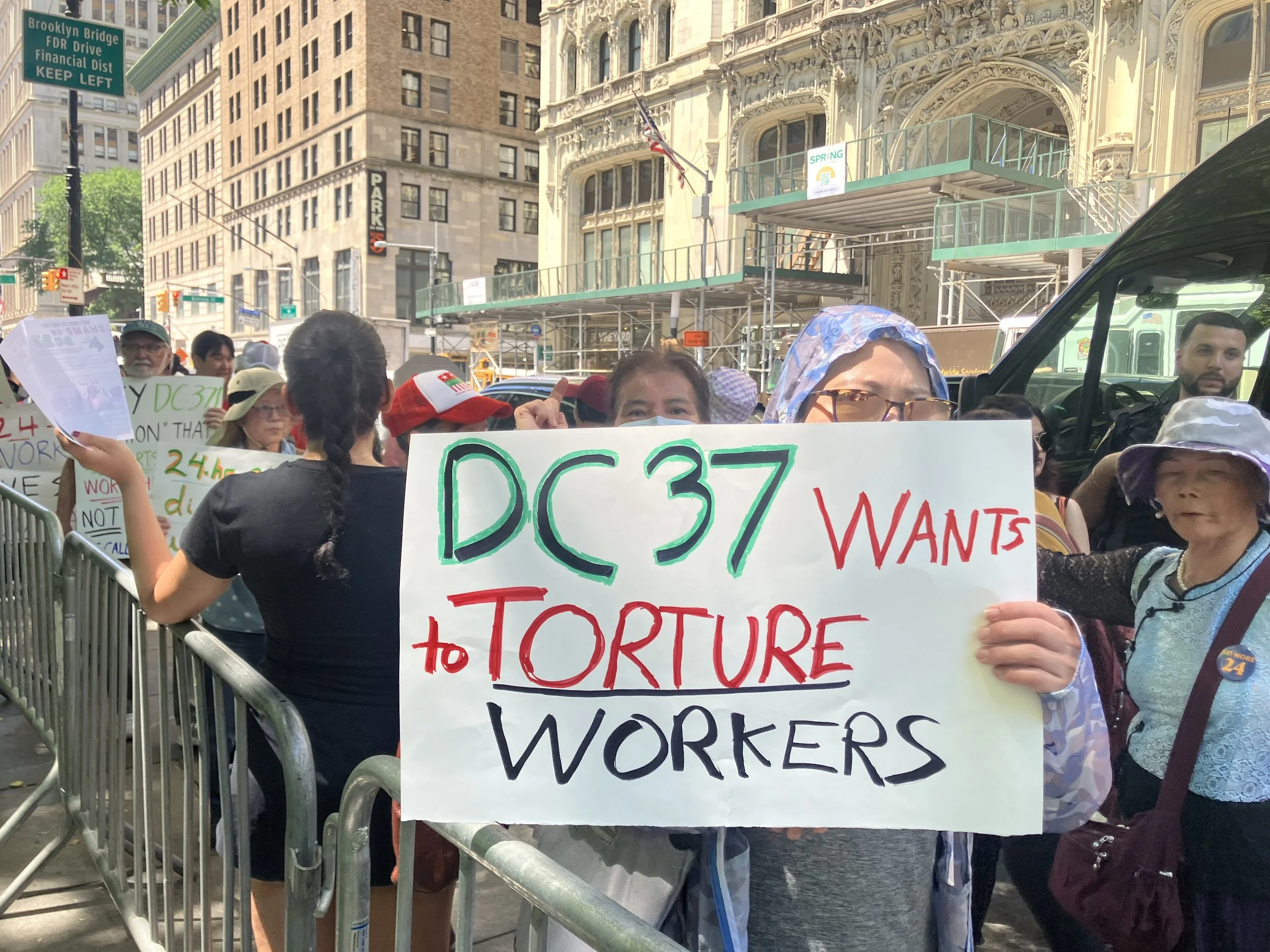
New York City home care workers and their advocates urging City Council Speaker Julie Menin to back the No More 24 bill clashed with members of District Council 37 at demonstrations held outside City Hall on May 20. Photos/Joe Maniscalco
By Joe Maniscalco
A coalition of both active workers and retirees from New York City’s largest public sector union is defying union leadership and calling on City Council Speaker Julie Menin to back a bill banning round-the-clock shifts in the home care industry.
“We, the undersigned retired and active members of District Council 37, are deeply concerned that the City is failing to enact the ORIGINAL, UNAMENDED No More 24 bill to abolish the 24-hour workday system,” the open letter to Speaker Menin states.
DC37 Local 3005, the union representing some 1,200 New York City Office of Chief Medical Examiner (OCME) and Department of Health and Mental Hygiene (DOHMH) employees, passed a motion at its May 28 general meeting announcing that it’s signing onto the open letter with retirees and members of more than 10 other DC37 locals as a “single entity.”
The action comes just a week after DC37 Executive Director Henry Garrido led an ugly demonstration outside City Hall on May 20 deriding No More 24 proponents for not having “skin on the line,” and warning that passage of Intro. 303 will deprive clients of the round-the-clock care that some require.
“Change is needed,” Brendan Griffith, president of the New York City Central Labor Council, told the DC37 rally. “But you can’t fix a flawed system by implementing new requirements without a sustained funding solution and hoping everything works itself out, and that is exactly what Intro 303 would do.”
Intro. 303 advocates led a counter protest during the same DC37 demonstration, however, in which they both dismissed those claims as fear-mongering and denounced Garrido’s historic failure to help advance efforts to ban the 24-hour workday during any point in the decade-old No More 24 campaign.

District Council 37 Executive Director Henry Garrido vowed to continue efforts to “amend” or “kill” Intro. 303 during a union demonstration held outside City Hall on May 20.
Local 3005 specifically called out the legalized system of wage theft in New York State that continues to allow home care employers to assign employees 24-hour shifts while only paying them for 13 hours.
“Home care employees realistically cannot take their legally allowed breaks while attending to their patients’ needs and due to the fact that their services were authorized as 24 hours of care, resulting in worker exploitation and worse care for patients,” Local 3005’s motion in support of Intro. 303 says in part.
Speaker Menin met with home care workers advocating for passage of the No More 24 bill during Day 2 of their previously-held City Hall sit-in on March 19, in which she promised to bring Intro. 303 to the floor for a vote the following month.
But April came and went without any action being taken other than attempts by Garrido and others to weaken or kill the bill.
“We saw you in the media promising the workers that you would submit Intro 303, unchanged, to be voted on,” the open letter to Speaker Menin goes on to state. “We know that you are under immense pressure from the insurance companies, home care agencies, and SEIU1199 & DC37. We also know that Governor Hochul and Mayor Mamdani are pressuring you. We are particularly stunned by Local 389 of DC 37 asking to be exempted from the bill, essentially sanctioning brutal 24-hour workdays for its own home attendant members.”
DC37 Local 389 represents about 5,000 New York City Home care workers.
“We should be getting paid more, but what can you do,” DC37 Local 389 President Margaret Glover told Work-Bites during the union’s May 20 demonstration outside City Hall. Asked whether aides get paid more when they don’t get uninterrupted sleep, she exclaimed, “No! We don’t get paid for it.”
Editor’s Note: This is a developing story and Work-Bites will have more as additional facts are obtained.