
NYC Home Care Workers Bring ‘Street Heat’ to No More 24 Fight; Mamdani, Menin Give ‘Aunties’ the Cold Shoulder Anyway
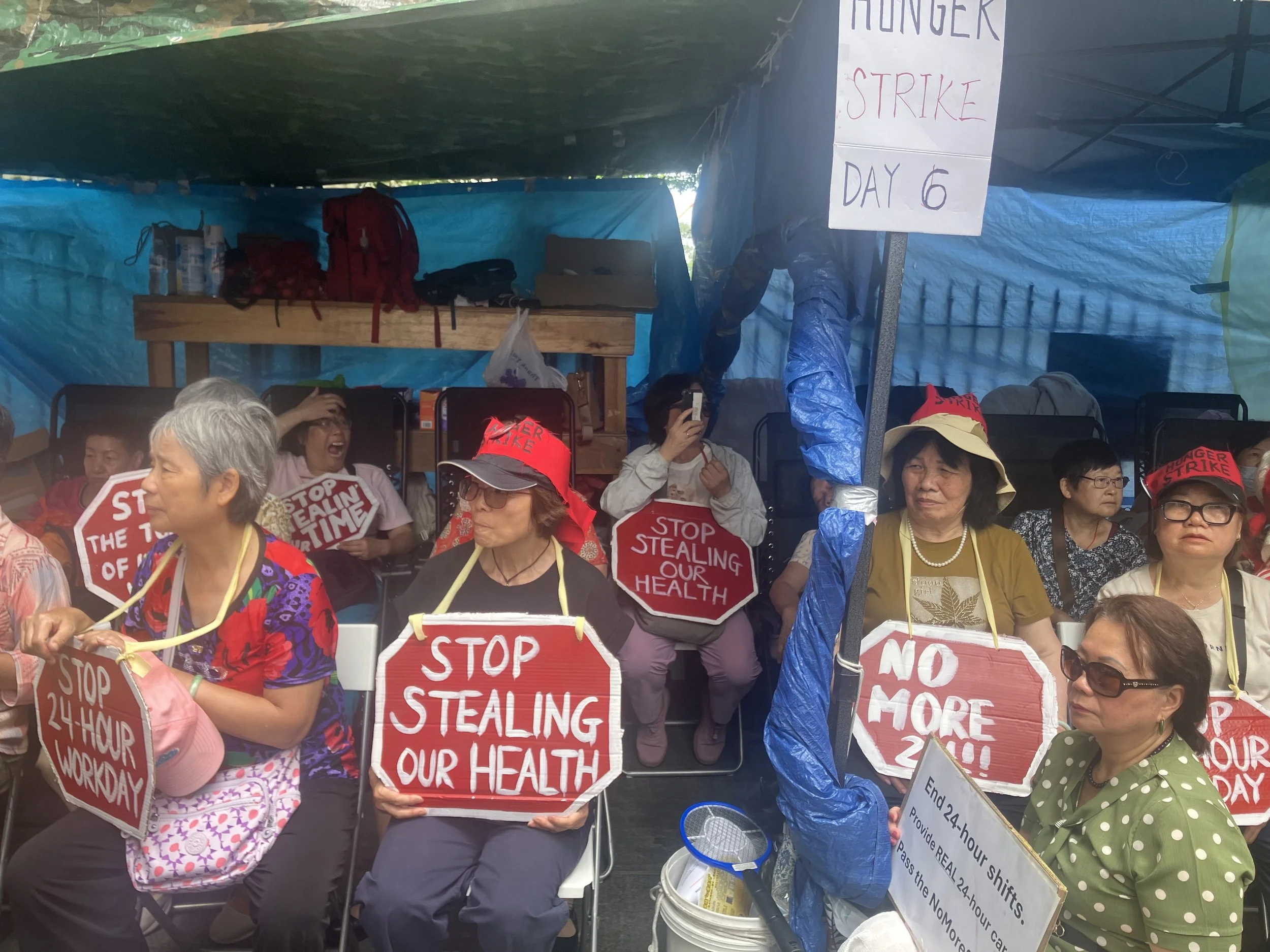
Home care workers fighting to end the 24-hour workday ended their 8-day hunger strike outside City Hall this week without seeing a vote on Intro. 303—the No More 24 bill. Photos/Joe Maniscalco
By Joe Maniscalco
Home care workers in New York City have generated a ton street heat this summer—but none of it has so far succeeded in moving New York City Council Speaker Julie Menin to fulfill the pledge she made months ago to allow a democratic vote on Intro. 303—the No More 24 bill.
What it has done, however, is strip away the already shaky pretense of New York City being a “Union Town,” while further exposing the ugly truth that this is a city where labor leaders and elected officials conspire to exploit the work that women do—especially the work of older immigrant women of color.
No More 24 advocates concluded an 8-day hunger strike outside the gates of City Hall on Tuesday—their second this year. That action was preceded by a two-week sit-in outside Menin’s upper east side residence. Home care workers and their allies also rallied on the steps of City Hall on July 30. But both Mayor Zohran Mamdani and Speaker Julie Menin ignored every one of those actions.
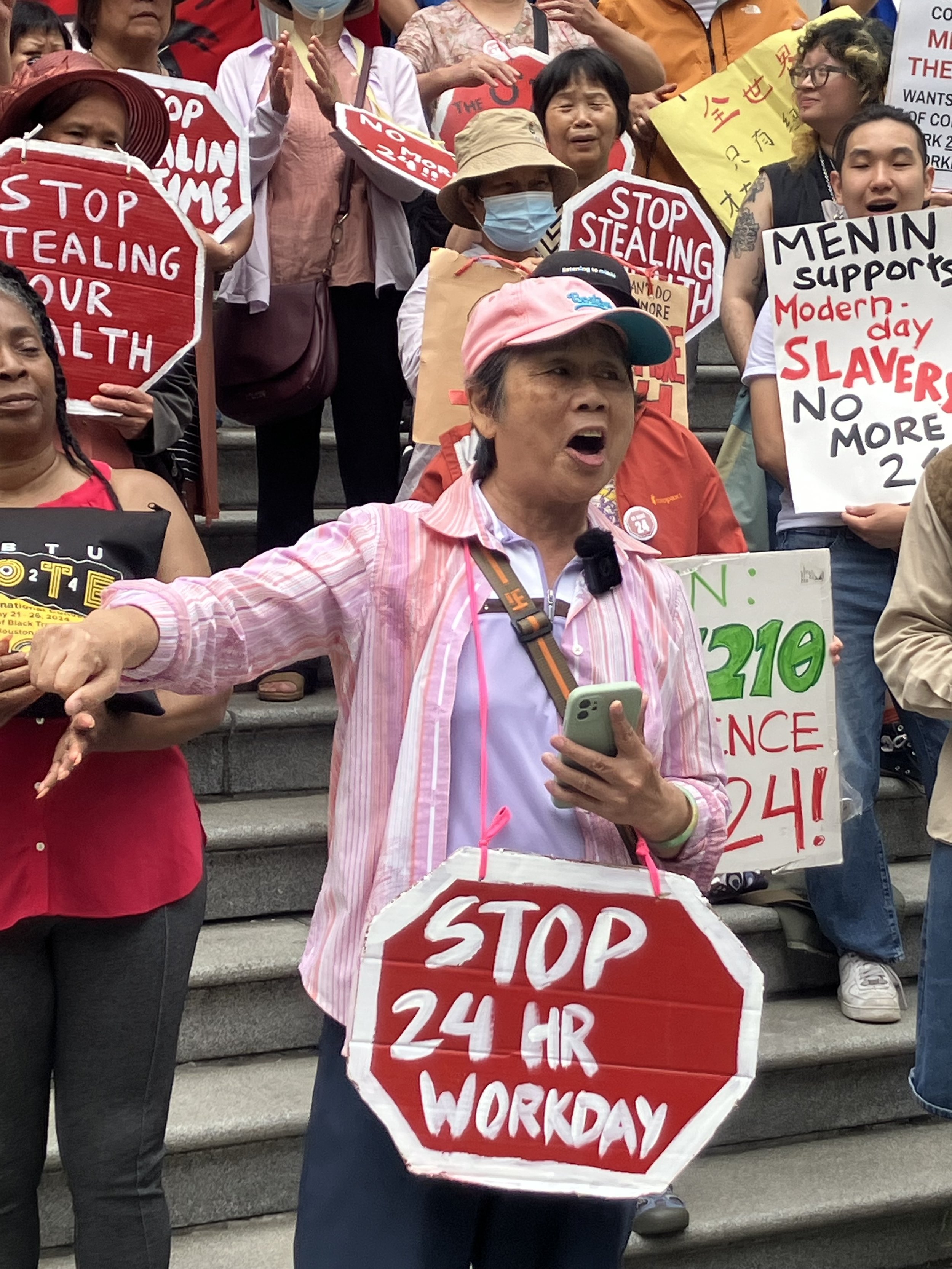
Retired home care worker and 1199SEIU member Lai Yee Chan charges City Council Speaker Julie Menin with dividing workers and perpetuating the torturous 24-hour workday.
The man who famously called for the end of the 24 hour workday while campaigning for office and celebrated “those so often forgotten by the politics of our city” once he became mayor—could not find it within himself to meet with the “aunties” actually leading the fight against round-the-clock shifts and institutionalized wage theft in New York City’s home care industry.
Neither could the woman who in March joined those same aunties on the sidewalk outside the gates of City Hall during yet another street action, looked them in the eyes, and pledged to be their No More 24 champion.
District Council 37 Executive Director Henry Garrido, the head of the largest public sector union in New York City, intervened in May and vowed to “kill” the No More 24 bill because he said his members in Local 389 want to work round-the-clock shifts while only being paid for 13 hours, and that requiring split 12-hour shifts would jeopardize patient care.
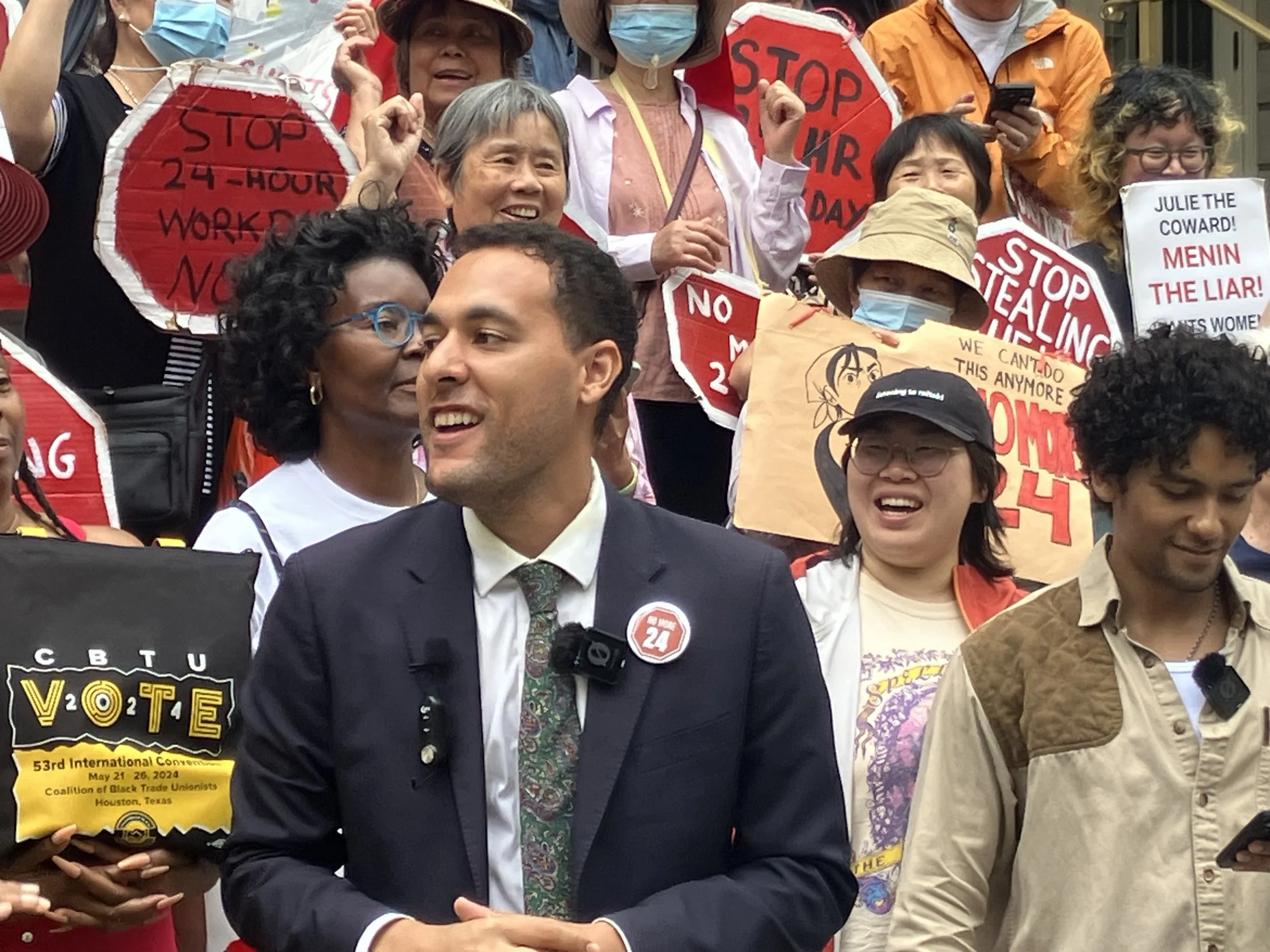
No More 24 sponsor Christopher Marte calls out DC37 Executive Director Henry Garrido for supporting a status quo that oppresses some of New York City’s most vulnerable workers.
The following month, Menin introduced new language into Intro. 303 explicitly exempting unionized workers from the intent of the bill to protect them from round-the-clock shifts at roughly half the pay.
“This is why people created unions—to come together as a collective and to fight for our rights,” Intro. 303 sponsor Chris Marte [D-1st District] said at last Thursday’s No More 24 rally on the steps of City Hall. “However, today in 2026, in the most progressive city in the country, we have these same labor leaders who are supporting the oppression of their workers. And not just any workers, but some of the most vulnerable workers here in New York City.”
Former City Council Member Charles Barron called Garrido a “traitor to human rights, civil rights, and the right of human decency.”
DC 37 Local 3005 member Christina Rodriquez-Hart said she was compelled to speak out at the July 30 No More 24 rally on the steps of City Hall because of the lack of leadership she is seeing from her union.
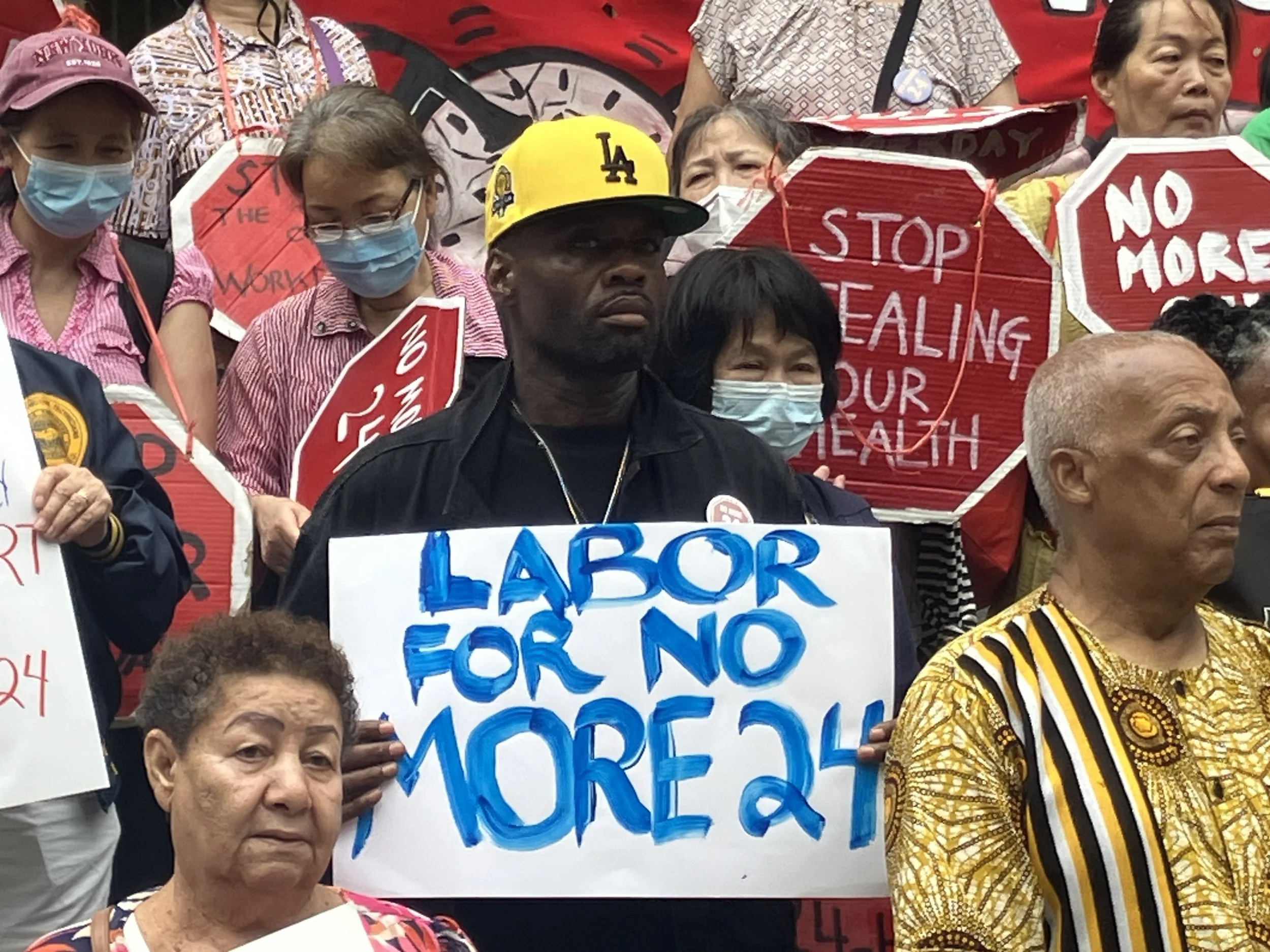
Coalition of Black Trade Unionists member Craig Moore, seen here holding a “Labor For No More 24” sign on the steps of City Hall with home care workers and former Council Member Charles Barron [r], said union contracts allowing round-the-clock shifts in the home care industry exploit workers.
In addition to the aforementioned rationale for wanting to kill Intro. 303, Garrido reportedly also told Rodriguez-Hart that Local 389 members would lose their benefits and jobs if the City Council were to pass the No More 24 bill.
“He didn’t show me any proof—so I don’t believe him at this point,” Rodriguez-Hart said last week. “Show us the contract language. It’s your staff that is responsible for negotiating—did you negotiate a bad contract?
Repeated efforts to reach District Council 37 and the Mayor’s Office for comment on this story were all unsuccessful. Speaker Menin’s office also failed to respond to repeated requests for comment, going so far as blocking emails from Work-Bites.

Former City Council Member and State Supreme Court Justice Kathryn E. Freed joins home care workers on Broadway to denounce the 24-hour workday.
The United Nations Working Group on Discrimination against Women and Girls officially flagged round-the-clock shifts in New York City’s home care industry as an ongoing human rights violation back in April.
Since then, it has proceeded to further alert both Mayor Mamdani and Speaker Menin, as well as Governor Kathy Hochul, about the international community’s concerns regarding New York City’s peculiar institution—one that “creates exploitative work conditions and disproportionately affects women, especially migrant women, in detrimental ways.”
Lisa Goldenberg Corn, co-founder of the Downtown Nasty Women Social Group, called institutionalized efforts to sink the No More 24 bill a “horrible example for the women and girls of New York City.”

Home care workers and their allies fighting for passage of Intro. 303-the No More 24 bill-have spent weeks camped outside City Hall without ever seeing Mayor Zohran Mamdani.
“New York City is a Union Town—we hear this every day from Mayor Mamdani,” she said on Sunday, the sixth day of the home care worker hunger strike. “And that he supports union workers, and that all New Yorkers deserve to live and work with dignity. Yet, Julie Menin is trying to change the [No More 24] bill and delay dignity for these union workers. It seems that when New York City government talks about giving dignity to union workers—they’re only talking about men in hard hats. Why are they abandoning the women union workers?”
Despite Garrido’s opposition, No More 24 advocates vow to return to City Hall on October 3, stronger than ever to press the fight against the 24 hour workday.
On Tuesday, UFT high school educator and DSA member Laurel Gwizdak called the latest No More 24 hunger strike a victorious “unifying force in bringing people together in the call for care-giving to be valued.”
This summer’s street actions in support of the No More 24 bill may have so far failed to result in Intro. 303 being allowed onto the City Council floor for a democratic vote—but they have already succeeded in raising public awareness about the issue and putting it context with the overall way the City of New York continues to devalue women—and the work that they do.
“Home care workers are expected to do care work for 24 hours straight,” Gwizdak added. “And this is possible because care is treated by all of us as something women naturally do out of love, at all hours, unpaid, and out of sight—which allows employers to demand more and more while paying less and less.”
The result, Gwizdak continued, is a care system “built on the mass exploitation of immigrant women of color.”