
NYC Home Care Workers Got a Hearing on the ‘No More 24’ Bill—Now, Will They Finally Get a Vote?
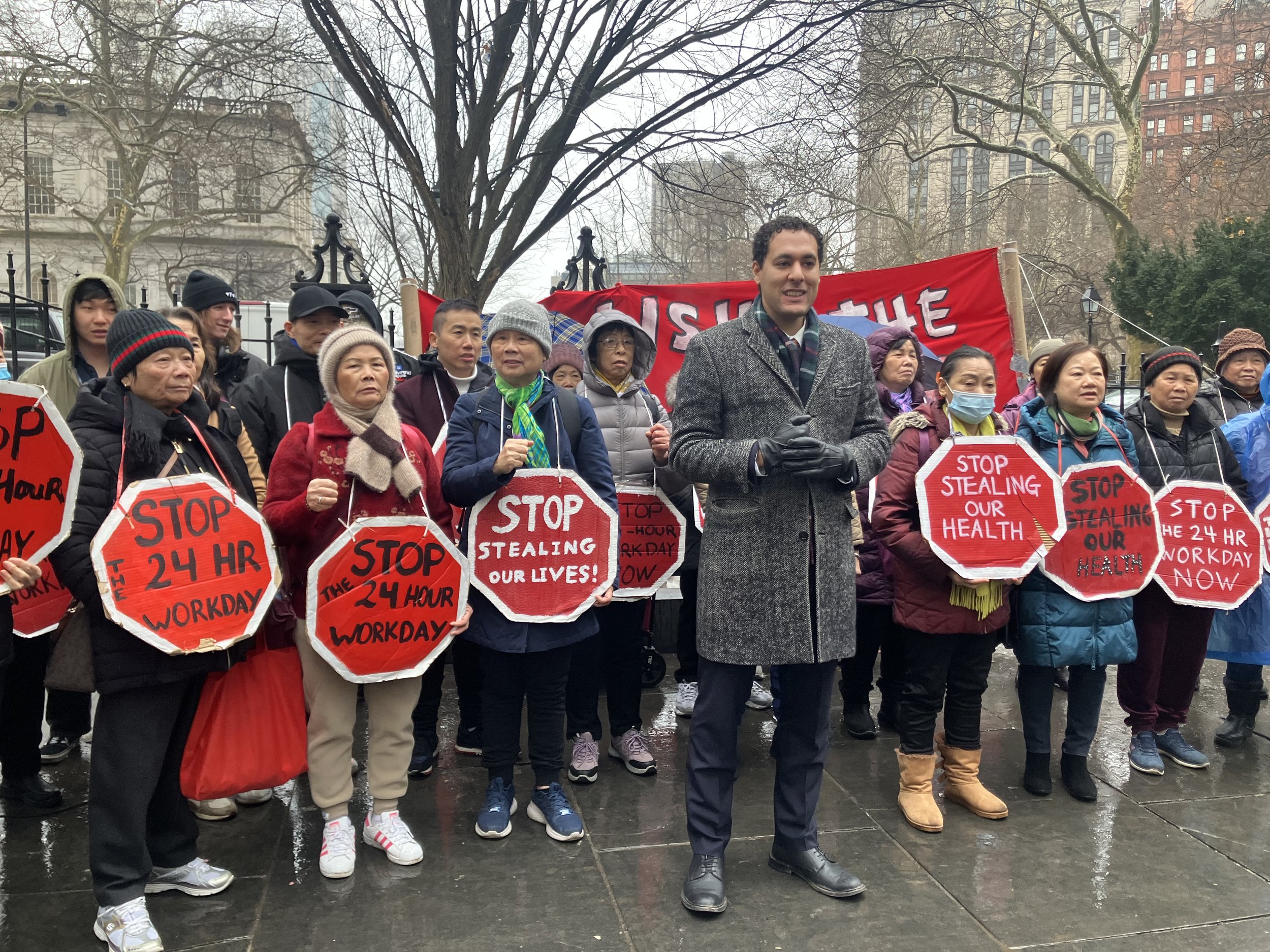
New York City Council Member Christ Marte rallies with home care workers outside the gates of City Hall on Wednesday morning ahead of a Labor and Civil Service Committee hearing on the “No More 24” bill—a measure that would effectively ban round-the-clock shifts in New York City’s home care industry if signed into law. Photos/Joe Maniscalco
By Joe Maniscalco
Home care workers forced to work slavish round-the-clock shifts and individually owed hundreds of thousands of dollars in stolen wages cheered a New York City Council hearing on the “No More 24” bill this week hoping a majority vote and Mayor Zohran Mamdani’s signature won’t be too far behind.
“I’m really excited that [City Council] Speaker Julie Menin [D-5th District] has been working to get this hearing so quickly in her term,” Council Member Christopher Marte [D-1st District] told Work-Bites and other reporters outside the gates of City Hall on Feb. 18. “It really shows she cares about this population.”
Former City Council Speaker Adrienne Adams consistently blocked a vote on previous versions of the “No More 24” bill during her entire tenure claiming that legislative efforts to institute split shifts and ending round-the-clock work for the city’s roughly 300,000 home care workers was an issue for the state.
Adams—recently tapped to be Governor Kathy Hochul’s running mate in the next gubernatorial election—steadfastly blocked a vote on the “No More 24” bill despite being accused of kowtowing to powerful special interest groups and helping to commit “violence” against women of color.
Council Member Marte—the original sponsor of the “No More 24” bill back in 2022—reintroduced the measure as Intro. 303 on January 29. If finally passed into law, Intro. 303 would cap the maximum number of hours any New York City home care worker could work during a single shift at 12. The legislation does allow for emergencies and exceptions, however.

New York City home care workers testified on Wednesday to years of institutionalized wage theft and exploitation.
“This bill will abolish the 24-hour [shifts] for home care workers which currently happens all across New York City, but hardly happens in the rest of this state. Why? Because most of the women and the women behind me are immigrant women of color,” Council Member Marte said on Wednesday. “They’ve been exploited not just by their employer—but by a system created by the state to push them down, take their wages, and make them work tortuous hours.”
In 2022, New York State Assembly Member Ron Kim [D-40th District] also produced a report called “The Nonprofit War on Workers” in which he blasted the powerful Chinese-American Planning Council in particular for exploiting home care workers. The Chinese-American Planning Council Home Attendant Program, Inc. (CPCHAP), employs more than 6,000 home care workers and touts itself as one of the largest non-profit home care service agencies in New York City.
On Wednesday, Assembly Member Kim said previous city and state officials “looked the other way as insurance companies and bosses made billions and billions off of these workers.”
“That day is going to end today,” he said. “We are going to get justice for these workers and workers who are no longer with us. After years of giving of themselves, many of those workers are now retired, aging, and their health is declining. Before it’s too late—let’s fight and get justice and make this right.”
A CPC spokesperson told Work-Bites that her organization “welcomes legislative efforts to address the need for reforms that improve scheduling for home care workers”—but that it has not testified or met with the City Council about Intro. 303.
“Currently, home care agencies, including our subsidiary CPCHAP do not have the authority to split 24-hour shifts on their own,” CPC spokesperson Alice Du said in an email. “For years, CPC has advocated at the State level for home care workers to be fully compensated for every hour they spend in clients' homes, and for better wages that reflect the essential care they provide.”

New York City home care workers are still waiting for what they’re owed and an end to slavish round-the-clock shifts.
Home care worker Zhen Li said on Wednesday that she spent more than a decade doing round-the-clock shifts for another New York City employer called Community Home Care, as well as another called Human Care.
“Longterm sleep deprivation, combined with frequent lifting and pulling patients, severely damaged my lower back and shoulders. I live with constant pain,” she said in a statement. “We repeatedly told the agencies that 24-hour shifts were too exhausting and that we had no time to sleep. The companies ignored us. They only said they would ‘talk to the patients,’ but nothing ever changed.”
Dr. Steve Auerbach, a retired physician testifying at Wednesday’s Civil Service and Labor Committee hearing at 250 Broadway on behalf of Health Justice for New York and Physicians for a National Health Program-NY Metro Chapter, called it “absurd and obscene that an employer is allowed to control where an employed person’s body is located for a 24-hour shift but then only pays for 13 hours.”
“It is claimed that these shifts are made acceptable due to the court ostensibly mandating that three hours are for meal breaks and eight hours designated to rest—five of which should be for ‘uninterrupted sleep,’ Dr. Auerbach said. “To be polite, this is bullshit. In reality all these patients require continuous attention or care. That is the entire reason a caregiver needs to be there continuously over a 24 hour day.”
State Senator Jessica Ramos [D,WF-13th District], likened the continuation of round-the-clock shifts in New York City’s home care industry to the “last vestiges of Jim Crow.”
“There’s a history to the feminization of poverty in our state,” the senator said on Wednesday. “When our state constitution was written they purposely left out agricultural workers and domestic workers because at the time, most of that work was done by Black people. And this work continues to be done largely by women and by women of color—whether they are Black, Asian, or Latinas. And every time there is an opportunity to do the right thing—to change the law, to give them a raise, to pay what’s just—the rich, the insurance companies come out with every excuse, every loophole, and every way to avoid doing the right thing.”
A $30 million “Special Wage Fund” covering wage theft claims for active and former home care workers was created in 2022 after unions, led by 1199 SEIU, consolidated wage theft claims against 42 different home care agencies—including the CPC—into a single arbitration case.
But home care workers, many who are 1199SEIU members themselves, insist that fund amounted to “crumbs” and failed to even approach what home care workers are actually owed in unpaid wages.
A union spokesperson told Work-Bites, “Home care workers should be paid for every hour that they are required to be in the homes of consumers”—but with significant qualifications.
“1199SEIU fully supports legislation ending 24-hour shifts that does not place unfair limitations on workers’ hard won right to earn overtime and includes full Medicaid funding for the additional hours to prevent consumers from being forced into nursing homes and subsequent job losses for their dedicated caregivers,” 1199SEIU spokesperson Rose Ryan said in an email.
Retired UFT educator and Cross-Union Retirees Organizing Committee [CROC] activist Sarah Shapiro called on Adrienne Adams’ successor to finally bring the “No More 24” bill to the floor for a vote.
“We are advocating for Speaker Menin to do the right thing—bring Intro. 303 to the floor for a vote. It’s time to pass the ‘No More 24’ Act,” she said.
When asked to comment, a spokesperson for Speaker Menin told Work-Bites, “Introduction 303 has only just been heard in Committee today and will continue going through the legislative process.”
Assembly Member Kim called Wednesday’s Labor and Civil Service Committee hearing on Council Member Marte’s “No More 24” bill the “first step” in finally securing justice for exploited home care workers.
“We’re going to take this to the state to make sure we get the back wages that’s owed to these workers and end 24-hour work once and for all—not only in New York City but across this country,” he said.
Intro. 303 has 16 co-sponsors at the time of this writing.