
No More 24 Fight Continues in NYC: is it Because Women of Color are Just Easier to Step on?
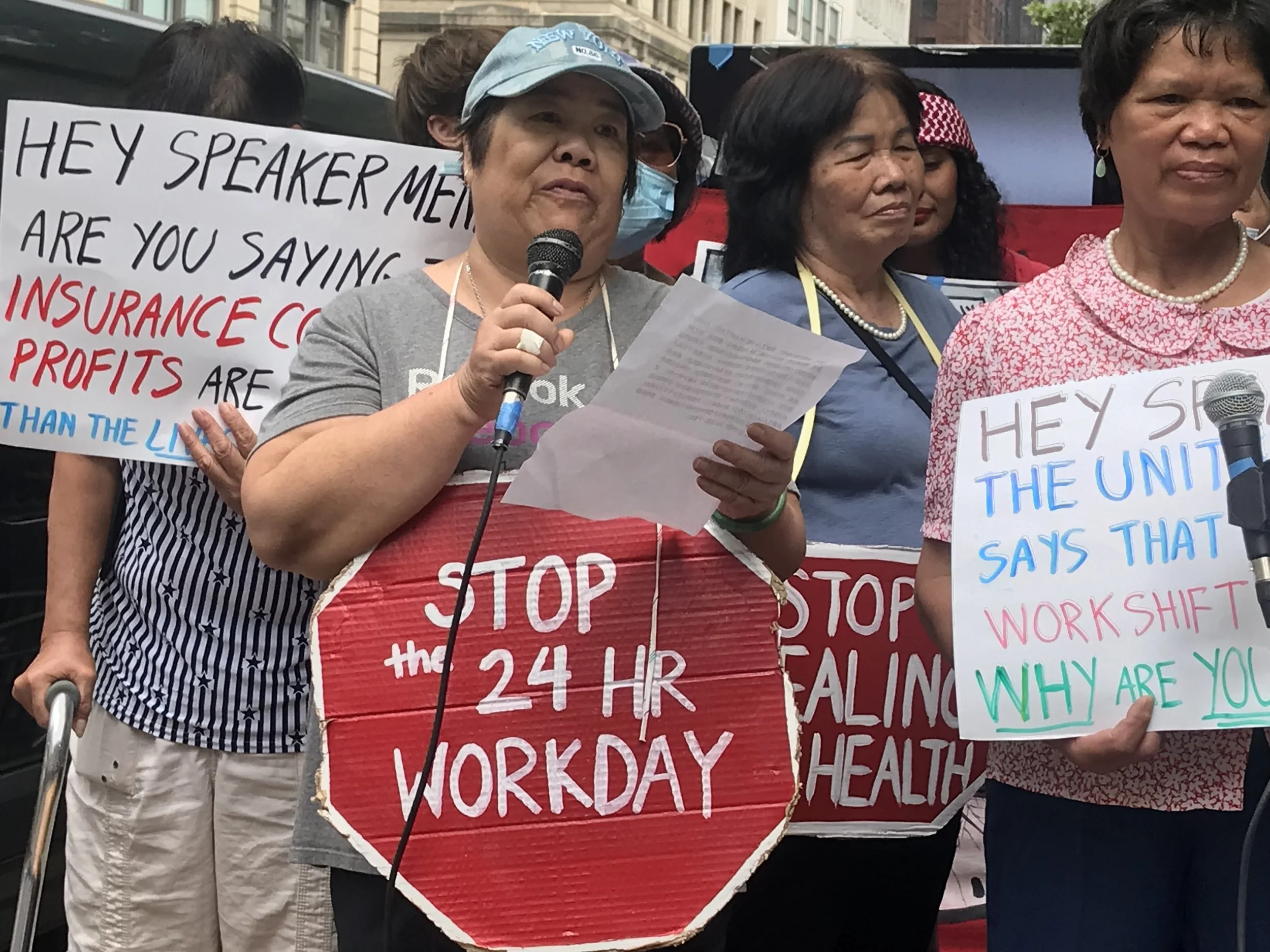
Retired home-care attendant Yun Fang Zhang, 70, worked round-the-clock shifts for more than a decade and still suffers from the effects. Photos/Steve Wishnia
By Steve Wishnia
Twelve black mesh folding chairs were arranged in two rows, like a jury box, by the Broadway entrance to City Hall July 28—places to sit for home health aides as they began another hunger strike to demand that the City Council pass legislation to ban 24-hour shifts.
Council Speaker Julie Menin has “delayed the bill multiple times,” hunger striker Yun Fang Zhang, 70, told Work-Bites after the rally, speaking in Mandarin and Fujianese through a translator.
The Speaker had promised in March to bring Intro 303, the bill to prohibit 24-hour shifts, to a vote, but in May proposed a revised version, Intro 303-B, that would exempt home-care workers covered by union contracts in effect on Feb. 18, 2026 and “renewed or replaced on or before December 31, 2027.” A spokesperson told Work-Bites earlier this month that Menin “encourages all stakeholders to come to the table to help identify a viable and sustainable path forward.”
That is “not acceptable,” a spokesperson for the Ain’t I A Woman campaign, which organized the rally, told Work-Bites. The hunger strike, she said, will continue “until the original bill gets passed. We’re not accepting promises.”
“Julie Menin is showing her true colors and exposing herself as no better than Governor Kathy Hochul, who colludes with greedy insurance companies and home care sweatshops to exploit torture women,” Ain’t I A Woman said in a statement after the rally.
“I worked 24-hour shifts for 12 years. It’s torture. Now I have heart problems,” former health aide Luz Estrella told the about 100 people at the rally.
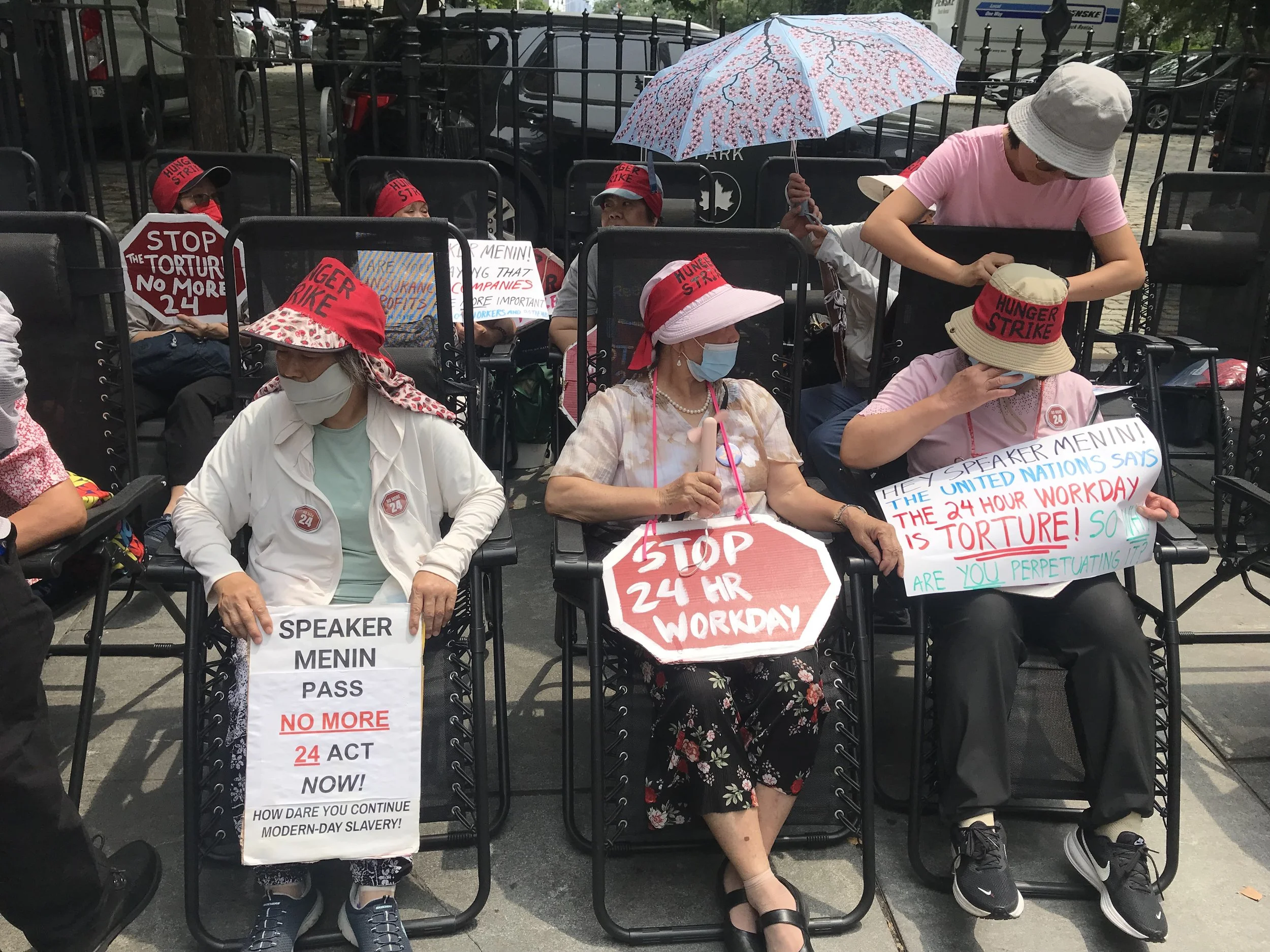
Home care workers fighting to end the 24-hour workday in New York City have resumed their hunger strike outside the gates of City Hall.
Estrella was one of several aides mentioned in an April report to the United Nations High Commissioner for Human Rights from five UN special rapporteurs which said they had “received concerning allegations of a government-subsidized 24-hour workday system for home-care workers in New York City that disproportionately affects women, especially migrant women, in detrimental ways.” Those allegations included that New York State was failing to enforce its minimum-wage law, by funding through Medicaid a system in which aides who do 24-hour shifts generally get paid for only 13 hours.
“She was not permitted time to rest or sleep,” the report said. Estrella was also not given time off to be with her daughter in the hospital when she had a Caesarean section; to visit her son when he had surgery; or to take care of her other son when he was sick and vomiting blood.
Zhang, an immigrant from China’s Fuzhou Province, retired two years ago after doing 24-hour shifts for 12 years. She says she had to turn her patient over four or five times at night to prevent pressure ulcers, do housecleaning during the day, feed her, carry her, and give her baths. Even when her hands were severely swollen, her employer wouldn’t give her time off; they told her they couldn’t find a substitute.
“My hands are still swollen,” she says. And she’s having a hard time sleeping, because her body is still used to having to get up every couple hours at night. She can usually sleep for three hours, five if she takes medication.
Xiu Lan Zhu, another hunger striker, told the rally that she too still wakes up at 3 a.m. every night. “Is it because we are women of color that we are easier to step on?” she asked. She led the crowd in chanting “No More 24” in English and Mandarin.
Few people say they support the system of paying aides 13 hours of wages for 24-hour shifts. The primary objection to ending 24-hour shifts is that the state would have to increase Medicaid funding for home care to finance paying full wages.
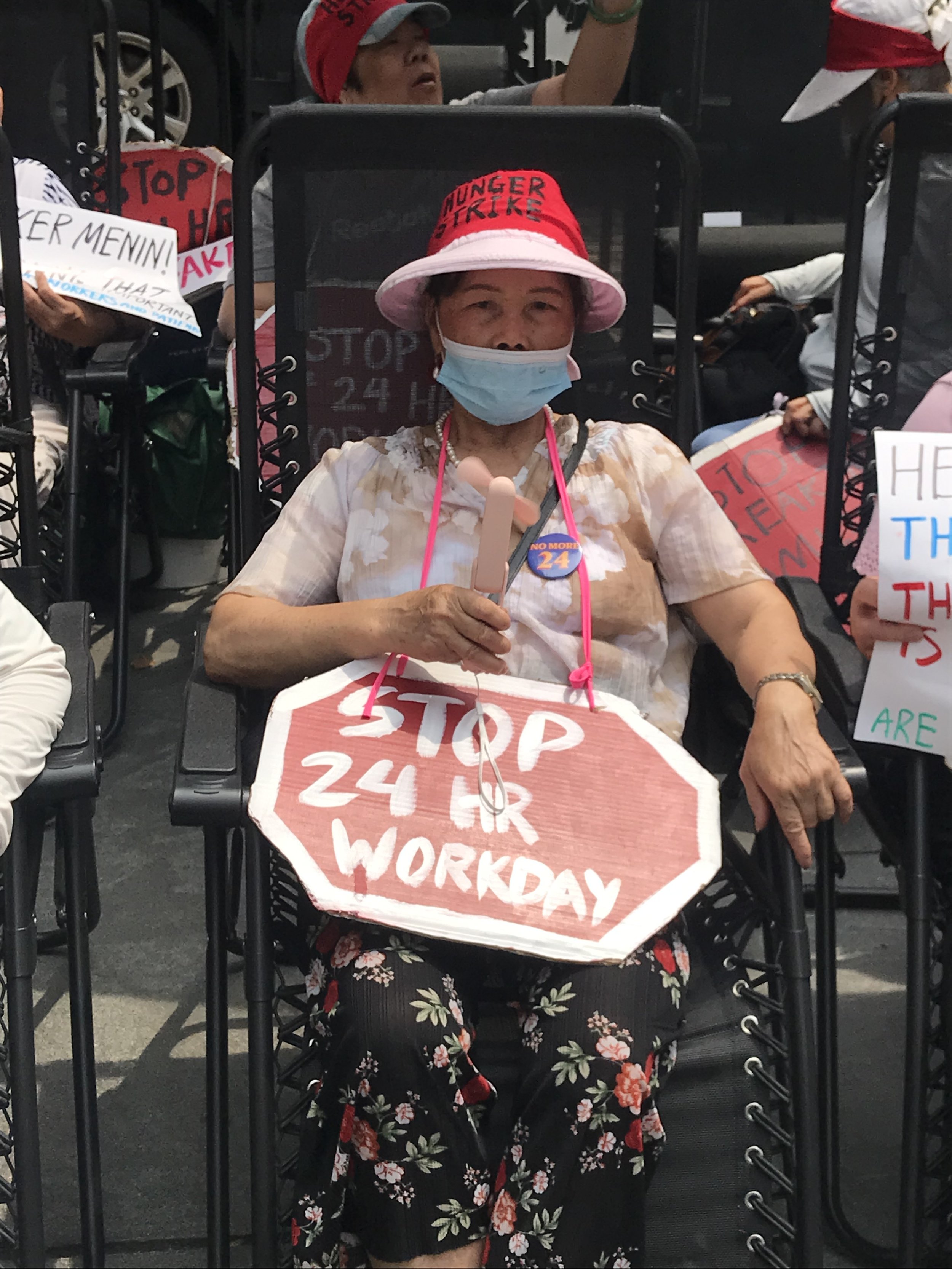
City Council Speaker Julie Menin promised home care workers in March that she would bring Intro. 303—the No More 24 bill—to the floor of the City Council for a vote. Instead, home care workers are once again on hunger strike.
The 1199SEIU union, which represents more than 70,000 home-care workers in the state, estimates that paying full wages for 24-hour shifts would cost Medicaid $460 million a year. A spokesperson for the union told Work-Bites in May that it “supports legislation abolishing 24-hour shifts that fully funds every homecare hour worked, to prevent vulnerable New Yorkers from losing access to care while at the same time ensuring that workers are compensated fairly.” District Council 37, which represents about 5,000 home-care workers in the city, vehemently opposes Intro 303.
No More 24 supporters usually respond to objections about the cost by saying that the home-care agencies and insurance companies have enough money to afford it, and that a system that is only financially viable with wage theft is slavery.
The Chinese American Planning Council, a major nonprofit provider of home care that fought workers’ efforts to get paid for all 24 hours work in the courts for years, had $69.7 million in revenue and $64.4 million in expenses, for a net income of $5.3 million in the 2025 fiscal year, according to its federal tax forms. Its two highest-paid executives were paid $300,000 and $220,000.
Trey Good of Brothas Express, a Brooklyn-based group of Black men “divesting from patriarchy,” said he came to the rally to support working women who are being exploited.
Helena Zeleke, an Ethiopian-born medical student at Mount Sinai hospital, said home-care workers are crucial help for the patients she sees in the emergency room. They are often the first to notice when a patient is deteriorating or showing signs of having a stroke, and they’re the ones who carry out instructions such as what medications they need to take and when.
“Why are we accepting a system that creates even more suffering?” she asked.