
Work-Bites International: ‘The Tiger’ Arrives in Colombia!
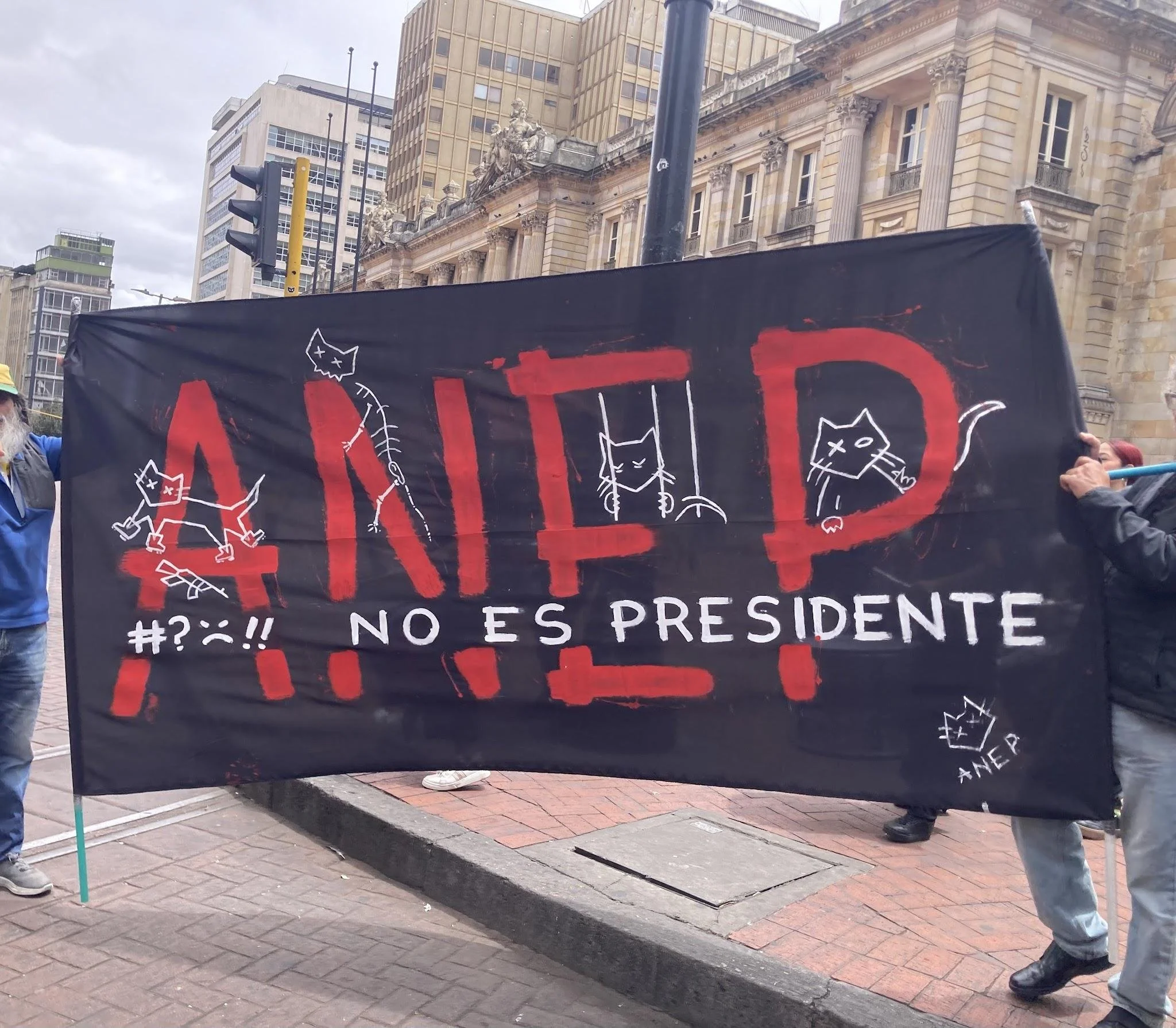
National Association of Pensioned Educators [ANEP] protest banner during de la Espriella’s inauguration in Bogotá this summer reads, “Not The President.” Photos/Eilean Faltin
By Eilean Faltin
Accused fascist Abelardo de la Espriella was sworn in as the new president of Colombia on Aug. 7 after claiming victory in a fiercely contested election. One day later, the Trump administration pledged $1 billion dollars in “security aid” to the South American nation, pending congressional approval.
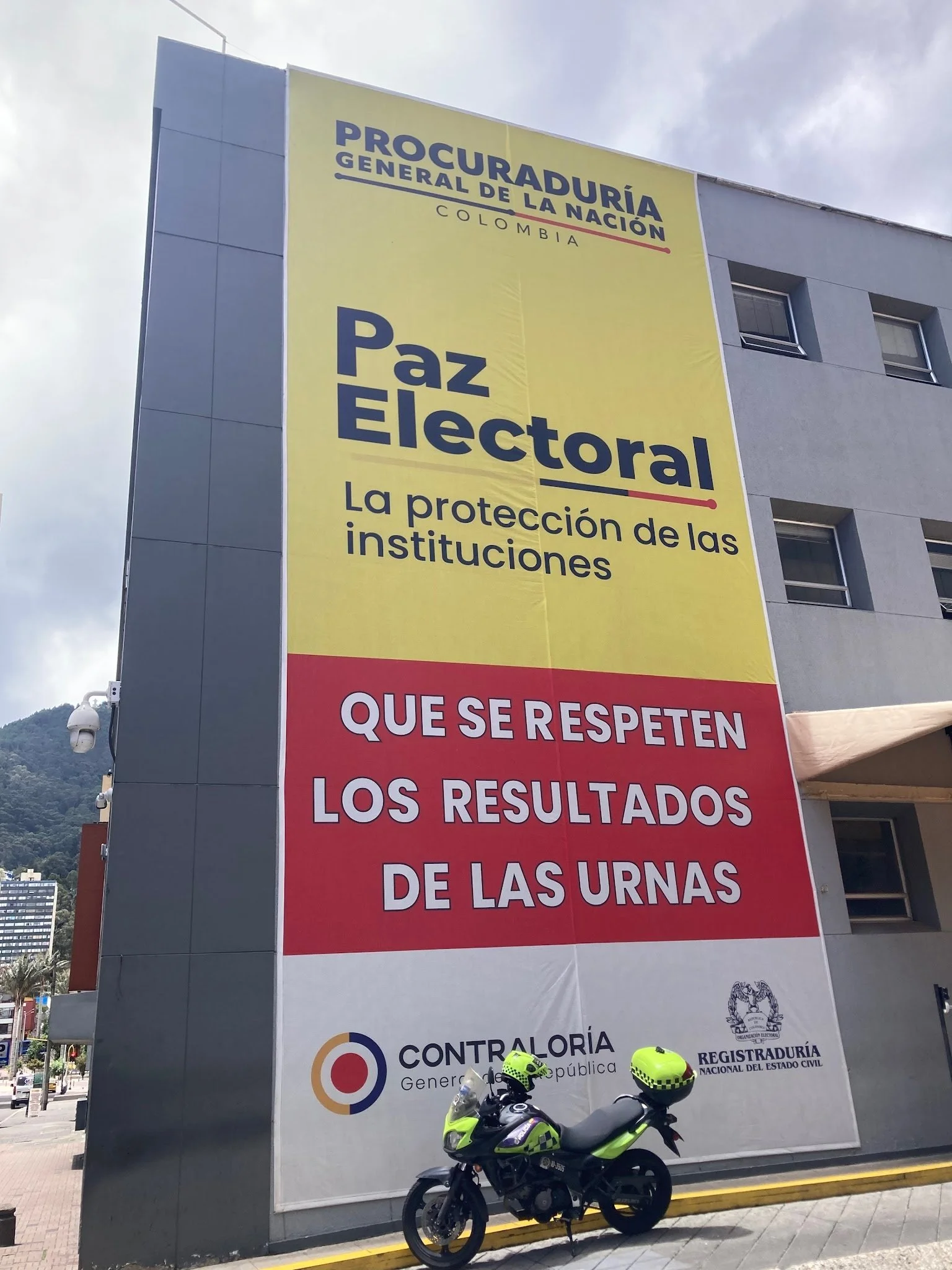
Inspector General’s Office sigh urges residents to “Respect the results of the ballot boxes.”
In his inaugural address, de la Espriella declared a renewed war on drugs, saying “the tiger has arrived, and they will know how hard it bites.” He ordered the military and police to “combat all criminal structures,” unwinding the fragile peace relations former Colombian President Gustavo Petro’s government had built with armed groups and the drug cartels.
U.S. funding and technology significantly helped to fuel the violence Colombia experienced over the past 62-years involving rebel armies, cartels, and paramilitary groups.
According to the National Center for Historic Memory (CNMH), U.S.-backed far-right paramilitary forces, including the United Self-Defense Forces of Colombia (AUC), were responsible for over 70% of the civilian deaths in Colombia’s “forever war,” targeting opposition leaders, trade unionists, and human rights activists.
De la Espriella’s warning suggests a return to a well-established pattern in the region where the U.S. government funds conflict, represses resistance to an exploitative status quo, and generates huge profits for arms manufacturers.
Colombia’s new president entered the race as an outsider, following a two-decade legal career defending the same kind of figures that he now claims to be fighting, including AUC paramilitary leaders and drug traffickers connected to the North Valley Cartel. His opponent, Iván Cepeda called his rise a “return to the… mafia-run, plutocratic, and corrupt past.”
In the streets of Bogotá, de la Espriella appears in posters and street art with devil horns, alongside words like “The Face of Fascism” or “Cat Killer” (referencing an anecdote de la Espriella shared of killing cats with fireworks as a child).
Cepeda, by contrast, appears alongside slogans like “For Life,” “For the Land,” and “For the Water.”
Cepeda is a left-wing senator and human rights activist. He co-founded the National Movement for Victims of State Crimes (MOVICE), facilitated government peace negotiations with armed groups like FARC and the ELN, and acted as a key voice alleging ties between right-wing paramilitaries and mainstream politicians.
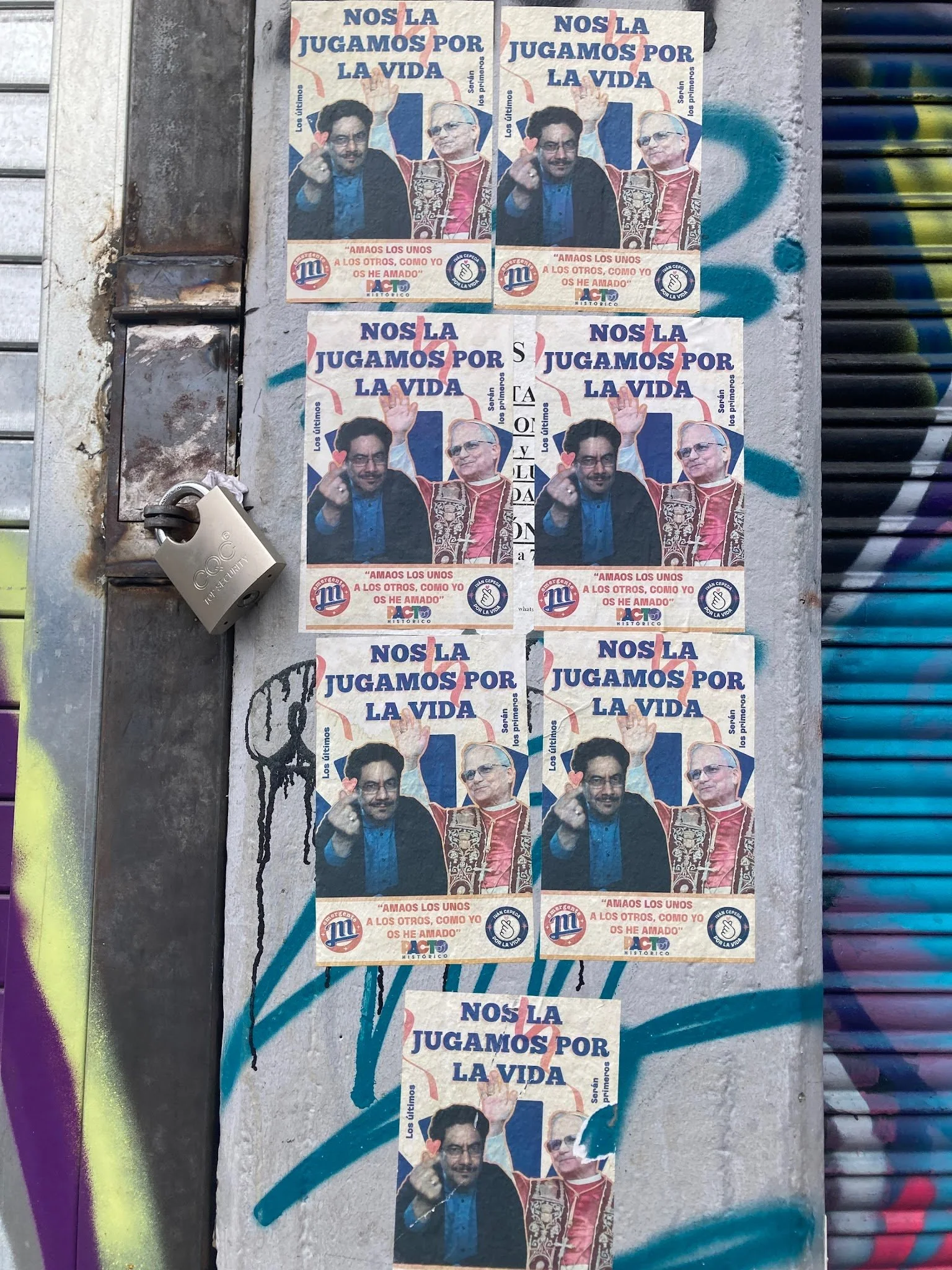
Poster featuring Cepeda and Pope Leo XIV declares, “We’re going all-in for life,” and “Love each other, as I have loved you.”
His “Tres Revoluciones” platform promised accelerated decarbonization, protections for environmental defenders (often targeted by armed groups), and land redistribution away from extraction. Conversely, de la Espriella has said that his government will “fully open the door to fracking,” saying that “Colombia cannot be condemned to energy backwardness because of fanaticism,” marking a sharp reversal in environmental policy.
Cepeda’s vice presidential candidate was Aida Quilcué, a social leader of the Nasa people, who have survived mass killings by FARC. She would have been the first indigenous person to hold vice presidential office in a country where indigenous communities face ongoing land dispossession and extractive-industry pressure.
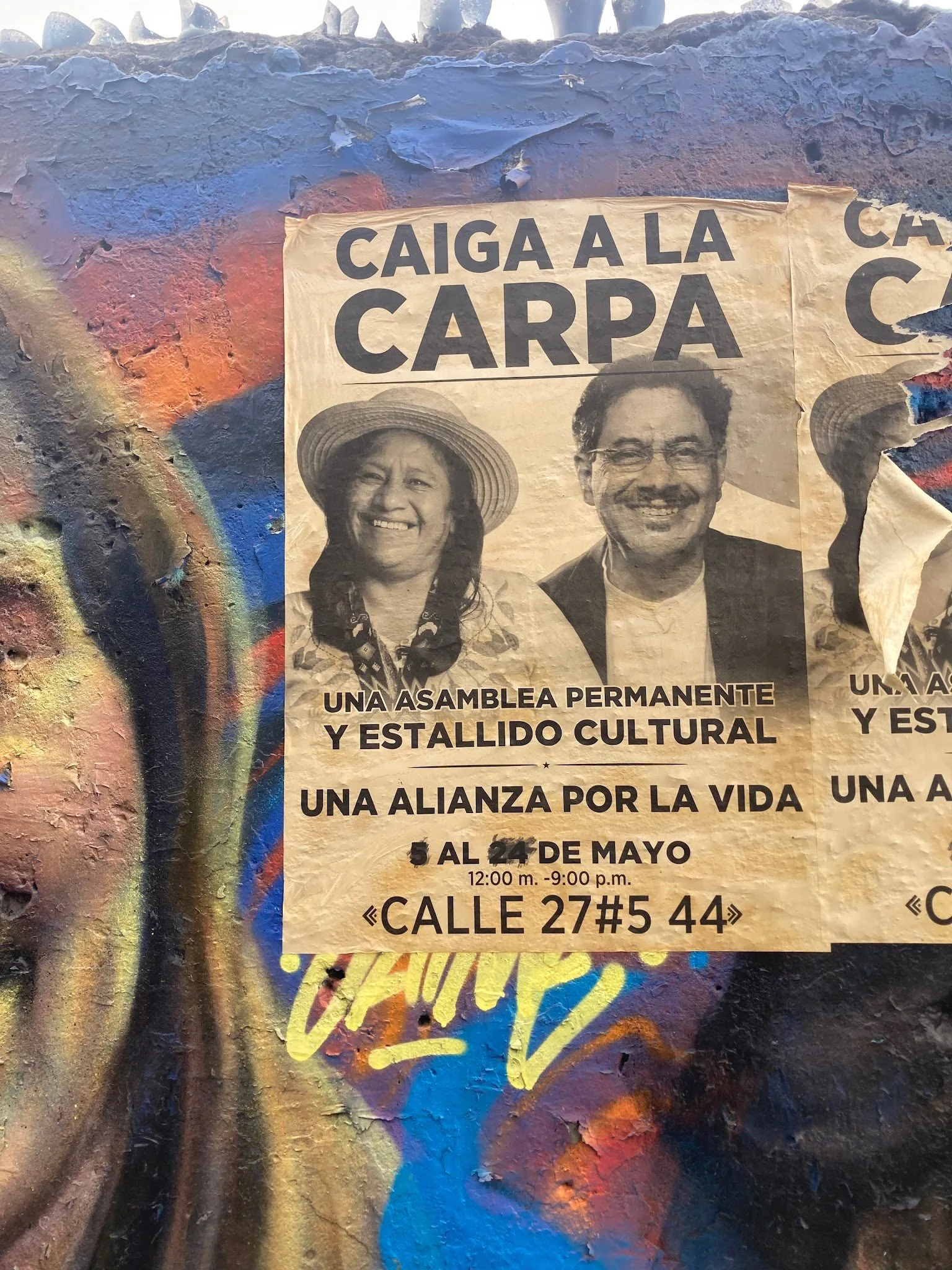
Poster for grassroots mobilization space featuring Quilcué and Cepeda reads, “Drop by the Tent. Permanent Assembly and Cultural Eruption. An Alliance for Life.”
Cepeda was the natural heir to outgoing president Gustav Petro. Petro, despite his controversial background as an M-19 guerrilla fighter, saw widespread popularity as Colombia’s first leftist president.
He ran on a socialist, environmentalist, and pro-peace platform, and as president, increased the minimum wage, strengthened worker protections, advanced land redistribution, cut deforestation rates in the Amazon, and made strides in healthcare, education, and infrastructure in rural and poor areas that had not before received state support.
However, his “Total Peace” approach to drug trafficking was widely criticized as ineffective, allowing drug cartels to expand operations without the threat of state opposition. In 2025, authorities recorded over 14,000 homicides, the most since the 2016 peace deal with FARC. This escalating insecurity led many voters to favor de la Espriella’s hardline approach.
Petro also deepened relations with China— joining its Belt and Road global infrastructure and investment program, and the BRICS New Development Bank— a pattern which, across Latin America, is being met with resistance from the U.S..
Now, de la Espriella joins a wave of far-right leaders being sworn into power across Latin America, numbering seven since Trump’s inauguration in January 2025. The list includes Javier Milei in Argentina, Rodrigo Paz Pereira in Bolivia, José Kast in Chile, and now, just weeks before de la Espriella’s inauguration, Keiko Fujimori in Perú, daughter of a president convicted of crimes against humanity.
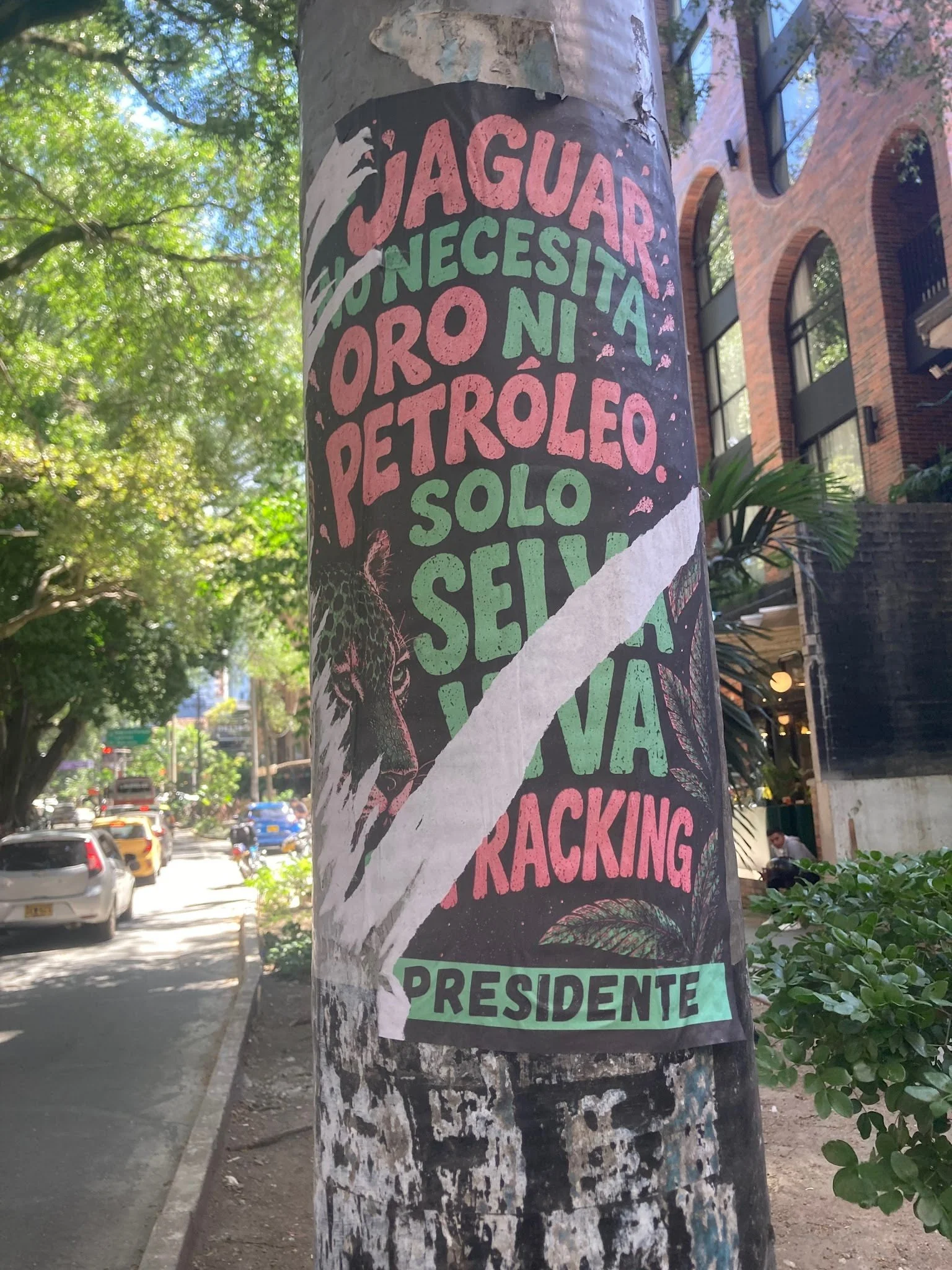
Defaced poster reads, “The Jaguar Doesn’t Need Gold or Oil, Just a Living Jungle. No fracking.”
They all share a few things: a fear-based nationalist approach, the promise of maximum-security prisons, increased cooperation with the United States and Israel, and most importantly, neoliberal economic policy—particularly in extractive industries like mining and fracking.
Colombia will now join the “Shield of the Americas,” a U.S.-led anti-cartel coalition started by Donald Trump in March 2026, which has already carried out over 50 extrajudicial strikes in Caribbean and Pacific waters. Referring to these attacks in his final U.N. address as president, Petro said that “anti-drug policy is not meant to stop cocaine coming to the United States, but to dominate the people of the South as a whole…while the real drug traffickers live in New York or Miami…the poor young people in speed boats were trying to escape poverty.”
Meanwhile, the Trump administration continues to fund war and genocide in the Middle East, targeting vulnerable populations, and producing environmental damage the extent of which remains unknown.
Since its emergence as a superpower in World War II, the U.S.’s gargantuan defense-based economy has relied on feeding fear and war, a program which degrades land and life worldwide. As the critical years to transition away from fossil fuels pass by, those with the most power double down on emissions and environmental destruction. Speaking about de la Espriella’s promise to expand fracking, one taxi driver in Medellín said, “These people’s goals are absurd. It doesn’t make sense—even for them.”
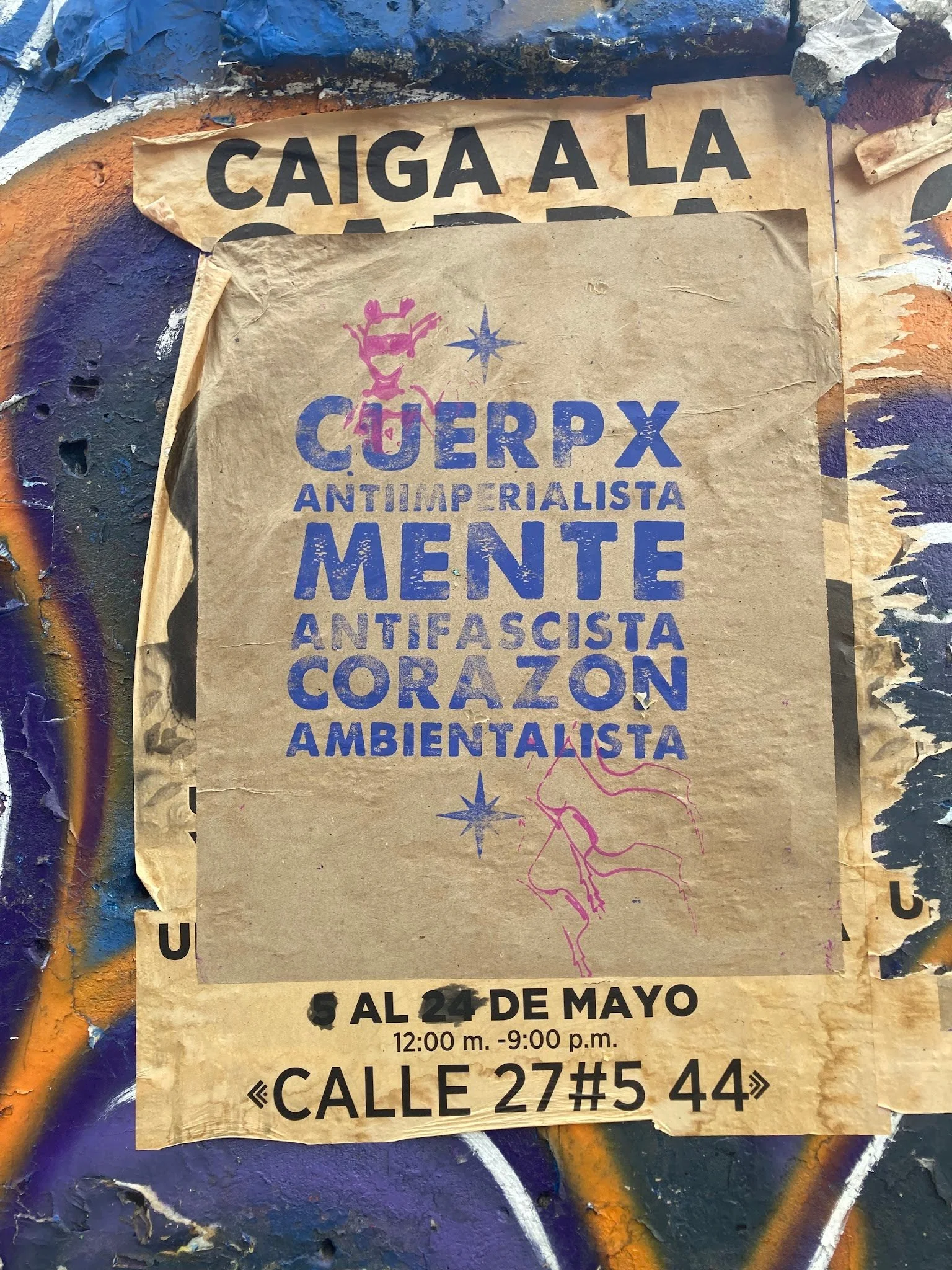
“Anti-Imperialist Body, Anti-Fascist Mind, Environmentalist Heart.”
As Gustavo Petro put it, “The global oligarchy is leading humanity to its own extinction…it is the time of the people, and we must locally act and globally coordinate.”
But in historically exploited countries like Colombia, coordinating towards peace requires more than just laying down arms, as demonstrated by the collapse of Petro’s “Total Peace.” strategy. Nor can peace be found by violently defending oppressive regimes against opposition, as the U.S. has done. It requires addressing the underlying structures that drive people to poverty and illegal economies—the most unequal land distribution in Latin America with 14% of landowners controlling 80% of the country—and relentless resource extraction.
And while it remains to be seen how de la Espriella’s government will put the Trump administration’s $1 billion dollar aid package to use—history shows that “security” will likely mean perpetuating more violence for economic gain in Colombia.