
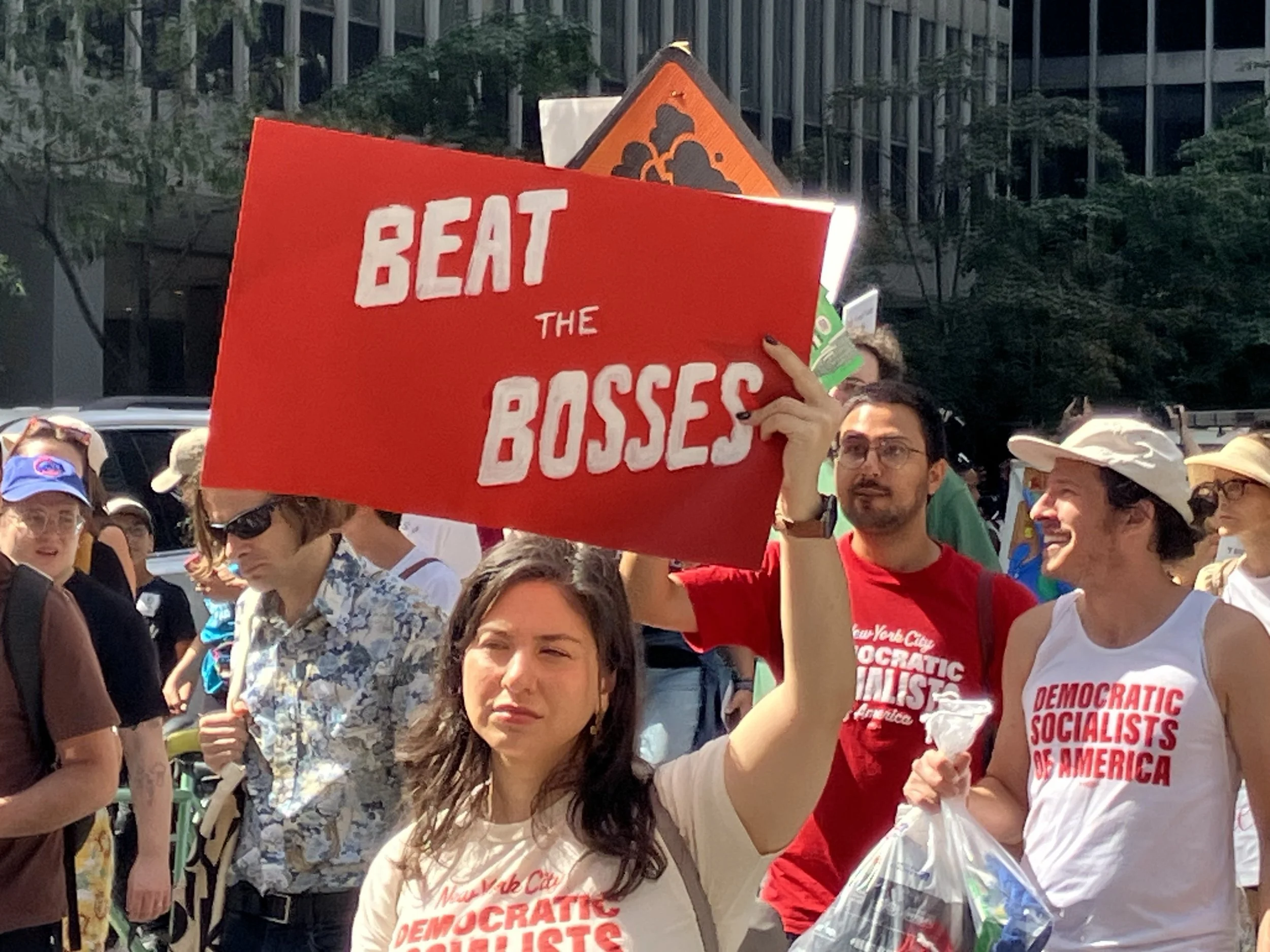
Can rank and file DSA members influence the Democratic Party’s direction post-blue wave—or will they be shut out and/or co-opted?
By Joe Maniscalco
The Democratic Socialists of America [DSA] can feel pretty good after the November 3 blue wave, posting a .482 batting average with 79 out of 164 DSA-endorsed candidates winning their races, according to the latest stats.
If this was baseball, the DSA would be on track to waltz into the Hall of Fame whistling “Solidarity Forever.”
But this isn’t baseball, and with victory comes a word of warning borne out of historical precedent whenever pro-worker and anti-establishment groups have risen up to try and challenge the two-party duopoly.
That’s what noted labor writer and academic Robert Ovetz was thinking about when Work-Bites recently asked what role the DSA has in deciding what direction the Democratic Party takes post-blue wave, and who they pick to be the next Senate Majority Leader and Speaker of the House.
“DSA is clearly a growing influence in the Democrats' fortunes,” Ovetz said during a wide-raging Work-Bites interview broadcast on Monday’s Labor and Healthcare Confidential radio show. “But I was just talking to some family yesterday that the pattern looks a lot like the Green Party 20 years ago.”
Back then, Ovetz noted, the Green Party looked in great shape, too, with a pretty good organizational structure and plenty of active state chapters.
“They had hundreds of Green Party candidates running and winning,” Ovetz said. “Even local mayors, county supervisors—particularly city council and school boards. And [yet] you could see the pattern. As soon as Green Party candidates got elected they wanted to move up the political ladder. They switched to Democrats—and the Green Party was decimated.”
DSA members, Ovetz warns, have to be very careful, look at the pattern of what happened with the Green Party very closely—and stick to their principles and convictions to avoid slipping into irrelevance.
“[Nithya Raman], the new Mayor[-elect] in Los Angeles, for example, is being touted as a DSA member. She almost lost her endorsement by one vote by National DSA,” Ovetz said. “And I think that's what DSA needs to be doing. They need to say that the endorsements and our time, and our money, and our sweat and blood is conditional on you delivering. You don't deliver—you're out. If you repudiate our positions—we will repudiate you.”
Raman came within a whisker of losing the DSA’s endorsement over her questionable support for the Boycott, Divestment and Sanctions movement against Israel. The DSA’s National Action Committee’s 14-13 vote to continue backing her came just one day ahead of the Nov. 3 election.
“[The DSA] need[s] to say that the endorsements, and our time and our money, and our sweat and blood is conditional on you delivering. You don’t deliver—you’re out. If you repudiate our positions—we will repudiate you.”
Los Angeles’ Mayor-elect has been favorably compared to New York City’s own Mayor Zohran Mamdani. And like Raman, Mayor Mamdani has a lot of DSA members inside the organization grumbling about positions Hizzonor has taken that just don’t jibe with a socialist worldview.
Those positions include Mamdani’s ongoing efforts to demolish and privatize public housing on Manhattan’s West Side, as well as his failure to support home care workers fighting to end the 24-hour workday, and his steadfast refusal to meet or even acknowledge municipal retirees advocating legislation to protect their Traditional Medicare coverage from diminishment.
Residents of the Fulton and Elliot-Chelsea Houses [FEC] fighting the planned demolition and privatization of their communities jeered Mayor Mamdani as a “sellout” after forcing the New York City Housing Authority [NYCHA] to shut down its general meeting in September.
This month, those same FEC tenants went further and joined the DSA’s New York City chapter in order to press the fight against Mayor Mamdani’s demolition and privatization plan.
“What's happening here doesn't fall under socialist principles,” Elliot-Chelsea Tenants Association VP Celines Miranda told Gothamist this week. “If you're a socialist, then you support socialist housing. We have no interest in being privatized. We have no interest in being demolished.”

DSA members sending a clear message in 2009.
The plan to demolish the FEC Houses, and allow the same private developers behind the tony Hudson Yards development located nearby to build a series of towering new high-rises consisting of mostly luxury apartments on public land in Chelsea—was the same scheme Mamdani’s predecessor Eric Adams had advocated before he was voted out of office last year.
DSA member Cea Weaver, head of the Mayor’s Office to Protect Tenants, tried to play off the growing FEC controversy within the DSA as a simple difference of opinions.
“One of the reasons why I love being in DSA is that reasonable people can debate, and I think a robust culture of debate, including debate that happens in public, is part of being a socialist,” she said.
Weaver also claimed that “many, many” FEC tenants are “very eager” for the demolition and privatization scheme to move forward.
That statement, however, belies the years-long campaign FEC tenants waged at local Community Board 4, ultimately resulting in that body officially rejecting the demolition and privatization plan last year.
The Adams administration—and now Mamdani’s as well—also ignored repeated requests from FEC tenants to hold a democratic vote on the demolition and privatization issue—and instead tried to intimidate tenants into moving and surrendering their Section 9 housing protections in the process.
Post-blue wave, Ovetz insists the DSA needs to do more rank and file organizing if it is to maintain its integrity and have any influence thwarting Democratic Party policies more in line with the wishes of big money donors that run counter to the electorate’s will.
“Democrats smell victory—and we need to snatch it out of their hands if they don’t deliver,” he said.