
New York City Shame: Home Care Workers to Restart Hunger Strike to End the 24-Hr. Workday

New York City home care workers fighting for passage of the No More 24 bill rallied outside the gates of City Hall on Jun. 30 in 92 degree heat. They vow to go back out on hunger strike beginning July 28 if Mayor Zohran Mamdani and City Council Speaker Julie Menin do not support banning the 24-hour workday with Intro. 303. Photos/Joe Maniscalco
By Joe Maniscalco
On July 28, New York City home care workers fighting for passage of the No More 24 bill in the City Council will again stage a hunger strike outside the gates of City Hall to end the 24-hour workday.
It was a blistering 92 degrees outside City Hall last week when home care workers and their advocates made the announcement during the latest No More 24 rally. Who knows how hot it’ll be later this month.
Home care attendants, many of them elderly retirees, will nevertheless be forced to stage their second hunger strike under Mayor Zohran Mamdani’s early tenure in an effort to force City Council Speaker Julie Menin to fulfill her pledge to bring Intro. 303—the No More 24 bill—onto the floor for a vote.
District Council 37 Executive Director Henry Garrido, head of the largest public sector union in the City of New York, has made it his mission to kill the No More 24 bill using all the fervor and energy he previously used to try and strip municipal retirees of their Traditional Medicare benefits and force them into a profit-driven Medicare Advantage health insurance plan.
Mayor Zohran Mamdani is on record opposing the Medicare Advantage push, but he’s close allies with Garrido and recently tapped him to be a part of Hizzoner’s new Commission on Government Efficiency [COGE]—and there’s still no law on the books preventing this administration or the one after it from returning to the Medicare Advantage scheme at some point in the future and pushing it all over again.
Intro. 1096 is the long-languishing bill from Council Member Chris Marte that would legally prevent that from happening. But like Marte’s No More 24 bill banning the 24 hour workday and mandating split 12-hour shifts in New York City’s home care industry, Garrido has thrown all of his efforts into putting the kibosh on that legislation, too.
In the fall of 2024, then mayoral-candidate Mamdani told Work-Bites that he supported the “spirit” of Intro. 1096, but that “as the next mayor it would not even be required given what my policies would be on the issue.”
Maybe. But having a law on the books codifying the healthcare benefits New York City municipal retirees earned on the job would sure help a lot of people dealing with profound health challenges and mounting copays to sleep easier at night.
And it’s not as if Medicare Advantage has become kryptonite in New York since former Mayor Eric Adams abandoned the push last year. Transit retirees want their Traditional Medicare coverage back and are still fighting tooth and nail to get out of the Medicare Advantage plan TWU Local 100 union heads previously herded them into.
All of this, meanwhile, is happening as corporate media and other news outlets outside New York City continue to spend their time and resources breathlessly reporting on the supposed significance of Mamdani-endorsed candidates winning their Democratic state primaries.
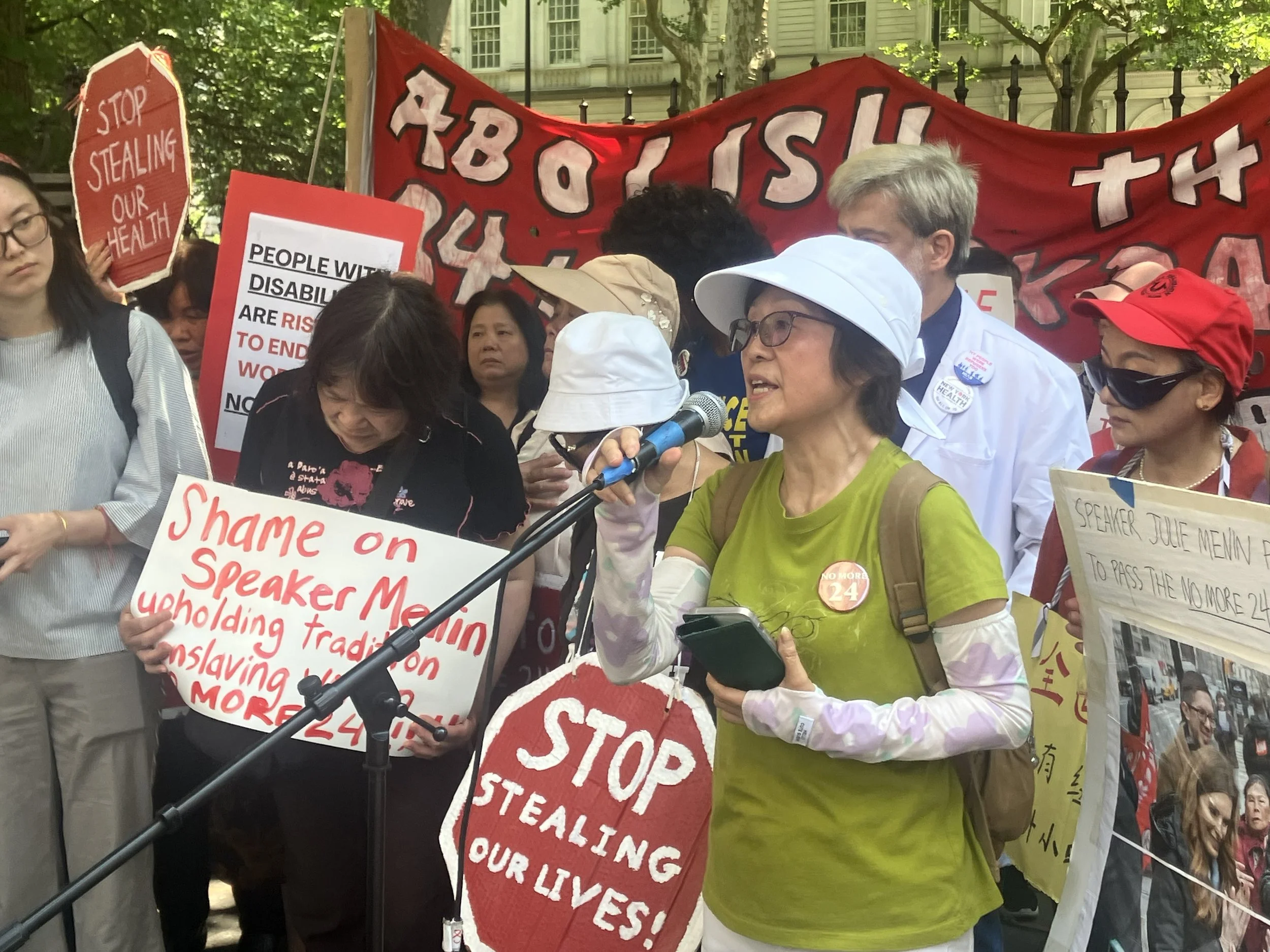
Retired home care worker Ah Lin Lok and fellow No More 24 supporters call out Mayor Zohran Mamdani and City Council Speaker Julie Menin for allowing the 24-hour workday—and the institutionalized wage theft it permits—to continue in New York City.
House Speaker Mike Johnson is reportedly so upset about democratic socialists winning their races that he doesn’t know whether to bleep or go blind worrying about how their victories represent a “serious threat to our whole system of government.”
It’s unclear if Johnson really believes this line of BS—or if he’s just playing out his assigned role in this little piece of left-right kayfabe—but there’s certainly no reason for the establishment to fret.
If all the “Mamdanis popping up” truly are a threat to Johnson’s world view, then why are elderly home care workers in New York City about to seriously endanger themselves by going out on yet another hunger strike on July 28 to end the 24 hour workday?
Why are New York City municipal retirees still spending their retirement pounding the pavement and lobbying legislators in the State Capitol to protect the city-backed healthcare benefits they earned on the job?
And why are low-income workers and elderly tenants in Chelsea still in court trying to stop the privatization and demolition of their communities?
In reality, the democratic socialist in charge of New York City government opposes all of these grassroots fights—so much so that he refuses to even meet with any of them to discuss their problems and concerns.
So what exactly is Speaker Mike Johnson worried about? On these vital issues, Mayor Mamdani and his brand of democratic socialism is demonstrably pro-privatization, anti-worker, and establishment-driven.
“Today we are outraged,” Ah Lin Lok, a retired home care worker who spent years working round-the-clock shifts for the Chinese-American Planning Council, told demonstrators outside City Hall on Jun. 30. “Speaker Menin, you stood before us and promised that the bill would be submitted. You continuously break your promises and deceive us.”

New York City municipal retiree Michelle Keller stands with home care workers on Jun. 30 demanding passage of the No More 24 bill.
Lok further, accused the Speaker of dividing union and non-union home care workers by inserting a carve-out into Intro. 303 exempting unionized workers from its provisions, claiming that “union workers are willing to continue working the torturous 24-hour workday.”
“That is completely unacceptable and outrageous,” she said.
Michelle Keller, a District Council 37 retiree and a leading member of the New York City Organization Public Service Retirees, talked about how immigrant women of color continue to be “degraded, devalued, and unseen” under Mamdani and Menin’s leadership.
“Speaker Menin, how can you separate and divide workers at a time when being union strong is all we have?” Keller said.
Both Mamdani and Menin previously voiced their unequivocal support for workers at an 1199 contract rally in Foley Square on Jun. 17, with the Mayor saying, “If you don't stand with the workers, then you're picking a side.”
“We are going to use the full power of our office and our administration to make our city better for working people—whether that means fighting for good jobs with fair contracts, delivering on an affordability agenda in the most expensive city in the United States of America, or looking for any which way we can to make a day brighter for the working class person in this city,” he said.
Interestingly, the Mayor’s Commission on Government Efficiency [COGE] released its preliminary staff report on July 2, citing “stabilizing city finances” as one of four areas of necessary reform.
“With a budget larger than that of most states, New York City must manage public dollars responsibly while preparing for future economic uncertainty,” the report says. “The Commission heard strong support for strengthening the City's fiscal guardrails through clearer standards governing reserve deposits and withdrawals. Building stronger reserves during good times will help protect essential services during future downturns.”
Are we watching the Mamdani administration gearing up to use “future economic uncertainty” and “downtowns” to justify reviving the Medicare Advantage push, hastening the further privatization of public housing, and continuing to perpetuate the 24-hour workday?
Well, what do you think? Why keep Garrido around so close, while shutting out home care workers, municipal retirees, and public housing advocates? Mamdani may be using the full power of his office and administration—but definitely not in service of these working class constituents.