
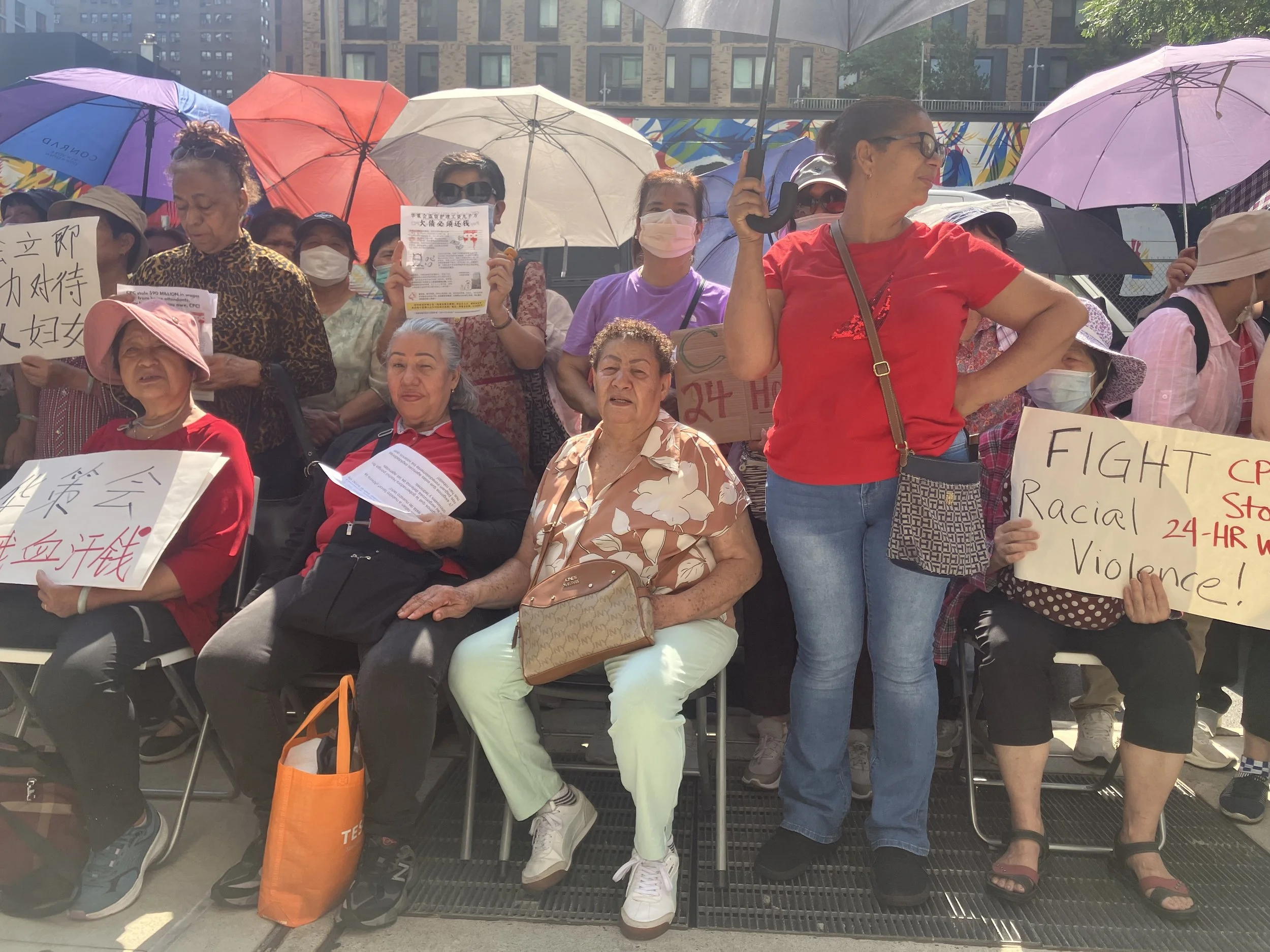
Home care workers rallying outside the offices of the Chinese-American Planing Council on July 22 withstood a blistering summer sun to press the fight against institutionalized wage theft and the 24-hour workday. Photos/Joe Maniscalco
By Joe Maniscalco
New York City home care workers fighting to end the 24-workday and reclaim stolen wages potentially totaling millions of dollars are calling on Governor Kathy Hochul to abandon any further efforts to appeal two recent court decisions moving them closer to ultimate victory.
The state Department of Labor had spent several years on a wide-ranging probe into wage theft claims by home care attendants forced to work round-the-clock shifts in New York’s home care industry before abruptly pulling the plug on the whole thing back in 2023.
New York State Supreme Court Judge Gerald W. Connolly later annulled that decision, requiring the DOL restart its investigations. But the state appealed Judge Connolly’s finding.
Last month, however, the New York State Supreme Court Appellate Division handed down a further ruling upholding Judge Connolly’s prior finding annulling the DOL’s decision to cancel the wage theft probe.
On Wednesday, roughly 100 home care workers rallied outside the headquarters of the Chinese-American Planning Council [CPC] to celebrate that ruling, along with another court win at the federal level that closely followed.
In that case, the United States Court of Appeals for the Second Circuit found that unionized home care workers who left four home care agencies before December 2015 can sue their employers for wage theft resulting from the 24-hour workday.
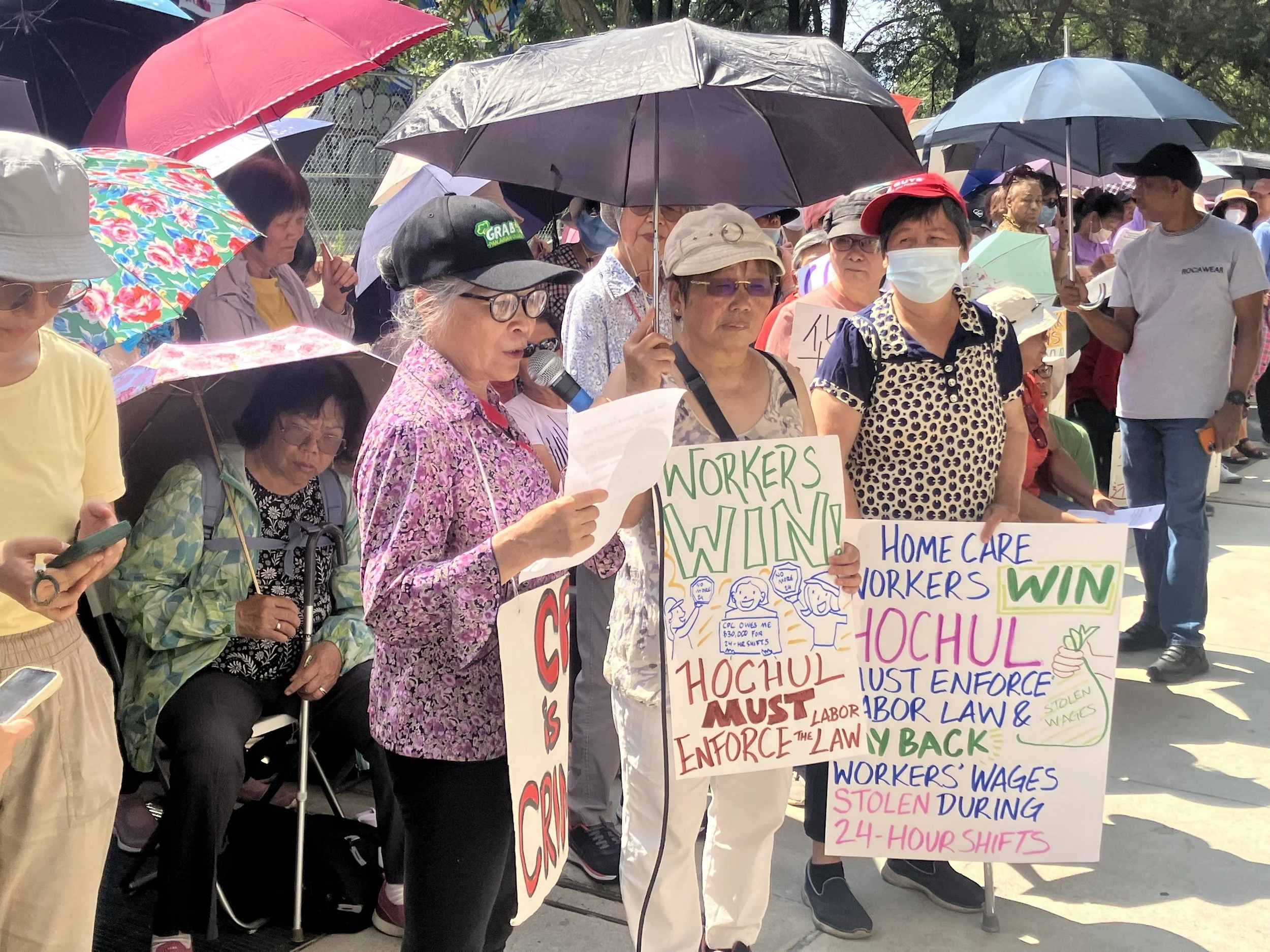
Plaintiff Gui Zhu Chen calls on the Chinese-American Planning Council to stop “colluding” with Governor Kathy Hochul and drop efforts to appeal the victories home care workers have won in court.
“In plain terms, our clients cannot be forced to arbitrate wage claims they never agreed to arbitrate, through an agreement that was entered into after they had already left their employment,” attorneys for home care workers said in a statement.
Further back in 2022, 1199SEIU, the union representing most of the home care workers, reached an arbitration agreement with 42 home care agencies, including the CPC, one of the most influential hiring agencies in the state, that resulted in the creation of a Special Wage Fund.
The roughly $30 to $40 million it yielded was meant to cover back pay claims made by more than 100,000 current and former home attendants—a paltry amount by the time it actually got into their hands.
Arbitrator Martin F. Scheinman said at the time that claims would have been impossible to litigate individually because of the volume of cases, and ordered employers to contribute $250 per employee to the Special Wage Fund.
“According to Scheinman, he chose the $250 figure because it was ‘the maximum that can be imposed’ without risking ‘employers having to close, file for bankruptcy protection or engage in massive reductions in force.’”
According to Scheinman, he chose the $250 figure because it was “the maximum that can be imposed” without risking “employers having to close, file for bankruptcy protection or engage in massive reductions in force.”
1199SEIU stands by the Special Wage Fund, calling it the “largest recoupment of lost wages for 24-hour home care workers to date, far surpassing the minimal amounts that non-union workers were able to achieve through class action lawsuits against employers.”
“The collectively-bargained arbitration process provided all of the rights and remedies available to workers in federal court, with the benefit of an expedited ruling,” a union spokesperson told Work-Bites via email. “Many thousands of 1199SEIU members actively participated in reclaiming lost wages through this Fund, which we are proud of and stand by. 1199SEIU continues to advocate for the state Medicaid funding needed to replace the exploitative 24-hour system. This funding is a prerequisite for transitioning in a way that for protects workers’ jobs and the care they provide to their clients.”
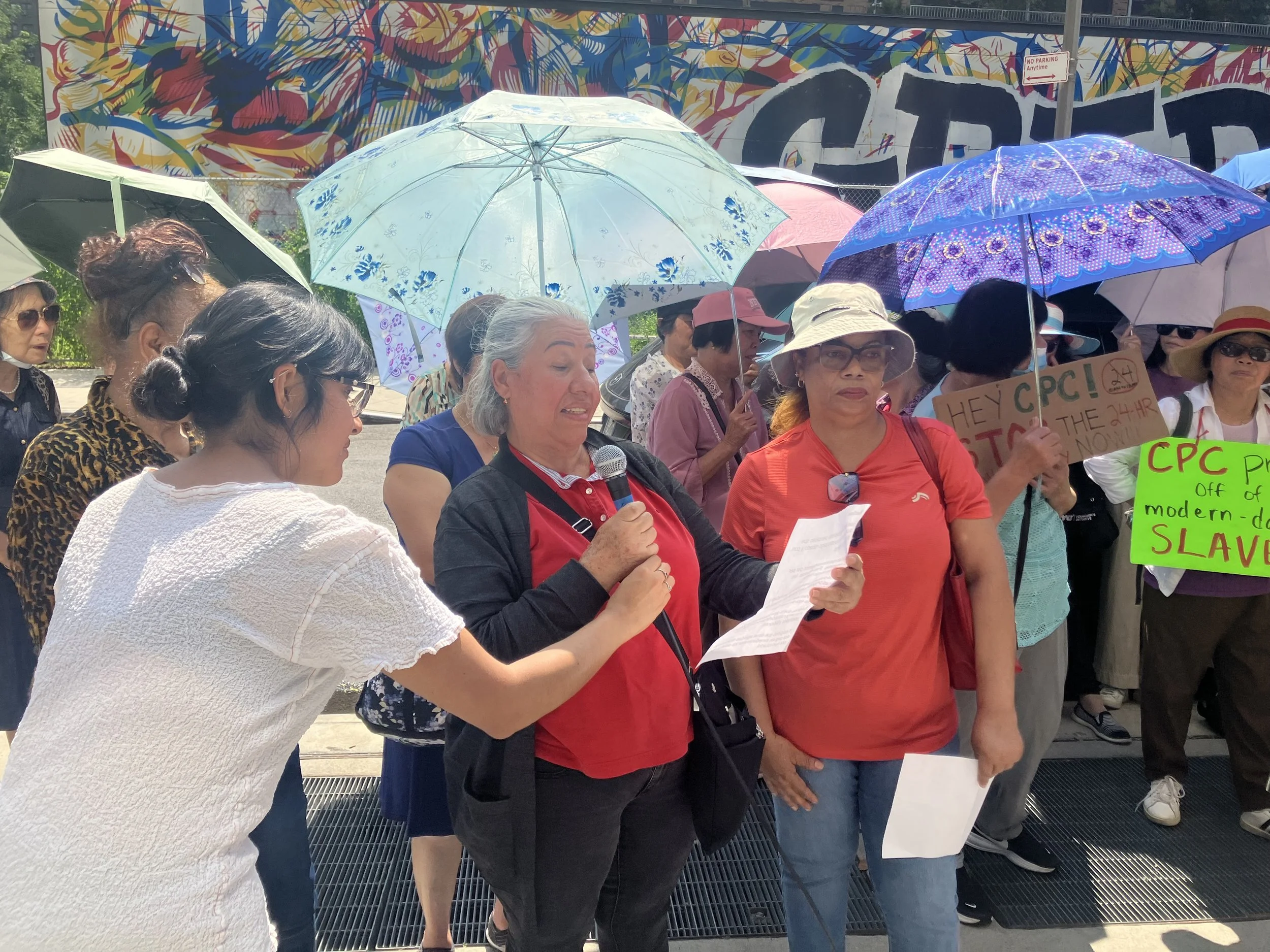
Home care workers speaking out against institutionalized wage theft outside the Chinese-American Planning Council this week said immigrant women of color have been exploited and intimidated by their employers.
A CPC spokesperson, meanwhile, said the organization is pleased with the Second Circuit Court’s ruling—and that it will continue to advocate for state-level reforms that "strengthen New York's home care system for both caregivers and the individuals they serve.”
“As a proud union employer, we value our longstanding partnership with 1199SEIU and respect the union's role as the representative selected by our home care workforce,” the spokesperson said. “We participated in the collective bargaining agreement’s grievance process in good faith and joined the other home care agencies in funding the settlement.”
The spokesperson also said the CPC respects that the state Appellate Division held that in deferring to the union arbitration process, the DOL did not follow the state's rule making process.
“We note that the Appellate Court decision made no finding as to the validity of any claims against any home care agency,” the spokesperson concluded.
Plaintiff Mei Kum Chu spoke out at this week’s rally outside the CPC’s Suffolk St. headquarters on the Lower East Side, saying that she worked round-the-clock shifts for years in the CPC’s employ and as a member of 1199SEIU—and that “years of this work left me with physical injuries to my hands and a weakened state of health.”
“Now, the Second Circuit Court has ruled that the home care agencies and the 1199SEIU cannot force the retired workers we represent into arbitration,” she said. “We demand that CPC, [and other hiring agencies including] FCP, and UJC stop appealing and immediately pay us wages we earned through our hard labor.”
Home care workers also called out Attorney General Letitia James for allegedly turning a blind eye to what amounts to institutionalized wage theft targeting older immigrant women of color in the state.
“As a woman yourself, you have turned a blind eye to the Governor’s promotion of the 24-hour workday—a practice that tortures women and reduces them to modern-day slaves, violence that is decried by the U.N. Working Group on Discrimination Against Women and Girls and four other U.N. entities,” advocates said in an undated open letter to James circulated this week. “By doing so, you have disregarded the contributions of home care workers who care for the disabled people and have devalued their labor.”
Home care workers continuing to push for passage of New York City Council Intro. 303—the No More 24 bill—also continued their sit-in outside Speaker Julie Menin’s upper east side residence this week.
They plan on re-launching their hunger strike outside the gates of City Hall on July 28.
Menin had promised to bring Intro. 303 to the floor of the City Council for a vote back in March. But that still hasn’t happened.
District Council 37 Executive Director Henry Garrido, head of the largest public sector union in New York City—and a close ally of Mayor Zohoran Mamdani—has vowed to kill the No More 24 bill, claiming his members want to work round-the-clock shifts and that mandating split 12-hour shifts without increased state funding would jeopardize patient safety.
When asked for comment on this story, the Governor’s Office reiterated her commitment to “ensuring our workers receive any wages they are owed,” but did not indicate if she would appeal the Appellate Division’s June 25 decision in favor of home care workers demanding the DOL restart its abandoned wage theft probe.