
Gen Z is Ready for a General Strike—What About You?
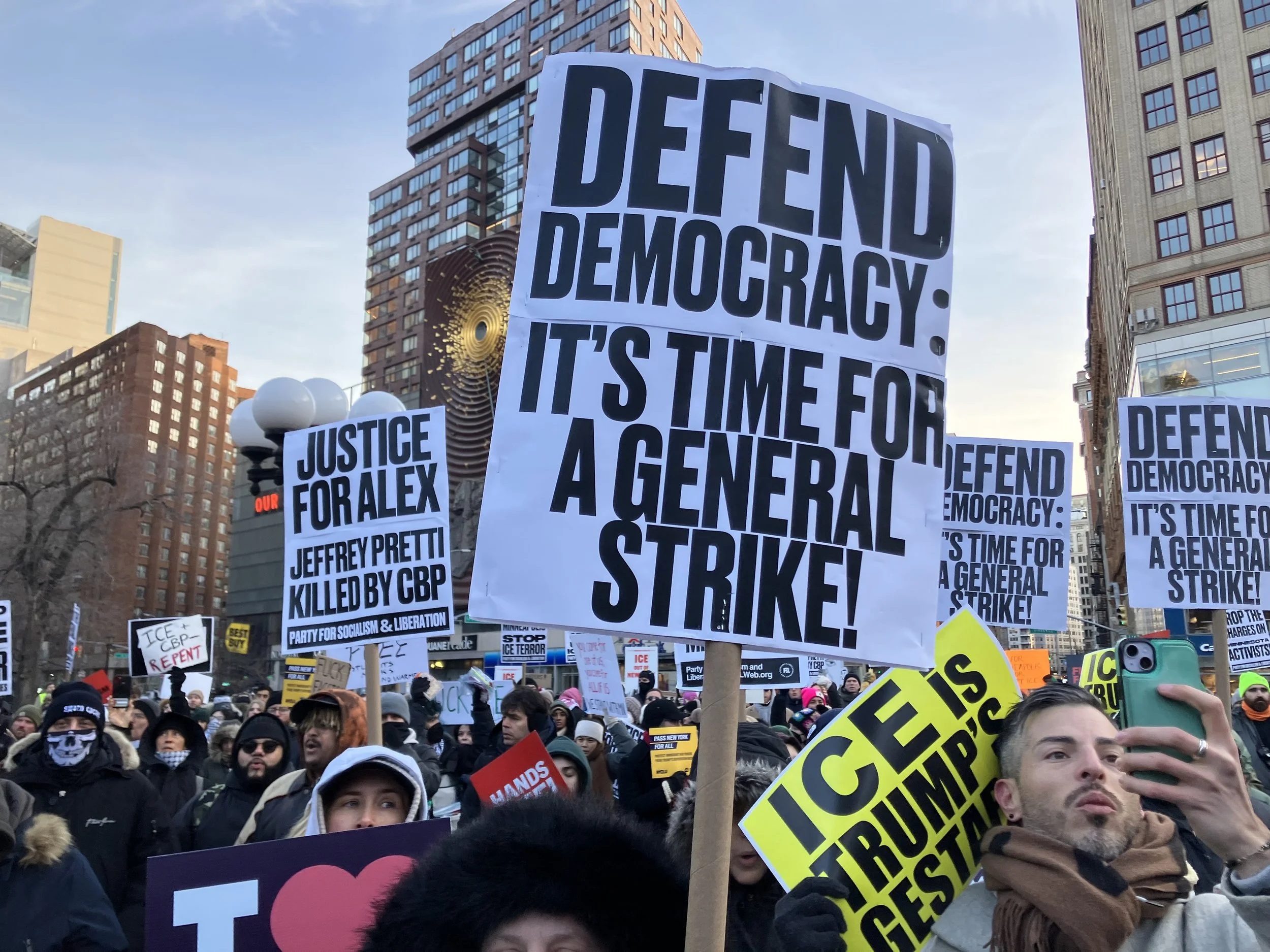
Protesters converge on Union Square and call for a general strike to “Defend Democracy” on Jan. 24 in the immediate aftermath of federal agents shooting Veterans Affairs ICU nurse Alex Jeffrey Pretti to death in Minneapolis. A nationwide shutdown is slated for Jan. 30. Photo/Joe Maniscalco
By Eilean Faltin
Federal forces are marauding across American cities, widely despised billionaires are flagrantly committing omnicide, and 60-70 million full-time U.S. employees do not make a living wage.
For many younger people, the necessity and the urgency of mass revolutionary action could not be any clearer. Yet, U.S. union membership remains at an all-time low of 9.9%, raising the question of whether or not a wider general strike built on the one seen in Minneapolis last week can be organized without militant labor leadership.
During last October’s “No Kings” protests the words “general strike” were emblazoned on signs and rang from bullhorns across the country. Chicago Mayor Brandon Johnson, also an organizer with the Chicago Teachers Union, explicitly called for a national general strike, harkening back to the mass strikes of enslaved people during the Civil War.
In the months since, grassroots organizations largely consisting of Gen Z activists have rallied behind this idea of a general strike across social media platforms and increasingly at regular street protests—forming a cross-industry web of individuals that can be mobilized by the thousands within hours, as demonstrated by the protests held at Foley Square just hours after the murder of Renee Good.
One Instagram account, appropriately named “thegeneralstrikeus,” outlined its five step strategy for a general strike in post published in December. Their sweeping demands included “ending US imperialism” and "redirecting war funding to life-affirming resources.” Rather than defining a specific contract or policy, the strategy proposed planting “seeds of the new world in the shell of the old” through mutual aid hubs, people’s clinics, and other independent parallel institutions to prepare for the nebulous strike.
Whether this base can build solidarity with organized labor is dubious, however. One Gen Z labor messaging consultant argued that those calling for a general strike are “fundamentally unserious people,” lacking both experience in the workforce and structures to build a credible threat to strike. They compared the transnational network of churches of the Civil Rights movement to frictionless social media campaigns and performative protests, calling the American left a “boat without oars.”
At a labor event also held this past December marking the 20th anniversary of the 2005 New York City Transit Strike, former TWU Local 100 President and strike leader Roger Toussaint responded to a young attendee asking about organizing for a general strike saying, “I don't know that there is a benefit to talking about a general strike.”
“When you look at [other] general strikes, there are a whole lot of factors and organizing that led to the possibility of being able to stage a general strike—none of which are available to us right now,” he said.
Toussaint later elaborated, saying that calling for a general strike from outside the labor struggle is “wishful thinking, or a self satisfying scheme for paper tigers and others masquerading as radicals.” Toussaint further clarified that he is not “skeptical” or advocating strike avoidance, but emphasizing the need to focus on existing strikes and allow broader momentum to develop organically.
Some younger organizers we spoke to for this story believe that the absence of centralized labor leadership does not preclude a general strike, but instead reflects a shift towards alternative forms of worker coordination.
“Frustration with the government is outpacing union organization in a way that we may see a general strike led by non-union workers.”
“Frustration with the government is outpacing union organization in a way that we may see a general strike led by non-union workers,” said Reyna Wang, a Gen Z member of District Council 37 and the Party for Socialism and Liberation. “We can prepare for the moment that triggers the general strike by building organization even when we're not in that moment of crisis, so that when it happens, we know who to reach out to.”
Brandon Medina, another Gen Z organizer, added that although there are downsides to digital organizing, it shouldn’t be discounted either.
“We haven’t fully explored new technology, both how we can use it to organize and what’s necessary to resist corporate control over the technology,” he said.
When protesters flooded Union Square on Jan. 23 in solidarity with the economic blackout in Minnesota, many urged their unions, including 1199 SEIU, IATSE, and UFT, to take further action. One organizer with the Labor Committee to Defend Immigrants asserted that, in the face of escalating ICE violence, “labor needs to take the lead…we have the power to shut the country down.”
The single-day action was relatively risk-free and did not require the support systems necessary to sustain a general strike. But it proved that a coalition between labor and anti-fascist activists is beginning to form. A further nationwide shutdown is slated for this Friday—Jan. 30. Whether or not this coalition will mature into a durable infrastructure for mass resistance or remain confined to reactive protests remains to be seen—and so does the country’s entire political future.