
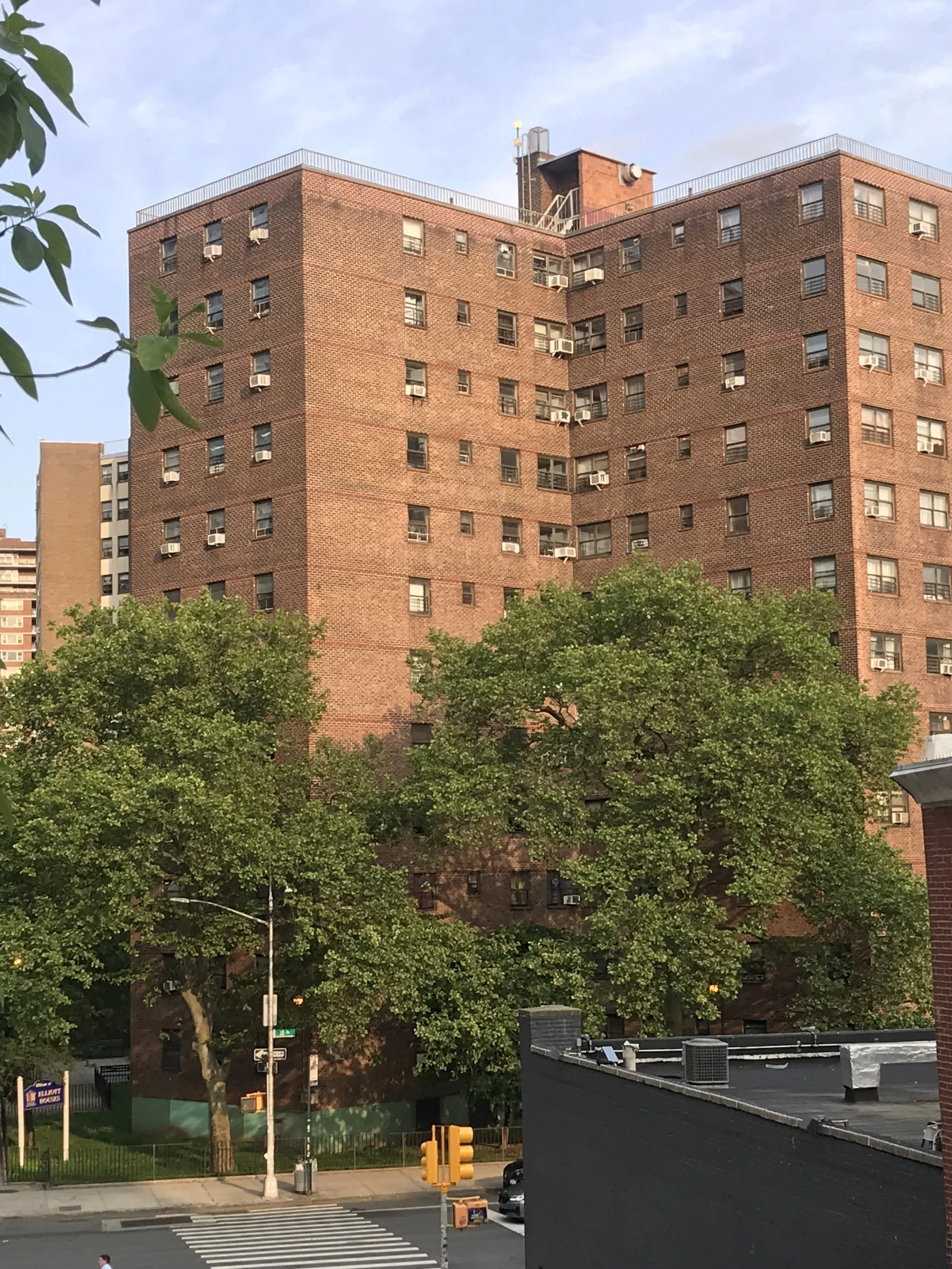
Judge David B. Cohen said this week that NYCHA had not “come remotely close” to demonstrating it would suffer “irreparable harm” to warrant ordering eight Chelsea Addition senior-housing residents to vacate their homes. Photo/Steve Wishnia
By Steve Wishnia
State Supreme Court Judge David B. Cohen on Dec. 4 denied the New York City Housing Authority’s request for a preliminary injunction ordering eight Chelsea Addition senior-housing residents to accept relocation so the building can be demolished.
Speaking to a courtroom packed with about 75 NYCHA tenants and supporters, the judge said he was “a little bit troubled” that NYCHA had not “come remotely close” to demonstrating that it would suffer enough “irreparable harm” to warrant granting an injunction.
The hearing involved two cases related to NYCHA’s plan to lease two Chelsea public-housing developments, the Fulton and Elliott-Chelsea Houses, to a private developer, the Related Companies and its Essence Development spinoff. Related/Essence would then gradually demolish all 2,056 apartments, moving their residents into new Section 8 housing as it was completed. It would also build about 2,500 new luxury apartments and 1,000 units of so-called “affordable” housing.
Under the plan, the elderly residents of Chelsea Addition, part of the Elliott-Chelsea Houses, would have to move twice, because the first new Section 8 building would be constructed on its site. NYCHA lawyers argued that demolishing Chelsea Addition and one Fulton Houses building was the option that would force the fewest tenants to move.
“I’m very glad,” Elliott-Chelsea tenant-association leader Renee Keitt told Work-Bites after the hearing. “We are not to be sacrificed for the ‘greater good.’ You do not harass tenants.”
One case was filed by tenant groups arguing that the demolition-and-privatization scheme was illegal. Judge Cohen said he would rule on it later. In the other, NYCHA was seeking to force the remaining Chelsea Addition residents to move. John Low-Beer, one of several lawyers representing them, told Work-Bites that NYCHA could still “go the slow route” of using normal court processes to get them out, but “so far, so good.”
The attorneys representing the residents argued that the plan was illegal under the state Public Housing Law because public-housing land can’t be used for private housing, and it had not gone through the public-approval process required for a “plan” or “project.” “NYCHA has indicated it has not sought such approval,” tenant lawyer Visnja Vujica told the court. Chelsea Houses, they added, is one of 15 developments covered by a 2010 amendment to that law which prohibits NYCHA from transferring ownership to any entity except a nonprofit it owns.
Vujica further said that ousting tenants was also illegal because the federal Department of Housing and Urban Development had not yet approved the conversion of the two projects, that tenants were being displaced without due process, and that the apartments residents were offered if they relocated were not comparable to their current homes.
“I wasn’t able to move comfortably with my walker in any of them,” Chelsea Addition tenant Yu Zhen Story stated in an affidavit. “Because the Chelsea Addition is senior only,” she added, “we don’t have to lock our doors,” so her neighbors were able to help her quickly when she fell.
NYCHA attorney Elizabeth Knauer responded that the demolition and rebuilding of the two developments did not require public approval such as the city’s Uniform Land Use Review Process because it was “simply replacing unit for unit.” Related/Essence’s constructing high-rent housing on the site, Knauer told the court later, was a separate project. She said it was legal because “this redevelopment is for the purpose of maintaining low-income housing.” The residents laughed.
NYCHA has contended that its backlog of repairs is so massive and the stream of federal funding so parched that public-private partnerships are the only viable solution. Neither Knauer nor Seth Kramer, NYCHA’s attorney in the second case, could say when HUD was going to approve the conversion.
Both lawyers insisted that the decision to demolish Chelsea Addition first was for the greater good, because it would get new apartments for more than 2,000 residents while forcing less than 10% of them to move twice. They accused the estimated 17 residents refusing to leave of “obstructionism.”
“Whose idea was it to have people in their 70s, 80s, and 90s move?” he demanded. “I would very much like to see that individual explain.”
Judge Cohen criticized the residents’ lawyers for not filing the cases until late October, more than two years after NYCHA put out a press release that it was “exploring” demolition and three months after an environmental impact statement made that official. But his harshest questions were directed at the two NYCHA lawyers.
“Whose idea was it to have people in their 70s, 80s, and 90s move?” he demanded. “I would very much like to see that individual explain.”
Both attorneys answered that they didn’t know whether it was NYCHA, Related/Essence, or both.
Kramer argued that having to move was a “very minimal burden,” because the residents would be getting new apartments within a couple blocks, and NYCHA was hiring people to pack and move their possessions. He said the court proceedings to get them out of their homes were not an eviction, because they were being given other apartments in the NYCHA system.
Moving is disruptive for most people, Judge Cohen told Kramer, more so for seniors, and worse for people with cognitive disabilities. One man said in his affidavit that his 90-year-old wife suffers from dementia, and “has almost completely lost her memory since the forced relocations began.”
The residents’ lawyers also accused NYCHA and Housing Opportunities Unlimited, a Boston-based tenant-relocation company Related/Essence hired, of harassing tenants.
“HOU said we would have nowhere to live if we didn’t move,” Jin Gui Tan said in an affidavit. “They have been pressuring us to move every day, knocking on our door, and harassing us with phone calls.”
“I hope this will lead HOU and NYCHA to stop calling them, stop knocking on doors, leave them alone,” Renee Keitt says. She believes Chelsea Addition was chosen to be the first building torn down because the tenants are elderly, with many of them Chinese, Polish, and Russian immigrants.
“There’s no regard for humanity,” Angela Donadelle of Good Old Lower East Side chimed in. “We fight for humanity, we fight for housing.”