
May Day and Beyond: NYC Marchers Contemplate Labor’s Next Moves
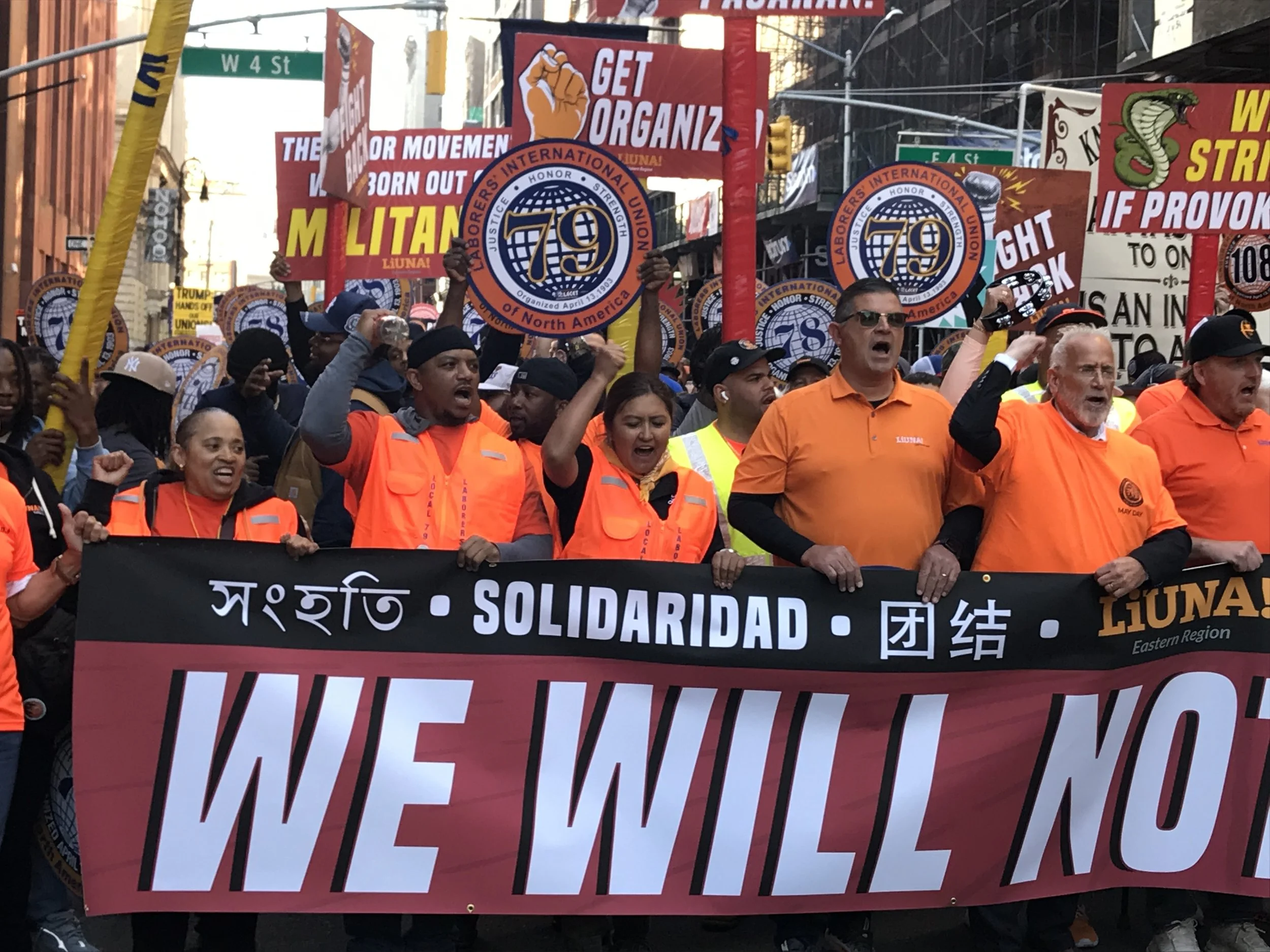
May Day marchers on Friday packed New York City streets between Washington Square Park and Foley Square. Photos/Steve Wishnia
By Steve Wishnia
Washington Square Park was a sea of orange May 1, as the Laborers International Union of North America brought hundreds of members from as far as New England and Delaware for the May Day march.
They packed into the park’s southeast side and the adjacent streets, waiting for the time to march down Broadway. A contingent from Laborers Local 78 slipped through the crowd like a human stream, and a brass band from Musicians Local 802 set up and played “Solidarity Forever.”
Lachelle Blaine of Jersey City, a tall, bearded member of Laborers Local 3, said good jobs and fair wages were the number-one reason he came out. “Unions have gotten a lot more popular,” he told Work-Bites. “We’re looking to have our voices heard.”
“Look to the future, give homage to the past,” said his companion, Local 3 journeyman Curease Oliver. He was standing one short block away from the site of the 1911 Triangle Fire, and near a banner commemorating the Knights of Labor, which in the 1870s and 1880s became the first major U.S. union.
The crowd was predominantly union members, with large contingents from the Hotel and Gaming Trades Council and 32BJ SEIU, and smaller groups from the Professional Staff Council (PSC), the IATSE theater union, the United Federation of Teachers, United Auto Workers white-collar locals, OPEIU Local 153, and various federal workers’ unions.
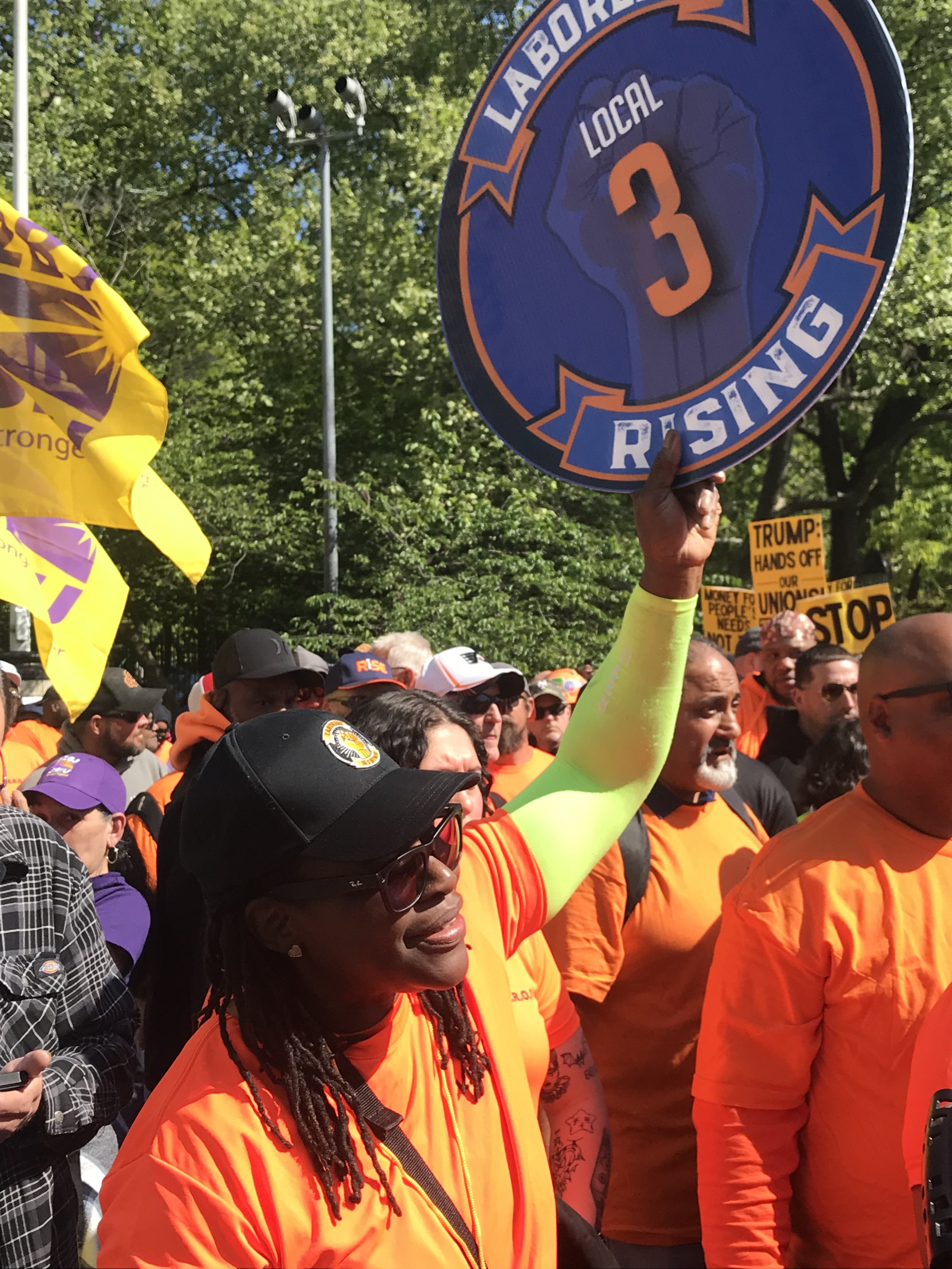
Orange crush: Laborers International Union of North America brought hundreds of marchers to this year’s May Day march in NYC.
Other contingents encompassed immigrant-rights organizations such as the women’s group Las Doñas, Mixteca from Brooklyn’s Sunset Park, and the Flushing-based MinKwon Center, along with multiple Marxist-Leninist, Trotskyist, and pro-Palestine/anti-Israel groups.
“Se ve, se siente, los trabajadores están en la lucha” (see it, feel it, the workers are in struggle) one contingent chanted, before switching to the simpler “Trump, escucha, estamos en la lucha” (Trump, listen, we’re in struggle).
Van, a 27-year-old wearing a pink Mixteca shirt, said she’d come out to support immigrant workers and keep the spirit of May Day going. Some immigrant workers are putting in 16-hour days, she said.
“I’ve been in the labor movement my whole adult life, and I feel the threat,” Faye Moore of Brooklyn, a former city social-services worker who now does contract enforcement for the PSC at City University, told Work-Bites. She said she’s seen “less humane conditions at work,” like more bullying and violence, in the public sector, and “it comes from the top”—the White House.
Andrew Stando, 35, a shop steward for UAW Local 2179 at the Strand bookstore, said he’d come out to defend freedom of speech and the right to protest, and to say no to Trump, ICE, war, and genocide.
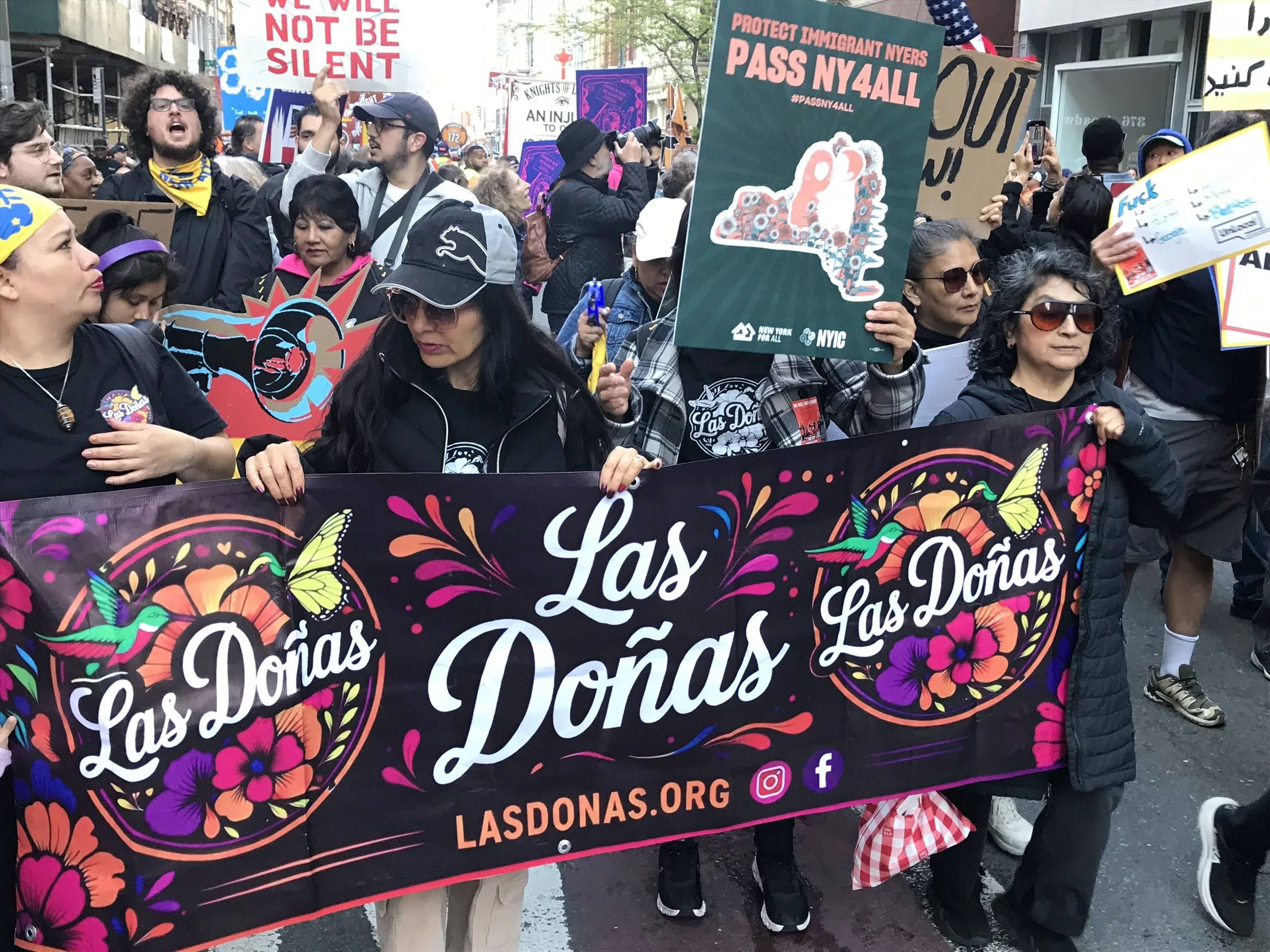
Las Doñas marchers carry signs urging the state Legislature to pass the New York for All Act to prohibit state and local governments from colluding with federal immigration enforcement without a judicial warrant.
“Just advocating for workers’ rights,” said Laborers Local 3 business representative Justin Mancini.
“We lost 20 percent of our workforce. We’re still suffering,” said Environmental Protection Agency [EPA] worker Mike Muldoon, a member of American Federation of Government Employees [AFGE] Local 3911. Last March, Trump issued an executive order terminating collective bargaining for more than 950,000 federal employees, which Muldoon calls “arguably a more significant attack” on labor than Ronald Reagan firing striking air-traffic controllers in 1981.
The union is suing to get bargaining rights restored, but in the meantime, Muldoon says, the EPA has suffered a “massive brain drain” of both experienced talent and “very passionate” younger workers—and water and air protections are being eroded.
The administration is also relocating offices to try to force workers to quit, said Eileen, a National Treasury Employees Union Local 335 member who works at the Consumer Finance Protection Bureau, where Trump budget czar Russell Vought tried to fire 95% of the workers last year. She declined to give her last name for fear of retaliation.
It plans to move the Forest Service headquarters from Washington to Salt Lake City, and the regional offices of the Army Corps of Engineers’ New York District from 26 Federal Plaza in Manhattan and the Fort Hamilton Army Base in Brooklyn to a private building in Jersey City.
The crowd marched down Broadway, Las Doñas behind a brilliant-colored floral banner, the Laborers behind an orange one that read “We Will Not Be Silent,” plus “Solidarity” in multiple languages. Las Doñas carried signs urging the state Legislature to pass the New York for All Act, which would prohibit state and local governments from colluding with federal immigration enforcement unless it has a judicial warrant.

Many May Day marchers came out on Friday to say no to Trump, ICE, war, and genocide.
At Worth Street, the crowd divided, the Laborers turning right to head back uptown to Washington Square, the others turning left toward Foley Square. “ICE Out of New York,” one group chanted as they passed 26 Federal Plaza, site of the ICE offices it also uses as a detention center. A masked couple in ragged crusty-punk clothes used a bullhorn to berate the cops on the sidewalk behind metal barricades as “class traitors.”
As people began to walk away from Foley Square, a bespectacled girl of about 10 asked her father what a “demonstration” was. “It’s a lot of people showing that they’re for or against something,” he answered.
“We fighting for our rights,” an older man with a thick Spanish accent interjected. “They’re trying to take away our medical.”
What-next ideas
After thousands of people have turned out for marches to protest the abuses of the Trump regime, what should they do next to stop them?
Marching is a good start, said Daniel Kim, a member of International Federation of Professional and Technical Engineers Local 98: It’s “a vehicle to strengthen the coalition we’ve been building.”
Unions are atomized, he added, so they “need to form a real coalition” and do “bottom-up organizing.”
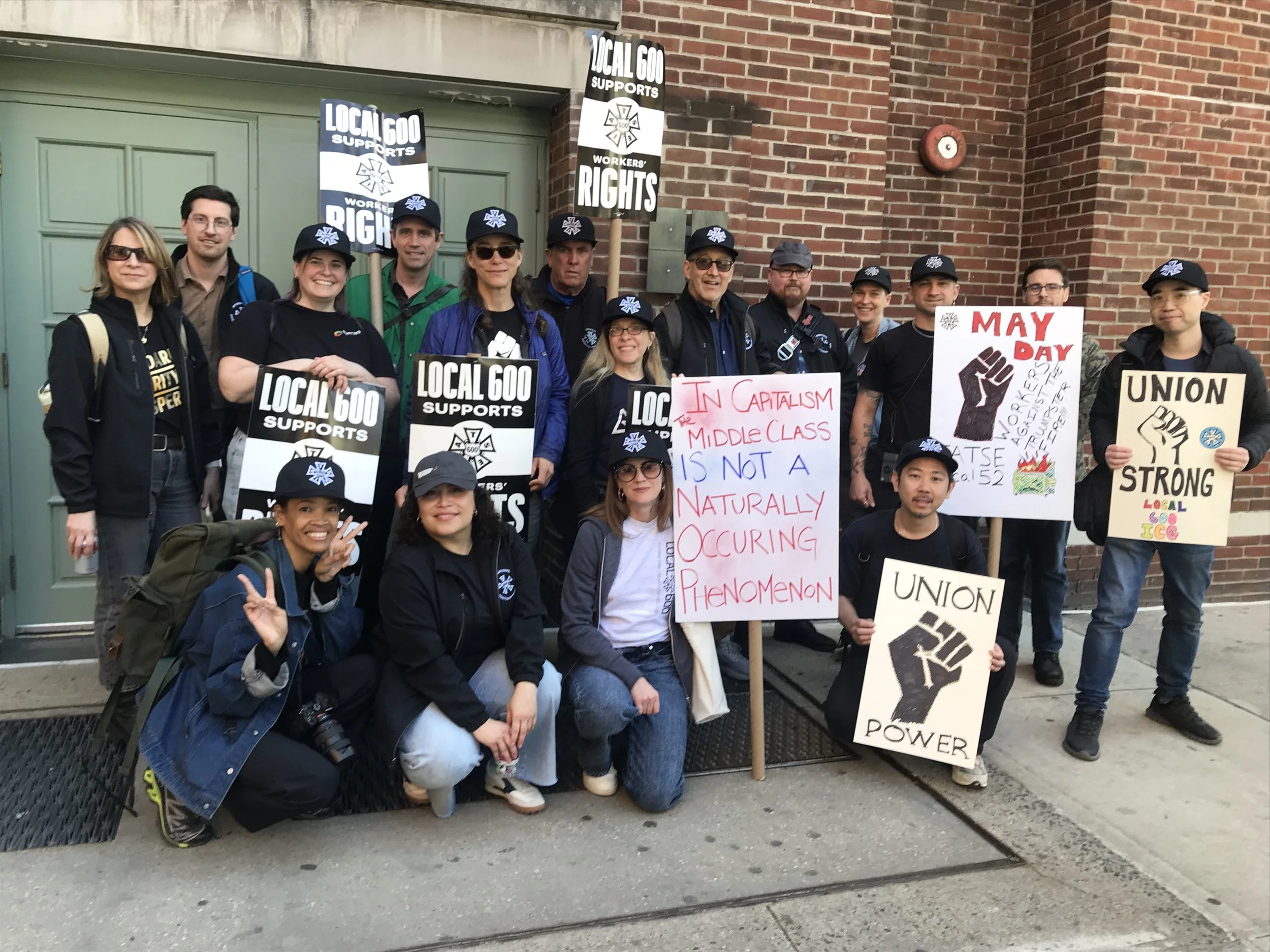
In Capitalism The Middle Class Is Not a Naturally Occurring Phenomenon: IATSE members pack a political punch on May Day.
Organizing was the most common answer. AFGE Local 3911 member Mike Muldoon, an EPA worker, said the Federal Unionists Network is trying to unify the distinct federal unions. “We’re trying to build a movement.”
Justin Mancini had a specifically building-trades perspective. Local 3, which represents laborers in northern New Jersey, would love to organize nonunion workers, he said. But if it brings in new members, it has to have enough work for them, so it needs to persuade contractors and developers to hire union labor. Ultimately, he says, union work is the only way to ensure good jobs in construction.
Faye Moore said labor needs to “get in the faces of politicians.” In order for the public sector to function, “people have to understand dignity,” she said. “If you have an oppressive workplace culture, it impacts the work.”
Lachelle Blaine emphasized voting. “We got to vote more,” he said. “We got to talk to our friends and family” and get them to “vote with our wallets,” not their emotions on social issues.
“Keep organizing working people,” urged Andrew Stando. “That’s where we hold the most power, to shut things down.”
He agrees with the philosophy Dr. Martin Luther King developed in his last days, his motive for joining Memphis sanitation workers on the picket line: The strike is the most effective form of nonviolent direct action.
Bringing that up to a national scale would take a lot of work. Still, four American Federation of State, County, and Municipal Employees locals in Vermont have won language in the contracts giving them the right to join a general strike.
Some of the federal workers who turned down offers to quit last year “saw part of their role in resistance to fascism as staying in their jobs,” Christopher Dols of the Federal Unionist Network told a meeting at United Federation of Teachers headquarters that evening. Now, they are trying to “rebuild a government that actually works for everybody,” he continued. “We need the entire labor movement with us.”