
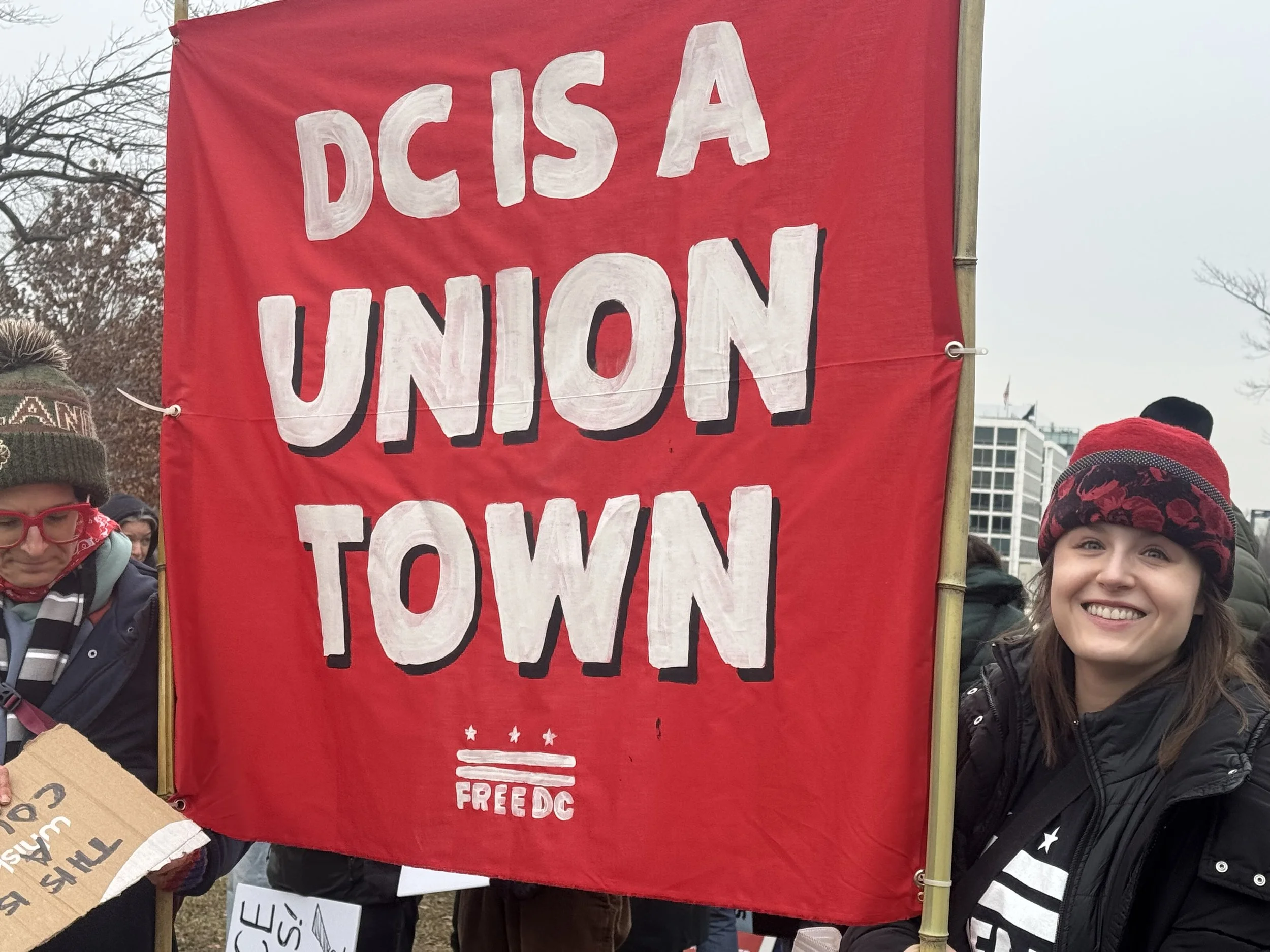
The Protect America’s Workforce Act now faces an uphill climb in the US Senate.
By Bob Hennelly
In a bipartisan rebuke of President Trump's stripping of collective bargaining rights from one million federal workers, 20 House Republicans joined 211 Democrats to pass the “Protect America's Workforce Act." The lopsided 231 to 195 vote came after a successful House discharge petition effort led by Rep. Jared Golden (ME-D) and Rep. Brian Fitzpatrick (PA-R) over the objection of Speaker Mike Johnson (LA-R).
The legislation heads to the US Senate where it faces an uphill climb. It is sponsored in the Senate by Sen. Mark Warner (VA-D) and Sen. Lisa Murkowski (AK-R).
President Trump’s March 27 executive order posited that the existence of collective bargaining agreements at the Department of Defense, State, Veterans Affairs, Justice and Energy, Homeland Security, Treasury, Health and Human Services, Interior, as well as Agriculture, posed a risk to national security.
“President Trump said ending collective bargaining was about protecting our national defense. But in my District, many affected workers build our warships and care for our veterans," Rep. Golden said in a statement. “These workers make our country safer and stronger every day. America did not vote to silence these workers, but this bill gives all of us a chance to restore their voices…if the majority we built over the past few months sticks together, we can overturn this union-busting executive order, and we can show America that this body will protect workers' rights.”
President Trump was defended on the House floor by Rep. James Comer (R-Ky.), chairman of the Oversight committee, who told colleagues the executive order was necessary to reverse last minute deals cuts by the outgoing Biden administration with federal unions to frustrate the incoming Trump administration plans to reform the federal government.
“The president has been fighting back against the deals that public sector unions have negotiated for themselves, at the expense of the American taxpayer, by invoking an existing legal authority,” Rep. Comer. Comer warned.
The Protect America's Workforce Act, he added, "directly threatens that progress by overturning the president’s executive order that exercises one of the few tools available to him under the law to more effectively manage the federal workforce.”
"I rise today in strong support of HR 2550 Protect America's Workforce Act," said Rep. Mike Lawler (NY-7). "Earlier this year an executive order changed the collective bargaining status of tens of thousands of federal workers. These are career public servants, many of them veterans who show up every single day single day to serve our country. Every American deserves a voice in the workplace and that includes the people that keep our government running."
"Federal workers, many of whom are veterans, are the backbone of our public service," Rep. Fitzpatrick said in a statement. "When they have a voice in the decisions that shape their work, our government is more stable, more capable, and better prepared to serve the American people. I’m proud to work alongside Congressman Golden in leading this bipartisan effort. Tomorrow, let’s carry this unity across the finish line, and restore the rights that keep our federal workforce — and the nation they serve — strong.”
Seven of the Republican breakaway votes came from the New York and New Jersey delegations, including Rep. Nicole Malliotakis (NY-R), Rep. Mike Lawler (NY-R), Rep. Nick LaLota (NY-R), Rep. Andrew Garbarino (NY-R) , Rep. Jeff Van Drew (NJ-R), Rep. Tom Kean (NJ-R), and Rep. Chris Smith (NJ-R).
During the House floor debate, Rep. Debbie Dingell, co-chair of the House Labor Caucus, told her colleagues that collective bargaining rights for federal workers had been embraced for decades no matter which political party was in power.
"We are here because President Trump signed an executive order seeking to end collective bargaining rights for unionized federal employees across several agencies," Rep. Dingell said. "Congress granted them—Congress—not the executive branch, granted collective bargaining rights for federal employees decades ago and they've been upheld for years by the administrations of both parties and now thousands of employees have had those rights taken away.”
Rep. Dingell went on to call federal employees “absolutely essential to keep our country running.”
“They are firefighters, they are nurses, they are doctors, they are air traffic controllers, they are food inspectors, law enforcement and public safety officials,” she continued. “They impact every part of our lives and we take them for granted."
“The labor movement fought back against the largest act of union-busting in American history by doing what we do best: organizing," said AFL-CIO President Liz Shuler. “We commend Reps. Golden and Fitzpatrick for leading us to a vote on the Protect America’s Workforce Act and urge every lawmaker to support this bill. Working people built a bipartisan coalition to restore union rights to federal workers in the face of unprecedented attacks on our freedoms and livelihoods.”
“AFGE will forever be grateful to Congressman Golden for his tireless efforts to restore collective bargaining rights for federal employees,” said Dr. Everett B. Kelley, National President of the American Federation of Government Employees (AFGE). “Time and again, he has answered the call to defend the working men and women who keep this country safe and secure, healthy and prosperous. I urge all members of Congress to support the bipartisan Protect America’s Workforce Act offered by Reps. Golden and Fitzpatrick and enact it into law.”
Joshua Freeman, labor historian, author and distinguished professor emeritus at CUNY's Queens College, told Work-Bites passage of the bill would be a "big lift requiring 60 votes in the Senate."
Freeman also said the overall response from the nation's broader union movement to a million federal workers losing their collective bargaining rights had been "pretty tepid."
"There's been remarkably little outrage over the Trump administration rescinding the collective bargaining rights which go all the way back to the Kennedy administration—it was a decided issue under both Democratic and Republican administrations until the Trump administration."
A broad coalition of unions lobbied for the bill including the American Federation of Teachers (AFT), American Federation of State, County and Municipal Employees (AFSCME), International Federation of Professional and Technical Engineers (IFPTE), National Federation of Federal Employees (NFFE), National Postal Mail Handlers Union (NPMHU), National Treasury Employees Union (NTEU), Professional Aviation Safety Specialists (PASS), Service Employees International Union (SEIU) and the United Steelworkers (USW).