
NYC Retirees: The Only Thing Intro. 1096 Undermines is Labor’s Ability to ‘Sell Out’ Retired Members
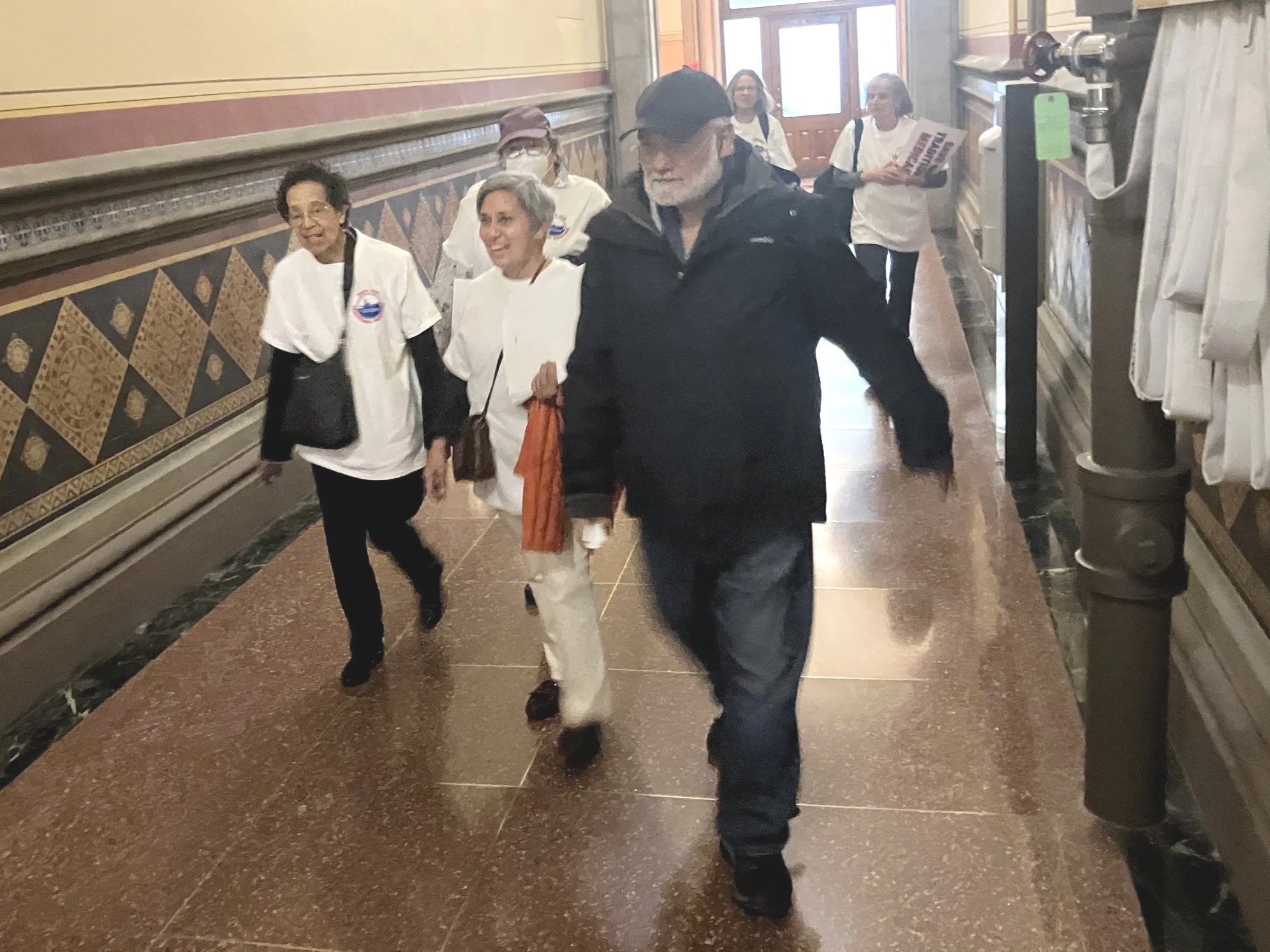
New York City municipal retirees advocating passage of Intro. 1096 and sister legislation in Albany ply the halls of the state capital on April 15, 2024—they will be returning by the busload on Mar. 24. Photos/Joe Maniscalco
By Joe Maniscalco
New mayoral administration or not, New York City municipal retirees continuing to fight for legislation protecting their health care from assault are heading up to Albany this week to lobby for some state-level action.
Former Mayor Eric Adams last year abandoned efforts to strip retirees of the Traditional Medicare and MediGap coverage they earned on the job and push them into a predatory Medicare Advantage plan in what many saw as a last ditch effort to win re-election.
But retirees—led by the New York City Organization of Public Service Retirees—continued to press for passage of Intro. 1096. That long-languishing bill from Council Member Christopher Marte would require the City of New York to offer Medicare-eligible municipal retirees and their Medicare-eligible dependents at least one MediGap plan with benefits equivalent to or better than those available to city retirees and their dependents as of December 31, 2021.
And despite the relief municipal retirees felt after successfully forcing Adams to abandon the Medicare Advantage push last year, members of the New York City Organization of Public Service Retirees continue to insist that new legislation from both the city and state is needed to further protect their health care from future assaults.
“Municipal retirees across the state are fighting to protect the healthcare they earned over a lifetime of public service,” Marianne Pizzitola, retired EMS worker and president of the New York City Organization of Public Service retirees, told Work-Bites. “Too many are being pushed into Medicare Advantage plans or facing a steady erosion of their benefits in retirement. Unlike active workers, retirees are not part of unions and have no seat at the bargaining table. Their only real protection is legislation.”
The largest and most powerful public sector unions in the city—under the leadership of District Council 37 Executive Director Henry Garrido, United Federation of Teachers [UFT] President Michael Mulgrew, and Uniformed Sanitationmen’s Association President Harry Nespoli [ret.]—originally opposed Intro. 1096 because it threw a monkey wrench into their combined scheme to push retired members into Medicare Advantage.
It was all part of an elaborate plot to supposedly save the City of New York hundreds of millions of dollars in exchange for raises denied active municipal workers stretching all the way back to billionaire Mayor Michael Bloomberg’s anti-union reign of terror.

New York City municipal retiree Evie Jones Rich boards a bus bound for Albany in April, 2024.
The heads of those public sector unions, who also make up the triumvirate at the helm of the Municipal Labor Committee [MLC]—the umbrella organization ostensibly representing municipal unions in New York City—still adamantly oppose passage of Intro. 1096 long after Adams abandoned the Medicare Advantage push in an effort to win votes.
MLC attorney Alan Klinger is on record stating that new legislation further protecting retiree health care would “put financial pressure on what the city says to us [it] is wiling to pay for actives if they have to pay so much more for retirees.”
UFT President Mulgrew continues to actively fight against retiree legislation even though he also abandoned the Medicare Advantage push last year after Intro. 1096 advocates won control of the UFT’s more than 70,000-member Retired Teachers Chapter. Passing Intro. 1096, according to Mulgrew’s narrative, would violate the Taylor Law and undermine collective bargaining rights.
“Intro 1096 would undermine collective bargaining and give an elected body the ability to strip healthcare from all workers, retired and active,” UFT spokesperson Alison Gendar recently told Work-Bites. “The UFT opposes the bill and any actions that seek to weaken the Taylor Law and the protections it provides to current and retired workers.”
The New York City Organization of Public Service Retirees argues that the only thing Intro. 1096 undermines is the MLC’s ability to sell out retirees who earned their Medicare benefits after decades on the job.
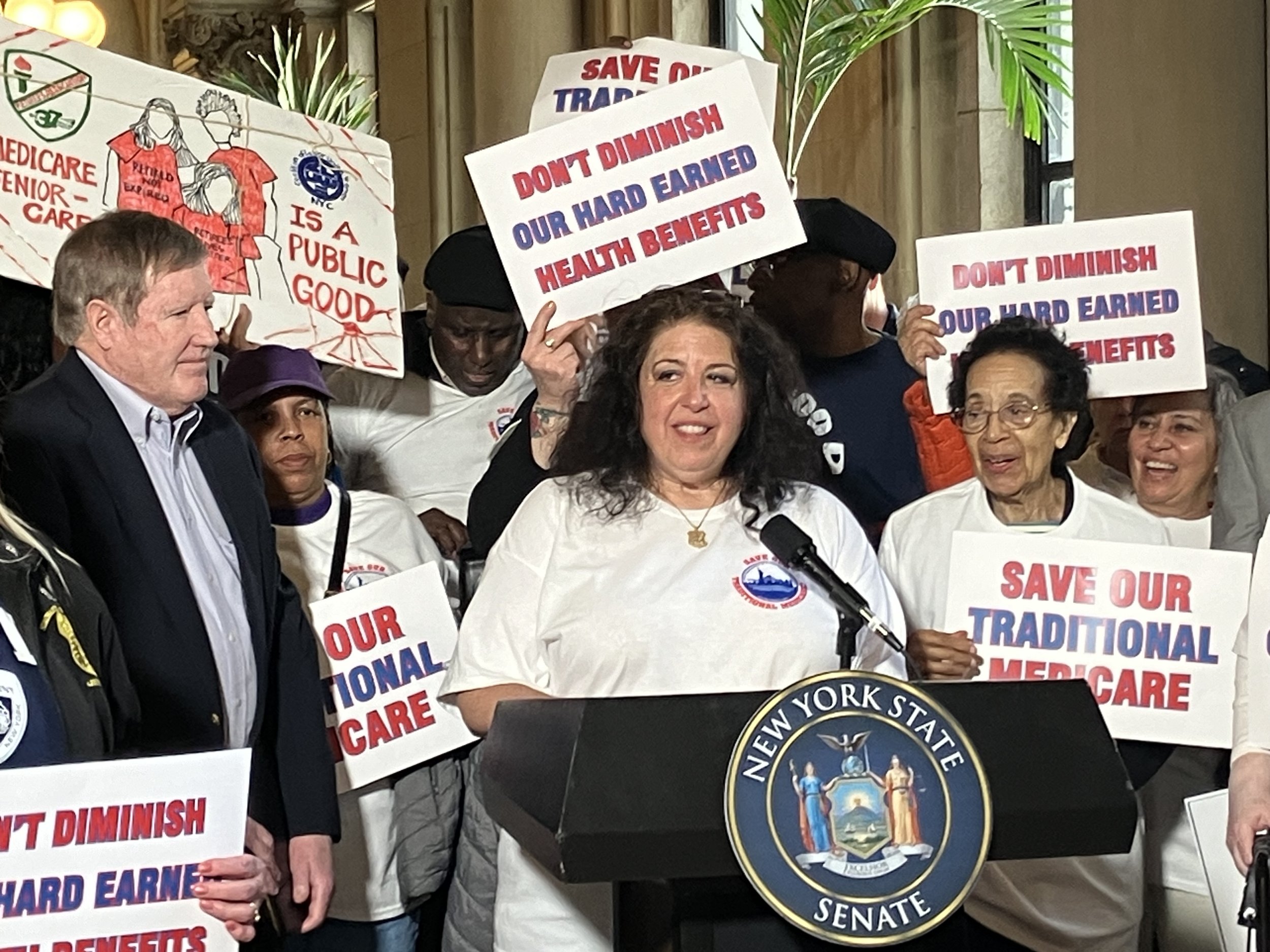
New York City Organization of Public Service Retirees President Marianne Pizzitola [center] will lead members back to Albany this week to ask legislators to protect retiree health care.
“It is disingenuous to claim that the reason why the UFT or the MLC is opposed this bill is because it would somehow interfere with collective bargaining,” Jake Gardener, former firefighter and New York City Organization of Public Service Retirees attorney, told Work-Bites. “It would just interfere with the MLC's ability to throw retirees under the bus.”
Legally speaking, there is nothing illegal about Intro. 1096, according to Gardener.
“The UFT cites the Taylor Law as a potential law that the bill violates, but that's just wrong,” Gardener further told Work-Bites. “The Taylor Law protects unions’ ability to collectively bargain for their benefits—and Intro. 1096 explicitly says that it does not interfere with or impair the ability of unions to negotiate the terms and conditions of employment for their members. So, even though the bill would require certain health insurance benefits for retirees, if unions wanted to bargain for different benefits for themselves when they become retirees, there's nothing stopping them from doing that.”
Again, the only thing unions wouldn’t be permitted to do, Gardener stressed, is sell out retired members who already fought for what they have.
“They can bargain for whatever retiree healthcare benefits they want, but they can't negotiate to take away the healthcare benefits of people who are already retired and don't have a seat at the bargaining table,” he said.
Some UFT Retired Teachers Chapter members have, themselves, abandoned the push to pass Intro. 1096, trusting that new Mayor Zohran Mamdani has their backs, and they can instead focus their energies advocating for passage of single payer health care and the New York Health Act.
Although he voiced opposition to Medicare Advantage on the campaign trail, the new mayor has never advocated new legislation further codifying the health care municipal retirees earned on the job. Mayor Mamdani is also closely aligned with Garrido, whose union backed him as their number two choice for mayor behind former City Council Speaker and current lieutenant governor candidate Adrienne Adams.
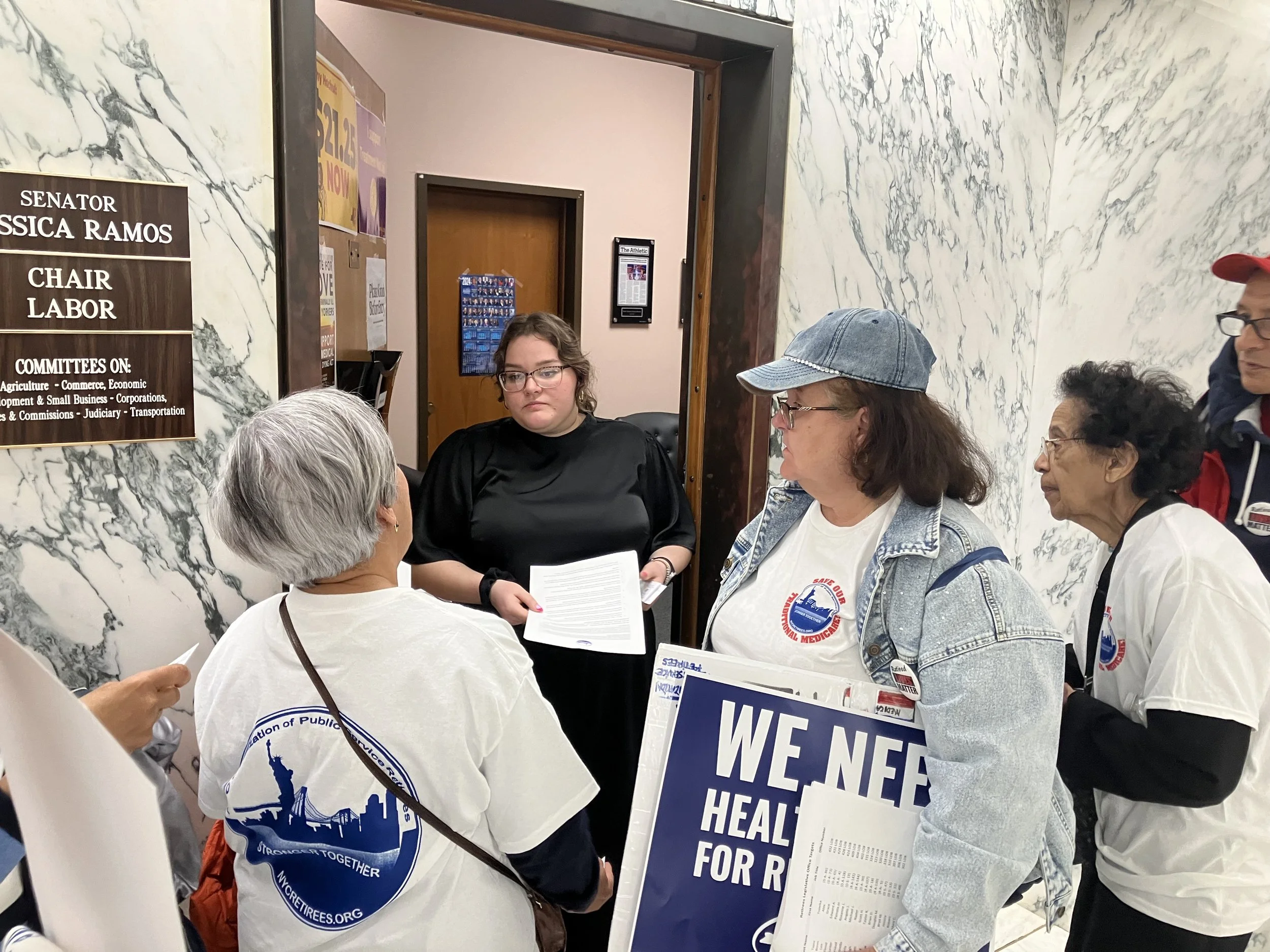
New York City municipal workers would like to be doing a lot of things in their retirement—instead they’ll be back in Albany on Mar. 24 continuing to fight for the health care coverage they earned on the job.
He raised the ire of other municipal retirees right out of the gate in February when he suggested dipping deep into the Retiree Health Benefit Trust Fund [RHBT] in an effort to help plug what he called a “historic budget gap” totally some $12 billion.
“This smells like the budget office continues to disregard the health and economic security of one of the City's most vulnerable populations,” Stu Eber, president of the Council of Municipal Retiree Organizations, told Work-Bites. “Over 20,000 City retirees are living at or below poverty levels with their minimal pensions and Social Security benefits. Raiding the RHBT can only further the affordability crisis for people who worked for decades serving the people of New York. We ‘won't get fooled again,’ and hope that Comptroller [Mark] Levine and Speaker [Julie] Menin will let the Mayor know they won't stand for this attack on the retirees.”
Previous efforts to push for passage of sister legislation to Intro. 1096 in Albany screeched to a halt last year after running up against opposition from New York State AFL-CIO President Mario Cilento, who lobbied hard against retiree legislation—again claiming it undermined collective bargaining rights.
“Every labor leader worth their salt should stand with retirees—to establish a clear, enforceable floor that protects the healthcare they were promised and paid for,” Pizzitola added. “Retirement should not mean diminished care. It should mean security, dignity, and the fulfillment of commitments made.”