
In Your Face, Adams! NYC Council Overrides Vetoes—Passes New Protections for App-Based Drivers, Security Guards, and Street Vendors
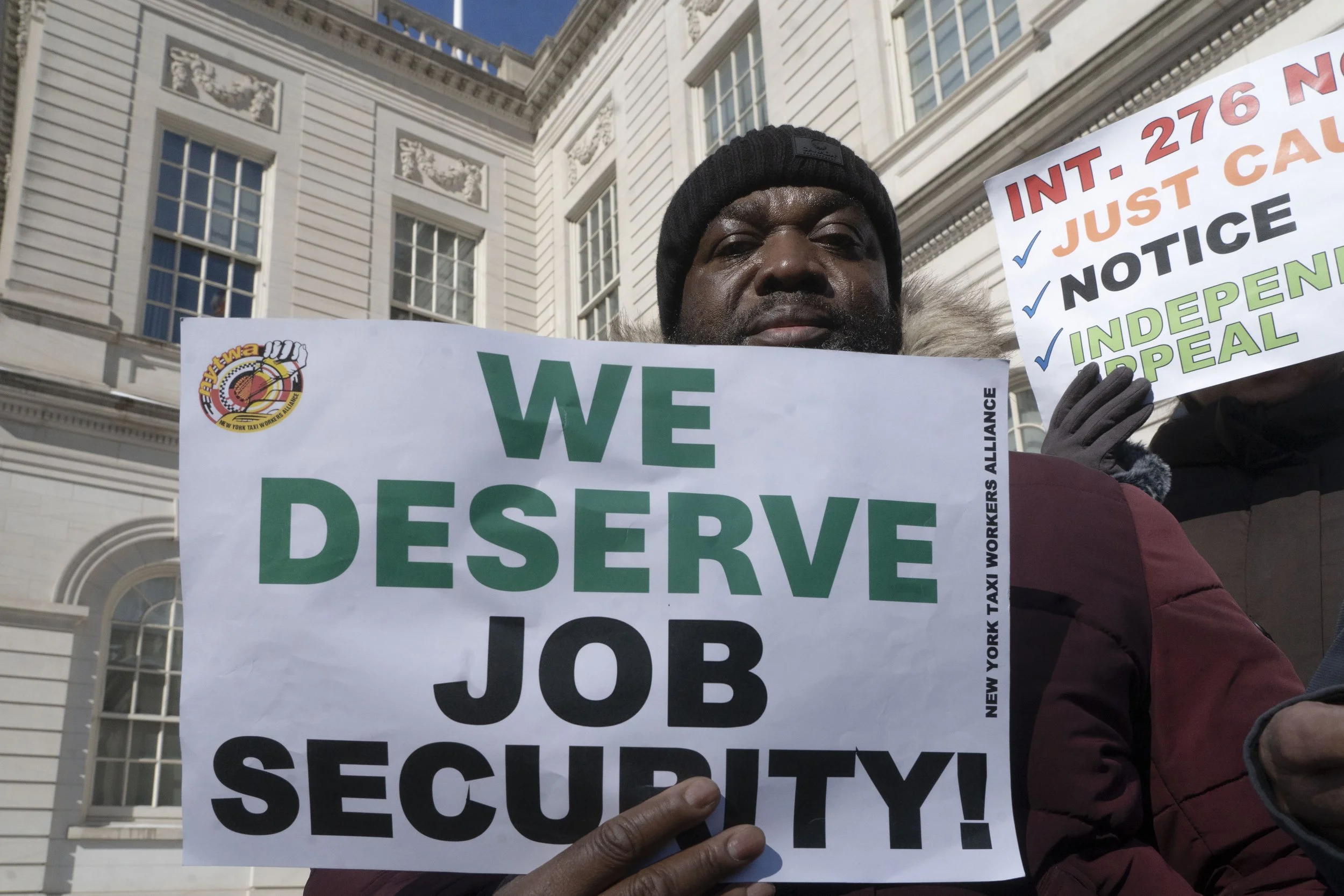
The Aland Étienne Safety and Security Act raises the minimum wage for security guards in NYC to at least $18 an hour, in addition to requiring paid vacations and time off, as well healthcare coverage. Photos/Gerardo Romo-NYTWA
By Steve Wishnia
January 29 was a day of celebration for three large groups of New York City workers: security guards, app-cab drivers, and street vendors. The City Council, overwhelmingly overriding former mayor Eric Adams’ vetoes of 17 bills, passed measures with major new protections for them.
“We stand here today about to triumph,” an elated Bhairavi Desai of the New York Taxi Workers Alliance told about 100 drivers in front of City Hall before the vote. “The drivers never gave up, never gave in.”
By a 46-5 vote, the Council overrode Adams’ veto of Intro 276, which prohibits “high-volume for-hire vehicle services” companies—Uber and Lyft—from firing drivers without a “just cause.” It passed Intro 1391, which sets minimum wages and benefits for the city’s 82,000 security guards, by the same margin. And it approved Intro 431, to issue more than 12,000 new licenses for street vendors, by a vote of 41-7.
“We are going to override more vetoes in one day than the City Council has done in the past decade,” Speaker Julie Menin (D-Manhattan) said before the vote.
Many Councilmembers gladly emphasized the word “former” when referring to Adams.
Security: Raises, Benefits, Days Off
The security-guard bill, named the Aland Étienne Safety and Security Act after the officer killed in a mass shooting in a Manhattan office building last July, would raise their minimum wage to at least $18 per hour. In its second year, it would require employers to give them paid vacations and holidays off. In the third, they would get health benefits.
The bill will put $1 billion in the hands of security officers, SEIU 32BJ President Manny Pastreich told a gathering at the union’s Manhattan headquarters. Many nonunion guards still make the city’s $17-per-hour minimum wage, he said, and it will also be the first time many of them get paid time off.
City Council Speaker Julie Menin said it was “disgraceful” that Adams had vetoed the bill, and noted that Étienne had shut down a bank of elevators to prevent the killer from reaching other floors.
Étienne, from the Haitian city of Gonaives and the father of a seven-year-old son, “did whatever he could to uplift others,” said his widow, Rachelle Paoli.
“Aland was an immigrant,” said his younger brother, Smith Étienne. “We’re not going to let anyone vilify a hardworking immigrant.”
“In terms of respect, we’ve come a long way,” said 32BJ executive board member Pedro Francisco. The union began organizing security workers in the early 2000s, and won its first sector-wide agreement in 2009. The number of guards it represents, only 1,000 in 2004, grew to 10,000 in 2011 and reached 20,000 in 2024.
Five Councilmembers voted to uphold Adams’ veto. Frank Morano (R-Staten Island) said the government should not “step into private industry” to set wages and benefits.
An estimated 350,000 Haitian immigrants, meanwhile, still stand to lose their temporary protected status, or TPS, beginning February 3 as a result of an executive order Donald Trump issued shortly after returning to the White House last year.
Due Process for Drivers
The Taxi Workers Alliance calls Intro 276 “the strongest and most comprehensive just-cause bill for Uber and Lyft drivers in the nation.” It prohibits the two companies from firing drivers—typically by “deactivation,” cutting off their access to the app—without a specific reason and without due process, including the right to appeal. Except in cases of “egregious” misconduct, they must give drivers progressive discipline and 14 days’ notice.
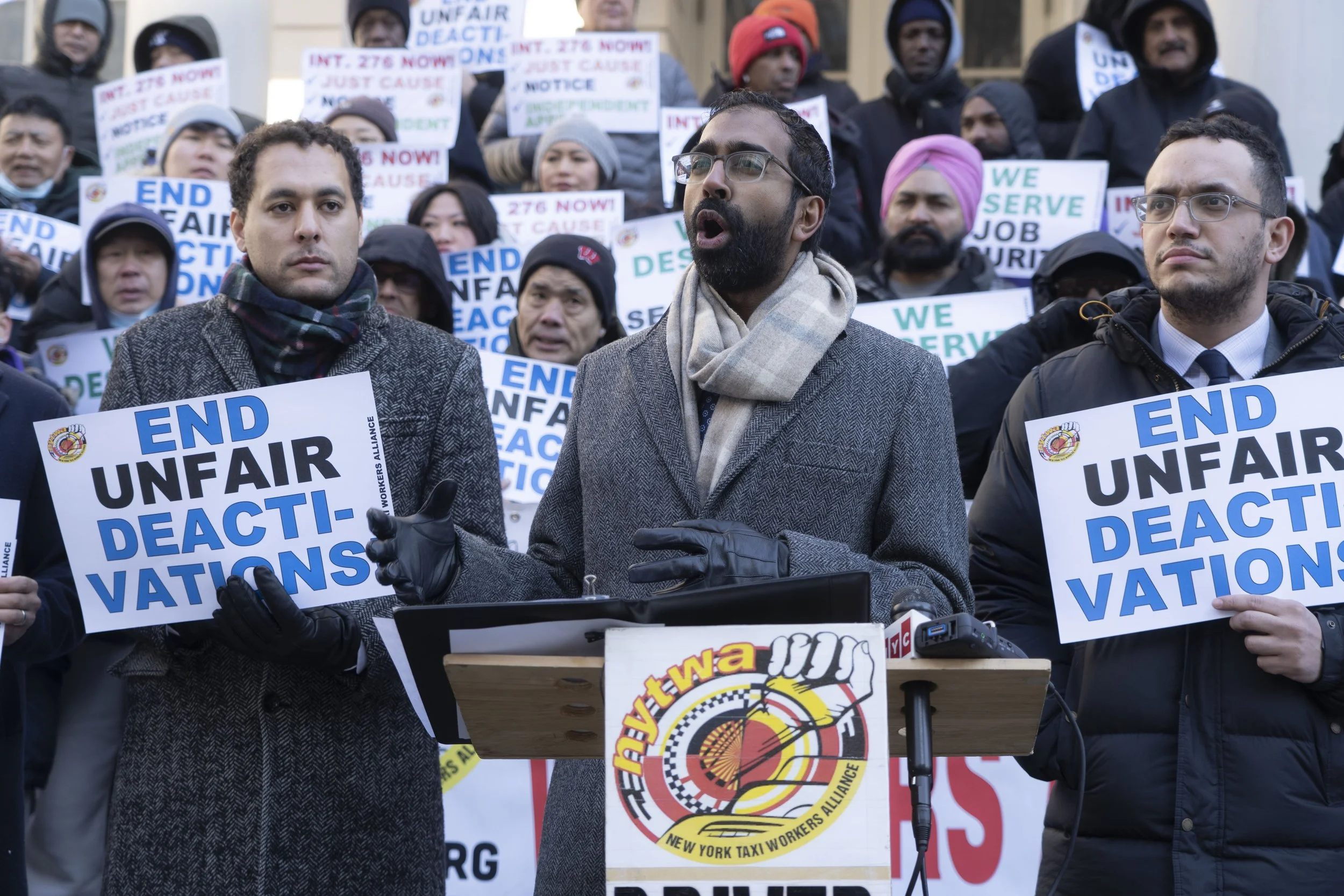
“We brought to an end the nightmare of drivers looking down at their phones and seeing they were fired,”—Councilmember Shekar Krishnan.
“We brought to an end the nightmare of drivers looking down at their phones and seeing they were fired,” Councilmember Shekar Krishnan (D-Queens), the bill’s lead sponsor, told the City Hall rally.
The drivers chanted, “One, two, three, four! Deactivation no more.”
“We make Uber what it is,” said Ibrahim Zoure, an immigrant from Burkina Faso who’s been driving for the company since 2017. “We are out in the cold. We are out in the rain. We pay for our cars, our insurance, our repairs out of pocket, but until now we had no job security. That changes today.”
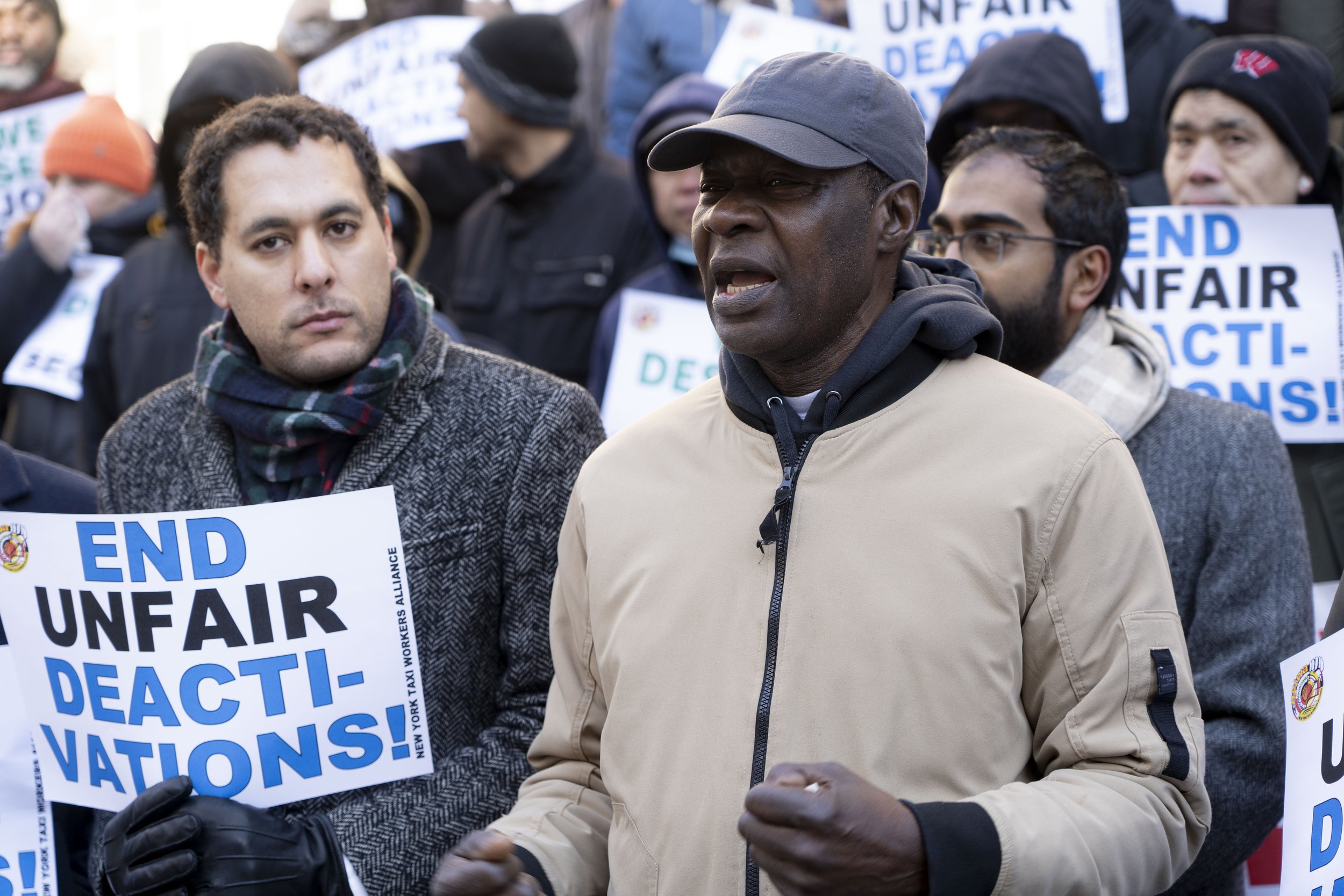
“We make Uber what it is.” —app-based driver Ibrahim Zoure.
“We need due process,” Desai said, “not only in our courts, but in our economy, in the battle between workers and capital.”
She told the rally that unfair deactivation prevents drivers from working after they’ve invested $60,000 in a vehicle and paid $6,800 a year for insurance. She said they’d overcome “billionaire opposition,” including from Uber’s “company union.”
The Independent Drivers Guild, a Machinists Union affiliate partially financed by Uber, opposed the bill, saying it would undermine its established grievance procedures for drivers.
Vendors
The vendors bill will have the city issue 12,700 new street-sales licenses, 2,200 a year for food and 10,500 for general merchandise.
“This bill is historic,” Calvin Baker told Work-Bites, as several dozen peddlers clad in gold “Vendor Power” wool hats rallied on the sidewalk outside City Hall. “It’s way overdue.”
He’s been selling items like watches, gloves, cologne, and chains on the street for 40 years. When he first applied for a license, he recalled, he was told the waiting list was too long.
With licensing effectively closed, Baker said, vendors have had their property seized by police without being given a ticket. One man got a $1,000 fine for selling bottled water.
Vendors, he added, often sell ethnic products that you can’t get in chain stores like Marshall’s or Burlington.
Council Member Pierina Sanchez (D-Bronx), the bill’s lead sponsor, said that 40% of the city’s vendors, and 70% of its food vendors, are currently unlicensed. She said the law would make life “more just for vendors, more predictable for brick-and-mortar businesses.”
Seven Councilmembers voted to sustain the veto. Vickie Paladino (R-Queens) said the bill was “irresponsible” and “punishes” law-abiding businesses.
Other Adams Vetoes Stand
Speaker Menin decided not to try to override Adams’ vetoes of three other bills, however. One would have given the Civilian Complaint Review Board direct access to police body-camera footage. Another would have required a minimum percentage of family-size apartments in new city-funded housing. The third, the Community Opportunity to Purchase Act (COPA), would have given qualified nonprofit organizations the right to make the first offer to purchase apartment buildings with chronic tax or landlord-behavior problems before the owner puts them on the open market.
Several Councilmembers called COPA a glaring omission from the override package. Shahana Hanif (D-Brooklyn) said losing it was a setback when “corporate landlords and private-equity firms are buying up our housing stock.” Sponsor Sandy Nurse (D-Brooklyn) described it as a “modest strategic agenda.” But Susan Zhuang (D-Brooklyn) said “taking private ownership out is not the solution.”
The Council did override Adams’ veto of Intro 1443-A, sponsored by Councilmember Nurse, by 45-6. It will require half of newly constructed rental units financed by the city to be affordable for “very low-income” households, based on the federal formula for determining such levels. That would mean roughly half of newly built “affordable” apartments would go to renters making less than the city’s median household income.