
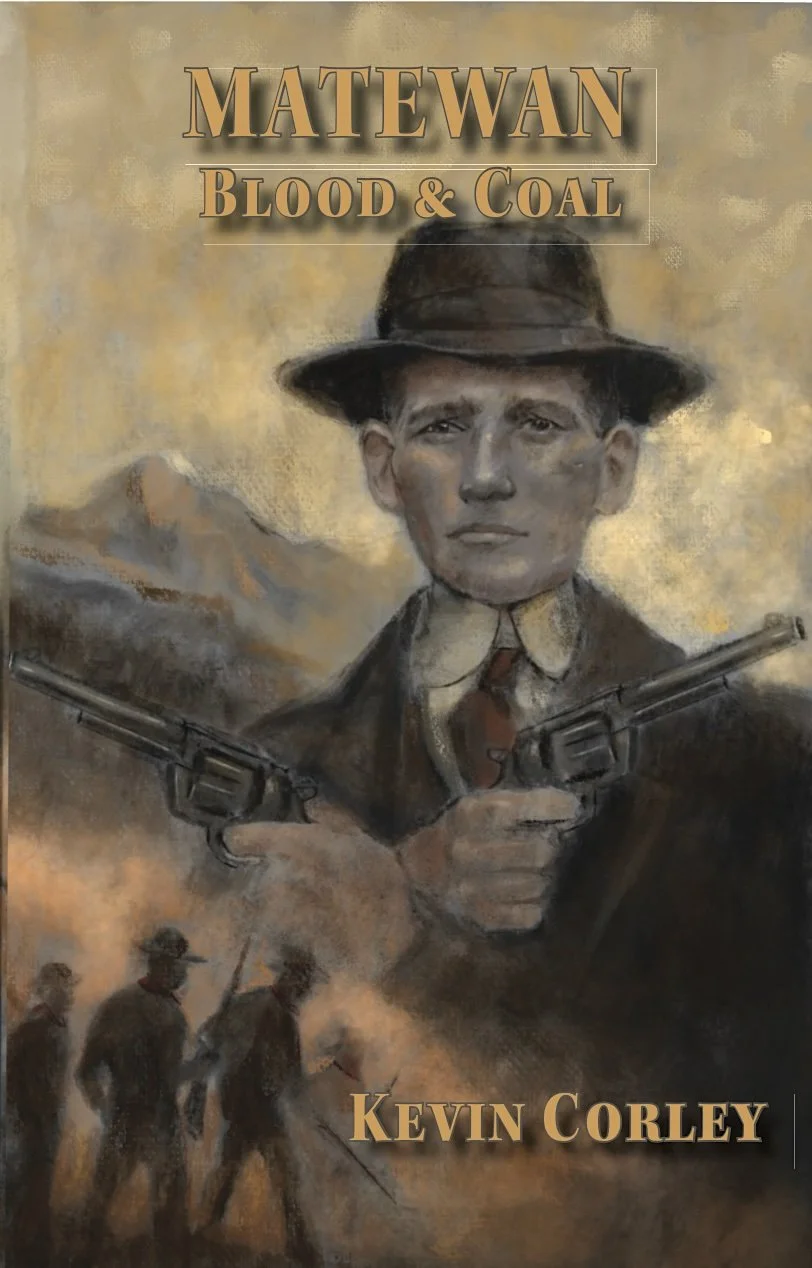
Cover of Kevin Corley’s newly-released Matewan Blood & Coal from Hard Ball Press.
By Joe Maniscalco
There’s an early passage in Matewan Blood & Coal, Kevin Corley’s riveting new novelization of the 1920 West Virginia coal miners’ strike and ensuing “Battle of Blair Mountain” where he writes about how “The moon cast long shadows over Matewan’s emptied streets: gunpowder lingered in the air, faint but unmistakable, like history refusing to leave quietly.”
Can you see it?
It’s a passage that perfectly reflects the narrative power infused in every line of this indispensable retelling of one of the most pivotal events in the history of the American labor movement.
It’s also a moving love story.
The complicated romance is set between Sid Hatfield, Matewan’s gold-toothed police chief who puts his own life on the line for the embattled West Virginia miners—and Jessie Testerman, widow of the town’s murdered Mayor Cabel Testerman.
Zoom out just a little bit and it’s also a love story about the bonds between neighbors and friends, co-workers and family.
“Greater love hath no man than this, that a man lay down his life for his friends,” certainly.
Corley recalls the spirit of late “country noir” master Daniel Woodrell, too, rolling out homespun grit throughout so fine it continually lands like the poetry of spent shell casings bouncing off the pavement.
“Sid likes to mix humor with menace,” Albert Felts, one of the private detectives the mining company hires to evict Matewan’s residents later warns his comrades. “If you see them gold teeth of his, don’t laugh—draw.”
Hatfield is initially introduced as a particularly flawed and conflicted protagonist guilty of “more sins than the good book has room for.”
Even Jessie has to concede that men like Sid are hard to read because they “carried too many thoughts behind their eyes and showed too few on their face.”
Descriptions of “coal smoke and frying grease” in the air, meanwhile, immediately transport readers back to Mingo County and a time when you could hear “history getting ready to clear its throat.”
Corley further resurrects Mary Harris “Mother” Jones from the stultified annals of labor lore as “a little thing in a long black dress, gray hair tied up in back like a schoolmarm,” who, nevertheless, possesses an almost mystic-like power to animate the masses.
“Mother Jones stood alone at the edge of the stage,” Corley writes. “She had eyes the color of weathered tin: steel blue, with something sharper behind them. She didn’t speak right away, which gave everyone time to get nervous. Then her voice came clear and low, like a knife drawn from a sheath.”
“Get it right,” she tells them. “I’m not a humanitarian. I’m a hell- raiser.”
Divorced from its historical roots, Matewan Blood & Coal shines on its own as an epic generational drama filled unforgettable characters whose unfolding lives prove endlessly captivating and compelling.
And while no additional research is necessary to appreciate the historical drama, it will no doubt send many to delve deeper into the history of the “Matewan Massacre” and “Battle of Blair Mountain” after reading.
After all, Republic House Speaker Mike Johnson just this month called for an additional $350 million to the Pentagon’s already obscenely-bloated budget for “fighting communism on our own shores.”
Kevin Corley’s Matewan Blood & Coal also perfectly captures the red hysteria and anti-communist fervor that gripped the hills and hollers of West Virginia a century ago.
“These union boys, these communists, they want to turn this country into something it was never meant to be,” Albert Felts rails.
To the mining bosses and their jackbooted henchmen, trade unionism itself was nothing but a “kind of sickness that’d crept in from Europe, along with garlic breath and bad ideas.”
Read Matewan Blood & Coal today and quietly conclude for yourself just how far removed we really are from Blair Mountain’s Gatlin guns.
Matewan Blood & Coal by Kevin Corley is available now through Hard Ball Press.