
Reporter’s Notebook: As Protections End, Layoffs of Haitians Begin
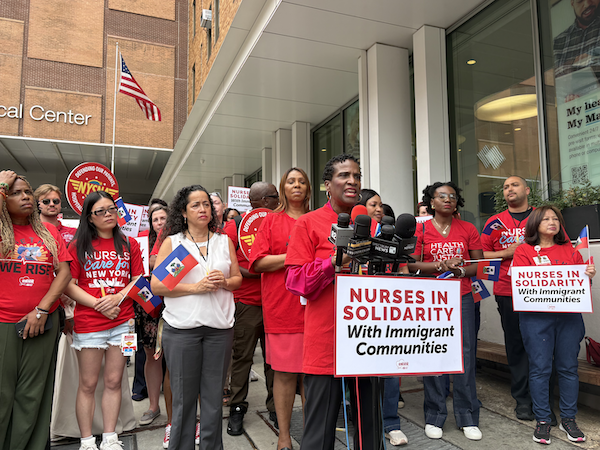
NYSNA President Nancy Hagans, along with NYS Attorney General Letitia James and City Council Member Alexa Avilés, leads a rally earlier this month at Maimonides Hospital in support of threatened Haitian workers. Photo courtesy of NYSNA.
By Steve Wishnia
One week after Mayor Zohran Mamdani announced that New York City was being “forced by federal law” to lay off Haitian-immigrant employees whose temporary protected status (TPS) was terminated July 27 when a June Supreme Court decision formally went into effect, it is difficult to find information about how that is playing out.
The Haitian Times estimated that “nearly 7,000” Haitian-born New Yorkers work in the public sector, based on figures from the city’s “The Newest New Yorkers, 2026” report. As of 2023, that report said, 49,500 Haitian immigrants in the city were employed, with 16% of the men and 12% of the women working for the city, state, or federal governments—about 6,830. That number obviously includes immigrants who have become citizens or have green cards, not just those whose permission to work legally came from TPS.
Neither the mayor’s press office nor AFSCME District Council 37, the union representing the largest number of city employees, responded to multiple phone and email messages seeking information about how many workers were affected and what agencies they were concentrated in.
A spokesperson for the 1199SEIU health-care workers union told Work-Bites that New York Health+Hospitals had informed them Aug. 12 that none of the roughly 1,000 workers it represents there have been terminated for reasons related to TPS.
Where the revocation of TPS for 350,000 Haitians in the U.S. is beginning to hit is in health care. The American Immigration Council, an immigrants-rights advocacy group, estimated in April that 113,000 Haitian immigrants work in that sector, including 58,000 home-care aides. A Journal of the American Medical Association analysis published last year estimated that 15% of the non-citizen health-care workers in the U.S., more than 160,000 people, came from TPS countries.
About 500 of 1199SEIU’s 200,000 New York area members are no longer working due to TPS termination, according to the union. Roughly 100 of them work in hospitals, with the rest in nursing homes or as home-care aides. Many are on unpaid leave, but some have been laid off, the spokesperson told Work-Bites.
At Brooklyn’s Maimonides Hospital, “a lot of people” were put on 30 days’ leave “until they could come up with some paperwork that would qualify them to continue to work,” New York State Nurses Association President Nancy Hagans told CNN Aug. 11. They included nurses, nurses’ aides, radiologists, and doctors, she said.
“When health-care workers live in fear of going to work, patient care suffers. This is more than an immigration issue; it’s an issue of public health,” she told a rally outside Maimonides Aug. 5.
NYSNA is asking the Trump administration “to reverse their course by allowing the front-line workers to continue to care for our communities,” she told CNN.
Amelioration efforts
NYSNA is also providing support for members concerned about their immigration status, setting up private consultations for them.
The 1199SEIU National Benefit Fund’s board has voted to extend health insurance for caregivers who lose their jobs for up to six months, with no premiums, deductibles, or prescription costs. The union’s new contract with the League of Voluntary Hospitals, reached in June and covering 86,000 workers in downstate New York, includes a labor-management fund to provide legal support for immigrant workers affected by changes in their authorization status—an “industry first,” according to the union.
It’s pushing to set up similar funds at other employers, and has secured unpaid leave for members at some facilities to seek alternative work authorization. It is also connecting them with “reputable immigration attorneys.”
In its Aug. 7 announcement, the Mamdani administration said “the city will do everything in its power to support TPS recipients,” including free legal consultations to assess their eligibility for other forms of work authorization and assistance navigating health insurance. It said “every affected employee is being connected with agency staff to understand their options” for leaving the job or seeking reinstatement.
Poisonous logic
TPS gives immigrants the right to stay in the U.S. and work legally if their home country is deemed too dangerous to return to. President Barack Obama’s administration granted it to Haitians in January 2010, after an earthquake there killed an estimated 220,000 people and left 1.5 million homeless. It has been renewed several times since then because conditions didn’t improve: A hurricane in 2016 destroyed or severely damaged more than 200,000 houses, and the government effectively collapsed after the assassination of President Jovenel Moise in 2021. Today, gangs control an estimated 90% of Port-au-Prince, the country’s capital and largest city.
Mamdani on Aug. 7 noted that “only President Trump has the power to restore TPS or grant ‘Deferred Enforced Departure’ to affected TPS holders.” He said Trump should do that to protect people and have an immigration policy that is “both orderly and compassionate.”
It’s true that Trump has the power to restore TPS, but expecting him to do it is wishful thinking. Trump has flip-flopped on some issues, such as oscillating from threatening to obliterate Iran to saying it’s close to a peace deal—but anti-immigrant racism is a core part of his attitude and agenda. His administration’s ethnic-cleansing minions attack suspected immigrants with vindictive violence, while his mouthpieces incessantly repeat the party-line lies that they are targeting “the worst of the worst”—a category that has included parents of disabled children and a 5-year-old boy in a bunny hat.
Being “compassionate” is not in his or his movement’s vocabulary. This is the man who delusionally ranted in the 2024 presidential debate that Haitians “are eating the dogs, they are eating the cats.” The sneering sadism of merch and memes for the “Alligator Alcatraz” concentration camp in Florida is more their speed.
In a more just world, legal action would be possible, as the common standard for overturning a Supreme Court precedent is that it was “egregiously wrongly decided.”
Justice Samuel Alito’s majority opinion held that the law prohibited the courts from questioning a decision to grant or revoke TPS for a country. But it ignored that the law specifies procedures for reaching that decision; Alito stated that the Secretary of Homeland Security could legally revoke TPS by flipping a coin. When then-Secretary Kristi Noem announced plans to end it for Haitians last November, she said the country was safe enough for them to return—even though the State Department warns that it is too dangerous for Americans to visit.
Alito also insisted that the government’s revocation of TPS was not racially motivated—that Donald Trump’s repeated statements that Haitians and other immigrants were “poisoning the blood” of the country were “racially neutral.”
“Racially neutral”? “Look at the ravages from which our people are suffering daily as a result of being contaminated with Jewish blood,” Adolf Hitler wrote in Mein Kampf. “All great cultures of the past perished only because the originally creative race died out from blood poisoning.”