
Is Ending Wage Theft in New York City Like Removing a Brain Tumor?
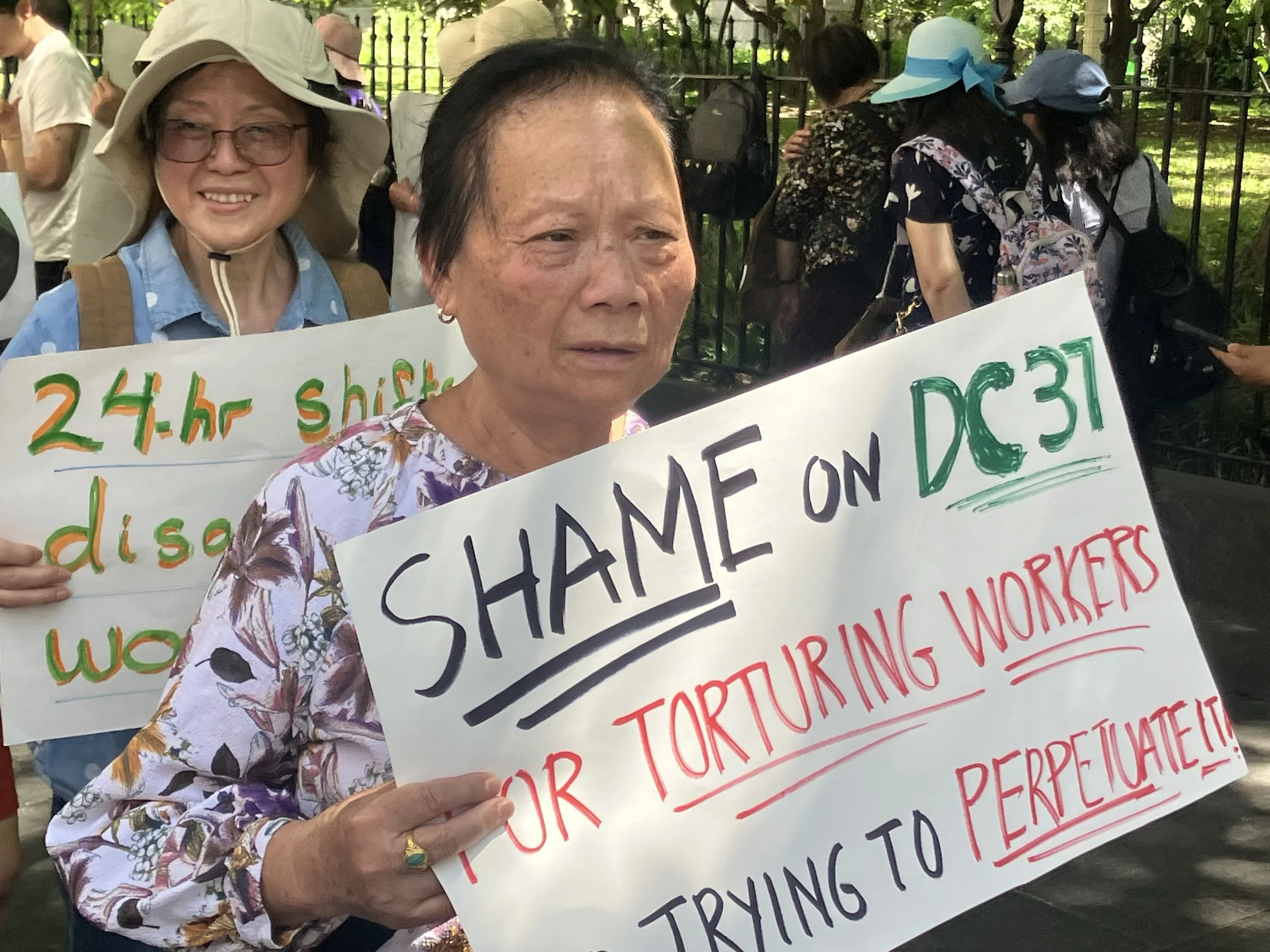
Shame on DC37: New York City home care workers rallying outside City Hall on May 20 call out union leadership for opposing their efforts to pass Intro. 303—the No More 24 bill—and finally bringing an end to mandatory round-the-clock shifts amounting to less than the minimum wage. Photos/Joe Maniscalco
By Steve Wishnia
Few people say they support the current system of paying home health aides who do 24-hour shifts for only 13 hours—even as they oppose efforts to end it. “We all recognize the onerous conditions some home care workers face. Every worker deserves a decent wage for every minute they work,” the Legal Aid Society wrote in March, joined by the DC37 union and a group of disabled people’s organizations, in a letter urging the City Council to reject legislation to prohibit 24-hour shifts.
The arguments for and against that bill, Intro 303, boil down to the moral one of ending wage theft versus the practical one of how to pay for ending it. At one of two dueling rallies near City Hall on May 20, DC37 President Henry Garrido told a couple hundred union members that “we believe people are going to die” if the bill is passed, because providers would cancel 24-hour care.
“How can DC37 say that this practice is in any way consistent with union principles?” asked former nurse Anne Kochman, a retired member of the union’s Local 2005 who joined the Ain’t I a Woman Campaign protest supporting the bill. “Are they here to assist the insurance companies that rob the home-care workers of 11 hours pay?”
“Change is needed,” Brendan Griffith, president of the New York City Central Labor Council, told the DC37 rally. “But you can’t fix a flawed system by implementing new requirements without a sustained funding solution and hoping everything works itself out, and that is exactly what Intro 303 would do.”
The bill’s sponsors, he added, “are trying to address a serious problem,” but the home-care system is state-funded and state-regulated, and “the city cannot legislate its way around that.”
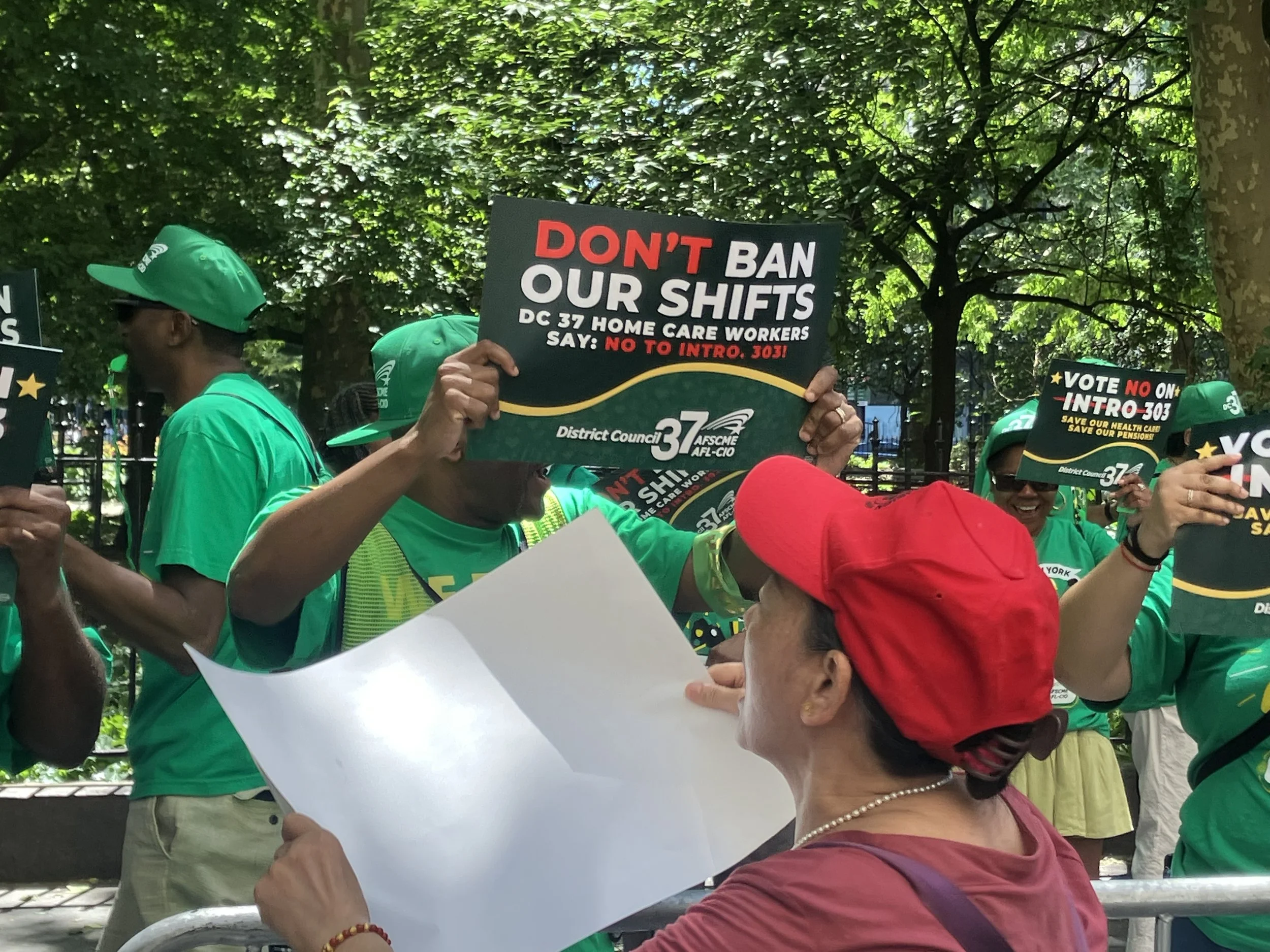
Home care workers advocating for passage of No More 24 legislation in the City Council and members of District Council 37 opposed to the effort clashed outside City Hall this week.
About 13,000 people in the city receive 24-hour home care. State Department of Labor regulations upheld by the state Court of Appeals in 2019 limit their aides’ pay to 13 hours, on the grounds that they have three hours for breaks and eight hours for sleep—which they often don’t get. The exception is if they can document that they did not get five hours of uninterrupted sleep during a shift.
The two primary objections to Intro 303 are that the state has not approved adequate Medicaid funding, and the city can’t force splitting 24-hour care into two 12-hour shifts. The 1199SEIU union, which represents more than 70,000 home-care workers in the state, estimates that paying full wages for 24-hour shifts would cost Medicaid $460 million a year.
Home-care agencies can’t change to split shifts on their own, Legal Aid lawyer Richard Blum told the DC37 rally, because they need authorization to do that from the insurance companies that oversee home health care under the Medicaid Managed Long Term Care program. He called Intro 303 “a gift to the insurance companies that are causing the problem,” because they would dump patients into nursing homes.
A lot of workers “want the 24 hours,” Margaret Glover, president of DC37 Local 389, which represents about 5,000 home-care workers, told the rally. Patients need care around the clock, and “we are the key,” she told Work-Bites. “We don’t complain. We do the hours.”
“We should be getting paid more, but what can you do,” she continued. Asked whether aides get paid more when they don’t get uninterrupted sleep, she exclaimed, “No! We don’t get paid for it.”
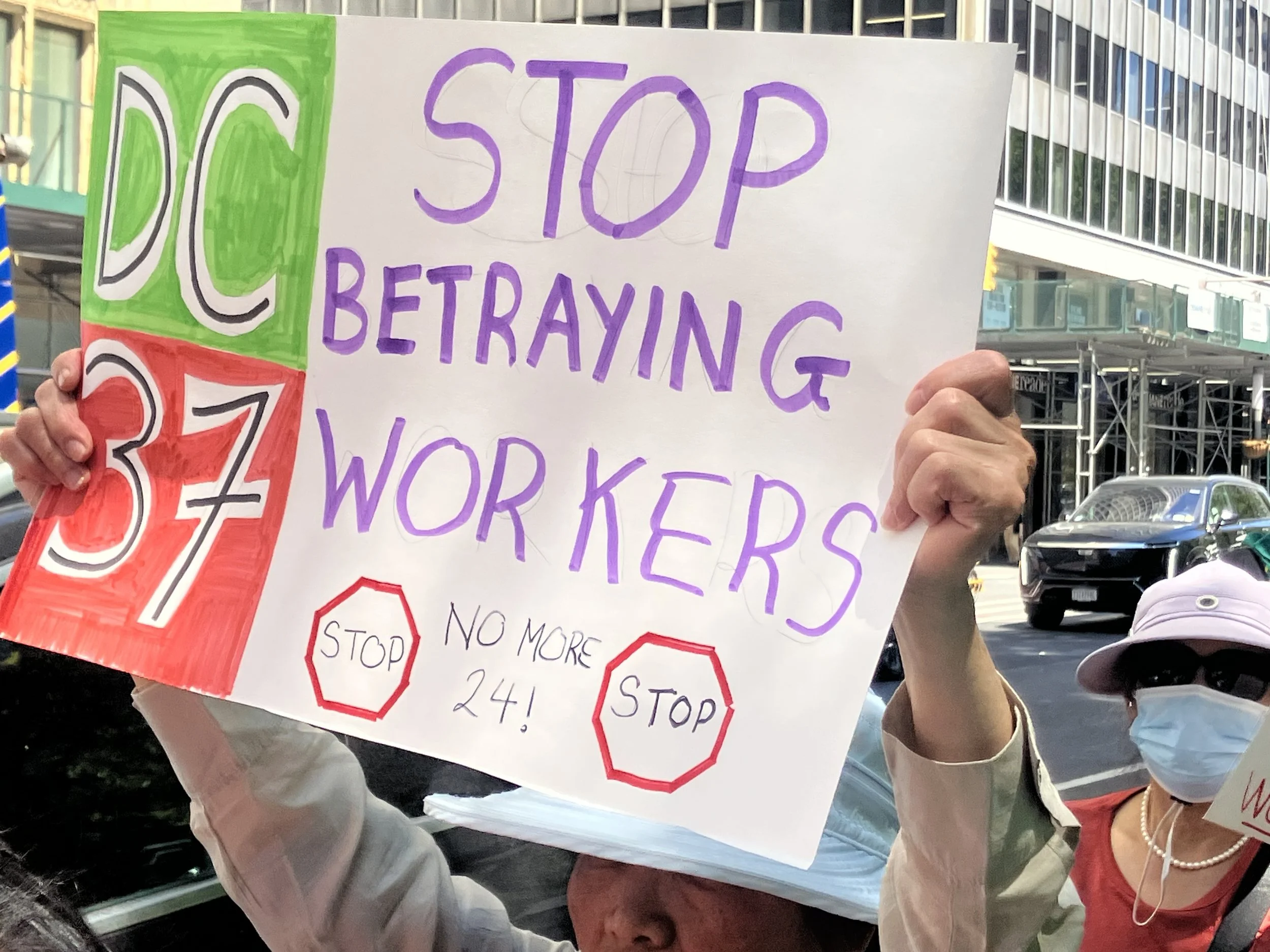
Home care workers who have spent the last decade fighting to end mandatory round-the-clock shifts in the industry delivered a clear message to District Council 37 opponents outside City Hall on May 20.
“We should all be working together,” Jose Hernandez of the New York Association on Independent Living, told the rally, speaking of the Ain’t I A Woman protesters. On the other hand, Garrido said it’s very easy to protest “when your skin isn’t on the line, when you don’t need care at 3 in the morning.”
The union did not respond to emailed questions about what efforts it has made to work for adequate Medicaid funding and to end the administrative barriers to split shifts.
A Legal Aid Society spokesperson on May 19 told Work-Bites in an email that the organization “will continue representing home-care workers forced to work 24-hour shifts for only 13 hours of pay, as we have in Chen v. Reardon.” In that class-action suit, a state court in Albany ruled in 2024 that the Labor Department had illegally closed aides’ claims that they were entitled to 24 hours of pay because they had to work during their supposed time off. The department is appealing that ruling.
“We will also continue advocating to end improper 24-hour ‘live-in’ authorizations issued by Medicaid managed long-term care plans through the Home Care Savings and Reinvestment Act (S2332A/A2018A)," the spokesperson continued. “We hope to work with proponents of Intro 303 on state legislation that includes meaningful protections for both workers and consumers.”
That bill, which would end the Medicaid Managed Long Term Care program, is sponsored by state Sen. Gustavo Rivera (D-Bronx). The current version was reported and committed to the Senate Finance Committee on May 19, the first action the Legislature has taken on it in two sessions.
A pessimistic view would be that wage theft is so embedded in the system that ending it would be like removing a brain tumor without causing any brain damage. But if nothing is done, the status quo will continue: Home-care workers, overwhelmingly immigrant women of color, will keep doing 24-hour shifts, getting up in the middle of the night to help their ailing clients, wearing out their bodies working 72 or 96 hours a week for only 39 or 52 hours pay. The state minimum wage for aides in the New York metropolitan area is $19.65 an hour—but getting paid for only 13 hours cuts it to $10.65.